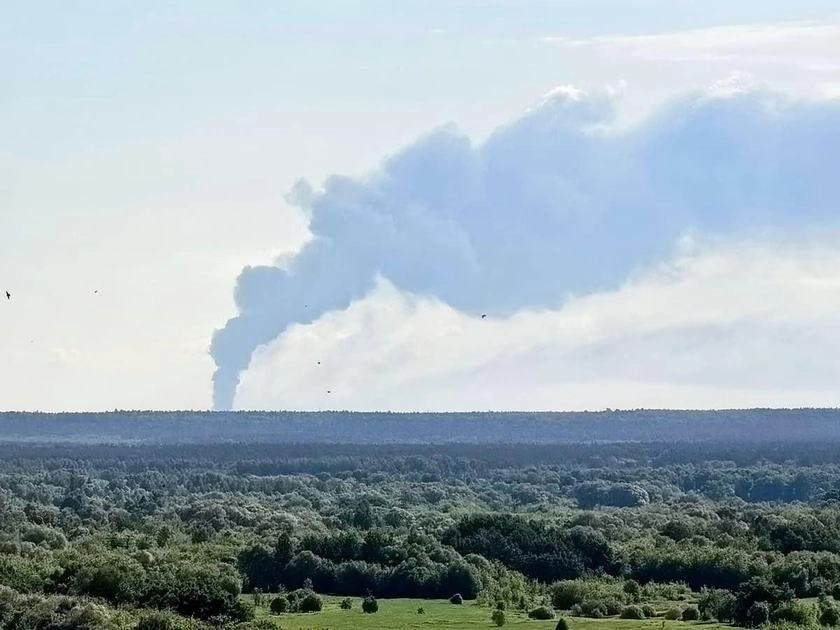
A pair of Ukrainian drone strike packages blew up an oil export terminal and set a navy warship in drydock on fire in the northwestern city of St. Petersburg, causing unmistakable damage and contradicting Kremlin news narratives that the attacks were ineffective and barely noticed by residents and thousands of foreign visitors to the Baltic Sea port, new satellite imagery made public on Wednesday showed.
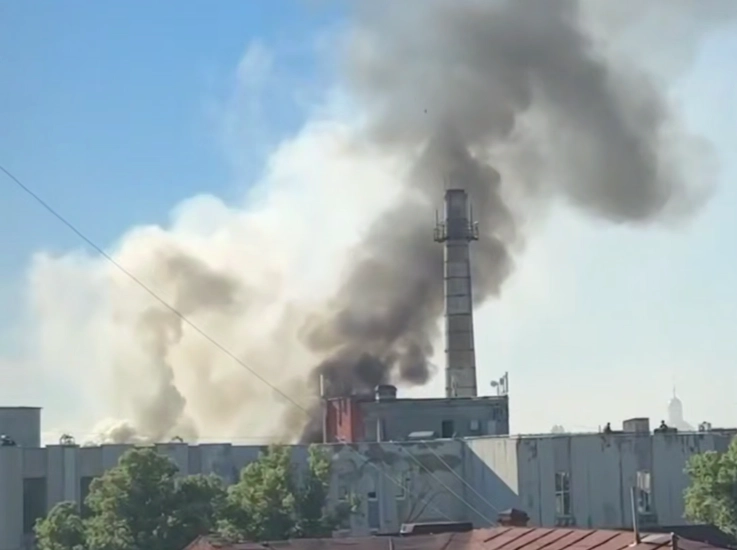
Eyewitnesses recorded at least five hits and fiery explosions during a Ukrainian kamikaze robot aircraft raid on the St. Petersburg Oil Terminal around dawn on Wednesday, only hours before a major international forum profiling Russia as a geopolitical, military, and economic world power was scheduled to open. President Vladimir Putin was the keynote speaker.
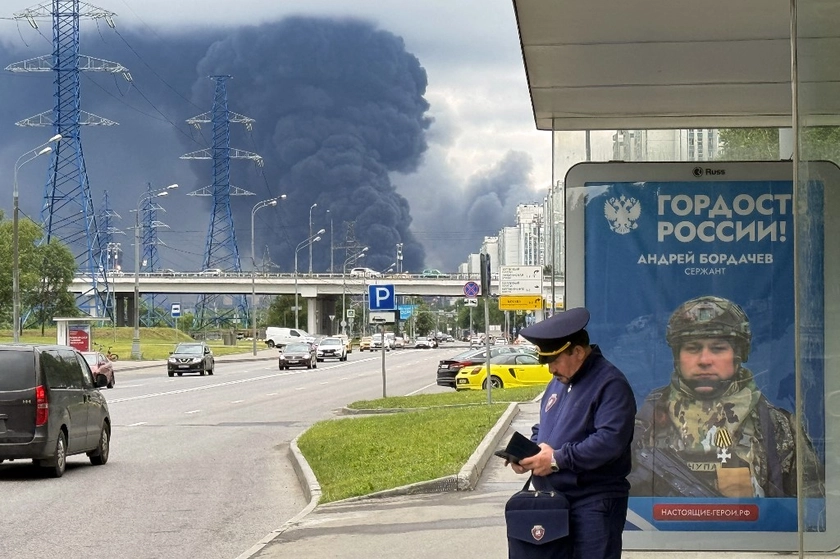
Later in the day, the Ukrainian investigative group Skhemy published Planet Labs satellite imagery showing a large-scale fire at the terminal site. Imagery released by the US spatial intelligence firm Vantor via AP showed a large smoke plume towering over the oil terminal. At least five reservoirs were destroyed, and others probably were breached, the Ukrainian OSINT researchers at CyberBroshono said in a Thursday report.
The conference, called the St. Petersburg International Economic Forum (SPIEF, or ПМЭФ in Russian), is Russia’s flagship annual business and economic event. State-controlled media usually describe it as “Russian Davos” or the Russian analogue to the World Economic Forum.
NATO Project Tests Perennial Grass to Clean Ukraine’s War-Hit Soil
Topics usually center on Russia’s purported status as a world power on equal footing with the US and China, and multilateral state-to-state relations bypassing superpowers.
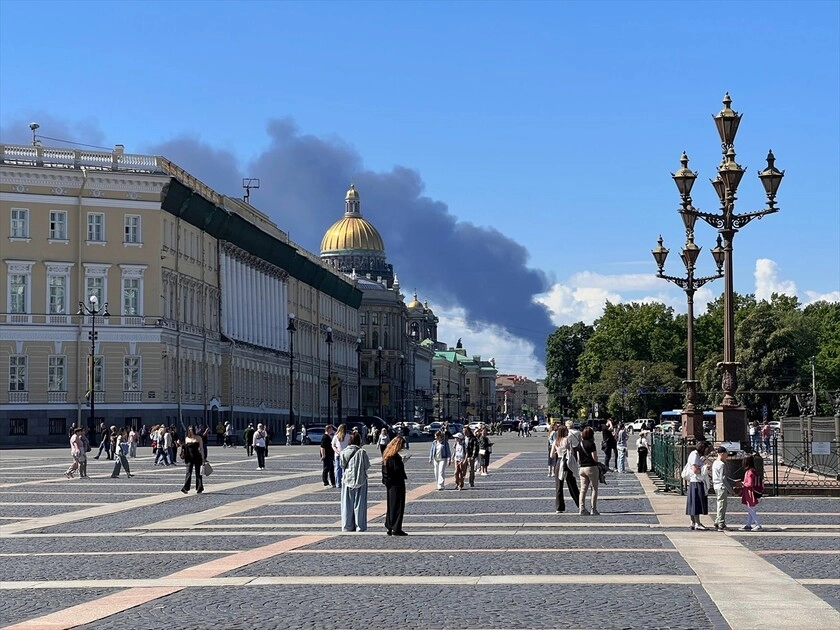
As they walked to the opening ceremony in a conference hall on the St. Petersburg waterfront, some dignitaries recorded black smoke from the burning refinery covering most of the northern horizon against a robin-blue northern sky.
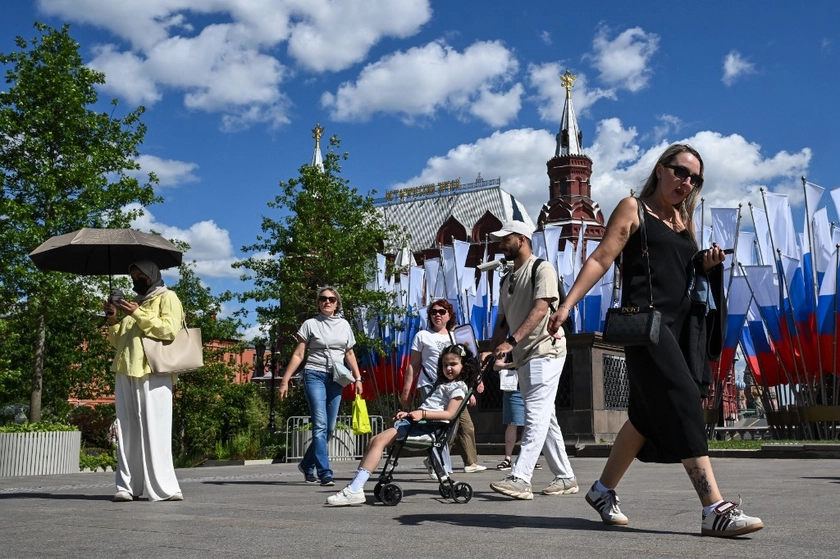
Russian mainstream media like TASS, RIA Novosti, and RT1 reported in detail on the opening ceremony, dignitaries attending, and even the excellent weather visitors would enjoy, but, for those Kremlin-loyal outlets, the refinery strike and its aftermath weren’t news and weren’t reported.
Also unmentioned was a surgical Ukrainian drone strike hitting the island of Kronshtadt offshore of St. Petersburg, and home port to the Russian Navy’s Black Sea Fleet.
As the attack against the refinery went on, Ukrainian military news feeds reported successful hits against a Kronshtadt-based warship, and by Wednesday evening, Ukraine’s drone forces command the SBS (Сили безпілотних систем) published dynamic video documenting the attack.
The Ukrainian military images geo-located to Kronshadt showed a kamikaze aircraft boring in on the Russian navy corvette Boykiy motionless in drydock, against negligible defensive fire, and a second drone likewise diving in and aiming at the Boykiy’s now-burning superstructure.
Overhead imagery recorded by Vantor showed the fire was still burning mid-morning, with firemen on the scene attempting to extinguish the blaze.
The black smoke plume from Boykiy’s fire in Kronshtadt naval port was visible some 15 miles (25 kilometers) away in St. Petersburg city, and to any attendees of the SPIEF conference looking in the naval port’s direction.
The ambitious and seemingly successful Ukrainian attack taking out a warship at one of Russia’s most heavily defended military bases, likewise, did not make Russian mainstream news.
Typical of content datelined St. Petersburg was a Russia Today piece airing comment by Kirill Dmitriev, CEO of the Russian Direct Investment Fund (RDIF) and frequent lead negotiator in US-Russia talks:
“More than 130 countries will be represented at the St. Petersburg International Economic Forum this week, because sovereign cooperation is replacing failed globalism…sovereign countries that are ready to move forward on the principles of partnership toward the development of their economies.”
Approximately 20,000 participants from over 130 countries and territories are attending SPIEF 2026. Among the highest-profile political attendees, reportedly, are Uzbekistan President Shavkat Mirziyoyev, Tanzania President Samia Suluhu Hassan, China Vice President Han Zheng and Saudi Arabia’s Energy Minister Prince Abdulaziz bin Salman.
Russian media gave high profile to a small official US delegation, the first in years, from the US Commission of Fine Arts, to the US blogger-influencer Candace Owens, the British-American blogger-influencers Andrew and Tristan Tate, and Hollywood actor Steven Seagal, according to those Russian news reports, were also in attendance.
Notwithstanding the official blackout (and in direct violation of law banning the recording and publication of images of Ukrainian attacks on targets in Russia) the Russian internet was flooded on Wednesday and Thursday of videos geo-located to St. Petersburg and documenting a complex and sophisticated Ukrainian air operation carried out by FP-2 drones, with some of the push-propeller aircraft seeking gaps in air defenses or flying at wave-to level, and others circling outside the range of air defense gunners, seemingly trying to draw fire.
Snarky Russian social media comment, likewise potentially illegal for criticizing authorities and civil security measures in public, pointed out that Governor Alexander Beglov, the Putin appointee in charge of St. Petersburg and its surrounding Leningradskiy region, one day before the Ukrainian attack declared safety and security preparations for SPIEF “fully complete” and “at the highest level…with all new security challenges [I.e. drones] fully taken into account.”
A female Russian social media user identified as aline.alien_beauty said of the Ukrainian attackers’ precise strikes hitting a refinery and a warship in Russia’s second-biggest city: “As a matter of fact I caught myself thinking today, how proper it is [for Ukrainians] to defend oneself, not targeting apartments and not peaceful civilians.”
Other Russian social media video uploaded after the attack showed St. Petersburg policemen firing at FP-2s buzzing overhead, almost certainly out of range of the law enforcers’ service machine pistols, and failing to stop the Ukrainian aircraft. On the night, Russia’s Defense Ministry claimed 354 Ukrainian drones were downed nationwide.
Ukraine’s General Staff on Wednesday evening took credit for the attack, calling it “highly successful,” and Ukrainian President Volodymyr Zelensky in an evening video address said his country’s drone forces “had performed well” and suggested more strikes like Wednesday were planned.
An SBS statement credited an elite long-range drone strike unit called 1st SBS Training Center for carrying out the air raids’ main effort and hits scored on the fuel reservoirs and the corvette, and stated agents from Ukraine’s national intelligence agency, the SBU, and operators from Ukraine’s military intelligence agency HUR assisted in carrying out the raid. Major Robert Brovdi, the SBS commander, in a sign-off note addressed to Russian readers, said: “There is more to come.”
The St. Petersburg Oil Terminal is one of Russia’s largest liquid cargo transshipment terminals on the Baltic Sea, with a reported annual capacity of around 10-12.5 million tons. Ukrainian drones have hit the facility some 1,290 kilometers (800 miles) from probable Ukrainian launch sites at least 20 times since Russia invaded Ukraine a second time in February 2022.
Following the attacks, Beglov in an interview aired from the conference center on the major Rossiya 24 television channel, on Thursday, claimed the Ukrainian attacks were completely unsuccessful because authorities knew the threat and had prepared well.
“If you are talking about security, then St. Petersburg, without question, prepared for the conference and all necessary steps were taken. Yesterday [the day of the Ukrainian strikes] is once again more proof that our enemies are losing their nerve.
“Yesterday, our system of air defense, our officials showed their class, they proved how capable they work. Yesterday we met our adversaries in a worthy way,” Beglov said, in commentary directly contradicting independent satellite imagery, strike videos published by Ukraine’s military, and the overwhelming majority of content uploaded on the subject by residents of his own city.
In an upbeat Wednesday interview with the Russian state-run news platform RIA Novosti, Romanian MEP Diana Șoșoacă (leader of the far-right S.O.S. Romanian political party) said she expected the SPIEF conference would be a success and that the Russo-Ukraine war would not interfere with that.
“I came here because I was interested in this forum. And I was curious why, in this time of war, so many people – almost 30,000 people – were coming here. Last year, you had 25,000 people. So, if you’re [Russia] so ‘bad,’ why are there so many Americans [e.g. Owens, the Tate brothers and Segal] here?
“What are so many French, Germans, Austrians, people from Luxembourg, and so on, doing here?... It’s a great honor for me to participate in this forum,” the politician Șoșoacă said. “I don’t think people should suffer because of what’s happening in politics around the world.”
You can also highlight the text and press Ctrl + Enter
Russia Hit by 660-Drone Overnight Barrage Targeting Moscow, Crimea and Key Military Sites