Russian occupation authorities in Crimea have started installing stationary payphones throughout the city as regular power outages and mobile network disruptions affect the peninsula.
The region’s operational headquarters reported that the first devices appeared in Dzhankoi, in the northern part of the peninsula, where mobile service is switched off on a set schedule, running only twice a day for four hours at a time, according to The Moscow Times.
JOIN US ON TELEGRAM
Follow our coverage of the war on the @Kyivpost_official.
The move comes as Ukraine repeatedly strikes Russian logistics networks supporting occupied Crimea, aiming to isolate the peninsula from mainland Russia and degrade its value as a military base.
Emergency payphones installed as blackouts deepen
Landline payphones were placed on Kutuzova, Vostochnaya, Internatsionalnaya, Tolstogo and Karla Marksa streets, and can reportedly be used free of charge to reach the 112 emergency line, as well as fire, police, ambulance and gas emergency services, according to The Moscow Times. A separate report showed that a similar payphone was installed on Theatre Square in Yevpatoria.
Regional occupation authorities say the devices function even without electricity or a cellular signal.
Moscow-installed regional head Sergei Aksyonov said it is currently impossible to draw up a fixed power supply schedule for the peninsula,The Moscow Times reported. He also announced reduced street lighting across all municipalities and the delivery of generators to areas where blackouts have lasted more than 12 days.
Russian Strike Hits Civilian Enterprise in Odesa, Kills 6, Wounds 6
In Sevastopol, occupation authorities said they can no longer maintain the previous “two hours on, six hours off” rationing schedule and have stopped forecasting when power will be restored, urging residents to follow radio broadcasts and charge devices at designated points.
Weeks of strikes on energy infrastructures
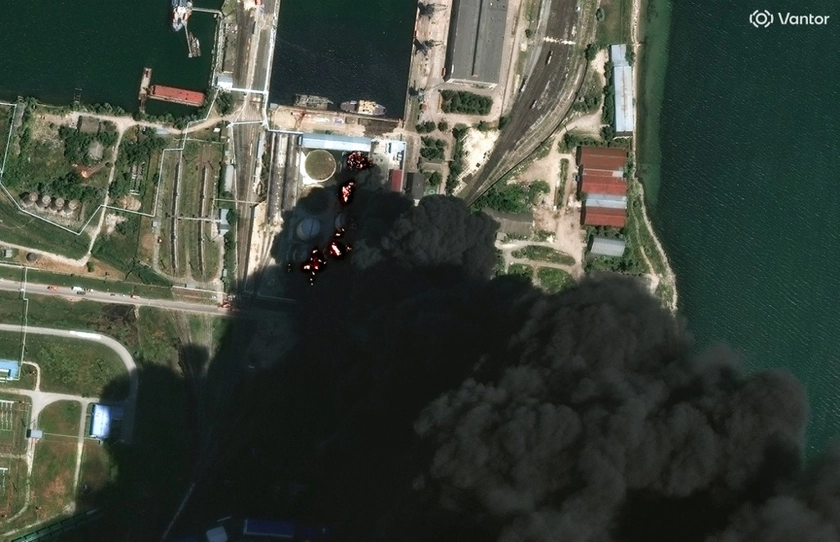
Ukraine has been deliberately targeting occupied Crimea’s critical energy and oil infrastructure as part of a broader strategy of pushing Russia towards peace negotiations.
According to Robert Brovdi, commander of Ukraine’s Unmanned Systems Forces, the main intent was “logistics lockdown.” Crimea’s residents were already facing major fuel shortages as the Russian oil crisis continued to deepen after weeks of Ukrainian drone strikes on fuel storage sites and tankers delivering supplies to the peninsula.The Simferopol Combined Cycle Thermal Power Plant, a major natural-gas facility known locally as the Tavriyska (Tavria) TPP, was one of the first key sites targeted in the campaign, with Ukrainian kamikaze drones reported to have hit it in three separate raids between June 20 and 25.
Russian-installed authorities, including Sevastopol mayor Mikhail Razvozhaev, have acknowledged that power outages are now hitting cities across Crimea. On Tuesday, July 14, he said a “special regime” had been introduced at energy facilities, though he did not explain what it involved.
He urged residents to save phone battery life, limit use of electronic devices to essential communication, and cut electricity consumption in general to avoid putting extra strain on the already damaged grid.
You can also highlight the text and press Ctrl + Enter

OPINION: The Bill for Crimea Comes Due for Putin