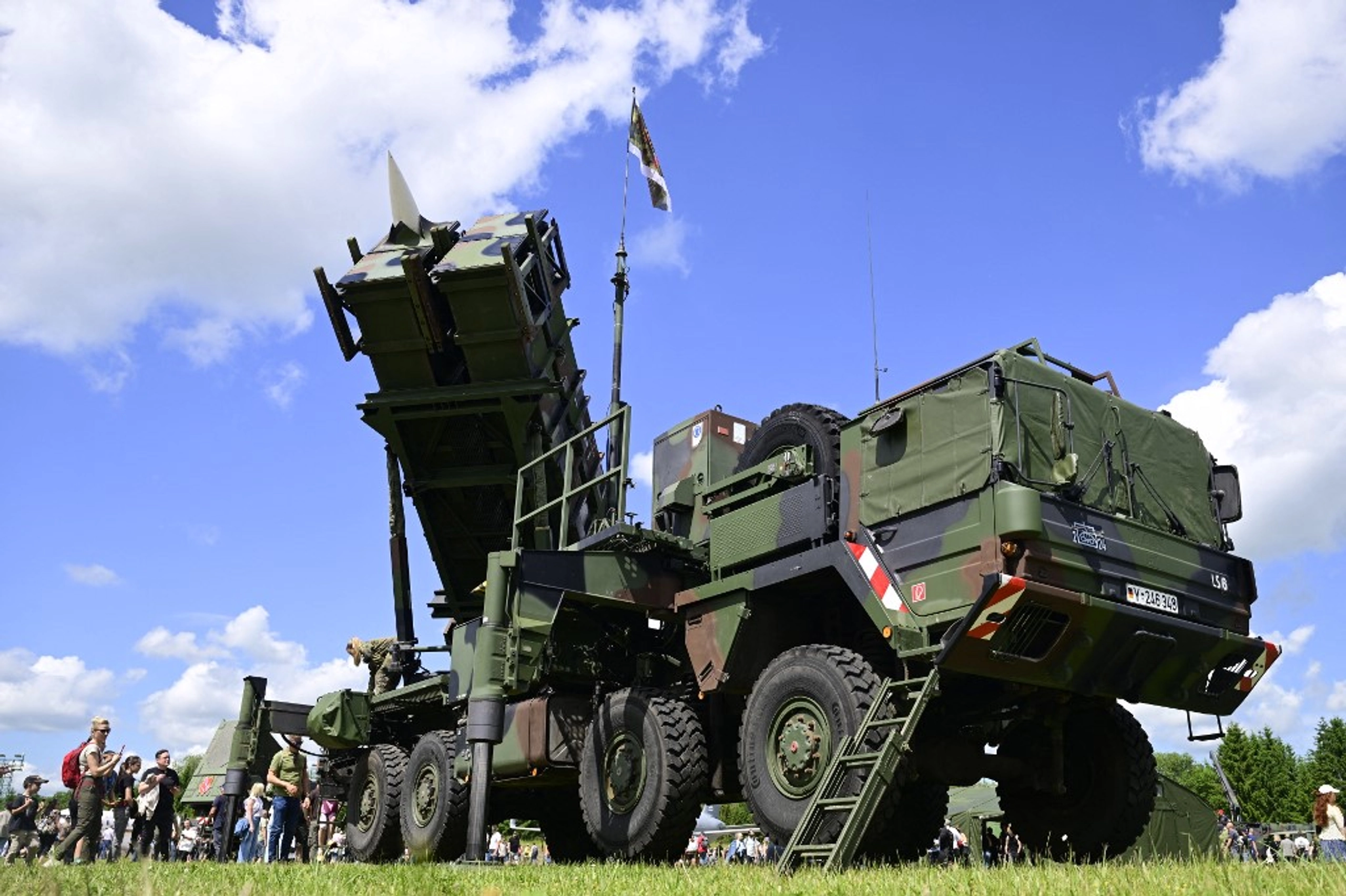
Lockheed Martin has introduced the PAC-3 Adapted Capability Effector (ACE), a new Patriot interceptor built to counter air and missile threats for less than half of the current PAC-3 MSE variant.
The announcement, made in Farnborough, England on Monday, came as Ukraine’s own supply of PAC-3 missiles remains critically low against ongoing Russian ballistic strikes. Current PAC-3 interceptors cost roughly $4 million per missile, Reuters reported, citing US Army budget documents.
JOIN US ON TELEGRAM
Follow our coverage of the war on the @Kyivpost_official.
“American and allied warfighters need a solution that is battle-tested and budget smart, and PAC-3 ACE delivers exactly that by building on the unrivaled performance of the PAC-3 MSE,” said Tim Cahill, the President of Missiles and Fire Control at Lockheed Martin.
“As we look to partner with our allies, we can further enhance resiliency and ensure our forces can swiftly counter emerging threats today and tomorrow,” he added.
Initial production is expected to start within 36 months, according to the company.
A missile Ukraine cannot do without
For Ukraine, the PAC-3 is currently the only weapon capable of intercepting Russia’s Iskander-M, a ballistic missile carrying a half-ton warhead strong enough to tear down a quarter to half of a typical apartment block.
That reliance became obvious by July, when the Armed Forces of Ukraine (AFU) reportedly had exhausted its PAC-3 interceptors during two Russian barrages: on July 1-2, Russia launched 24 ballistic missiles, four of which were intercepted, and on July 5-6, Russia launched 23 ballistic missiles, none of which were intercepted. Around the same time, Russia launched four Zircons on July 1-2 and six on July 5-6, none of which were intercepted either.

Zelensky, UK’s Burnham to Discuss Anti-Ballistic Coalition Cooperation at Upcoming Meeting
Highest civilian toll recorded in June
Because of Russia’s increasing strikes on civilians and critical as well as residential infrastructure, June 2026 was one of the deadliest months of the war for Ukrainian citizens, with 265 killed and 1,816 injured, according to figures from the Human Rights Monitoring Mission in Ukraine’s (HRMMU) latest “Protection of Civilians in Armed Conflict” report.
Long-range weapons remain the leading cause of civilian casualties, accounting for 45% of total deaths, with the toll expected to rise in the coming months if Ukraine doesn’t secure the PAC-3 interceptors needed to counter ongoing ballistic missile strikes.
The consistency of the increased strikes on civilians suggests this escalation is not an isolated spike, but rather a progressive shift in the intensity and reach of attacks on populated areas.
Russia launches more ballistic missiles than it can produce in a month
In the first 19 days of July, Russia already exceeded its estimated monthly ballistic missile production, while also expending at least two-thirds of its planned annual output of 3M22 Zircon missiles.
Based on the data from AFU, Russia launched 107 ballistic missiles and 20 Zircon missiles between July 1 and July 19. By comparison, 102 Iskander-M and S-400 ballistic missiles, as well as two Kh-47M2 Kinzhal missiles and 15 Zircon missiles were launched throughout June.
The Main Directorate of Intelligence (HUR) estimated that Moscow plans to manufacture only 30 Zircon missiles in 2026, meaning the 20 fired so far this month account for about two-thirds of the year’s planned production. Before the latest wave of strikes, Russia’s estimated missile stockpiles included more than 100 Iskander-M missiles, over 400 RM-48U missiles, and more than 120 Zircon missiles.
Authorities analysing residue from Russia’s attack on Bila Tserkva on May 24 told Kyiv Post that the Iskander-M ballistic missile used in the attack contained foreign parts – confirming the Kremlin continues to bypass recent international trade restrictions for at least some of its weapons production.
Patriots remain scarce
At the beginning of June, Lockheed Martin announced that it cannot guarantee delivery timelines for the much-needed PAC-3 interceptors, even as it moves to expand annual production from roughly 650 missiles to 2,000 by 2033 under a $4.7 billion Pentagon contract.
Brian Dunn, the company’s vice-president for strategy and business development for missiles and fire control, told the Financial Times at the ILA Berlin Air Show that, despite plans to significantly increase production, Lockheed cannot control how missiles are allocated among customers.
Even with expanded capacity, he said, delivery timing remains uncertain for countries including Poland, Germany, Japan, the United Arab Emirates (UAE), and Saudi Arabia, all of which operate Patriot systems, as Washington prioritizes rebuilding its own reserves because of the conflict with Iran.
During the latest NATO summit in Ankara, Turkey, on July 8, US President Donald Trump announced that Washington would grant Ukraine a license to manufacture its own Patriot defense systems, while his administration confirmed that it is also discussing Kyiv’s ability to strike deeper inside Russia. His announcement came after President Volodymyr Zelensky appealed for more Patriot missiles for months, citing a critical shortage.
PAC-3 missiles, the most advanced and sought-after model, are currently only produced in the US and under license in Japan. Germany, meanwhile, manufactures older PAC-2 variants domestically, with some scheduled for delivery to Ukraine from 2027 under a €4 billion ($4.7 billion) deal signed in April.
Most recently, Poland’s defense minister said preparations to produce Patriot PAC-3 interceptor missiles in Ukraine could begin within weeks, with Warsaw playing a key role in transferring the necessary technology. However, the planned production is expected begin in Germany.
You can also highlight the text and press Ctrl + Enter

OPINION: The Bill for Crimea Comes Due for Putin