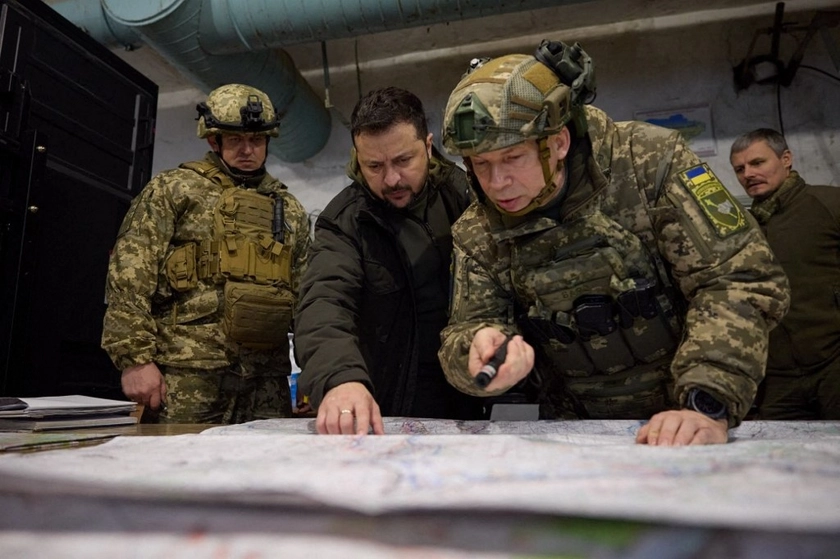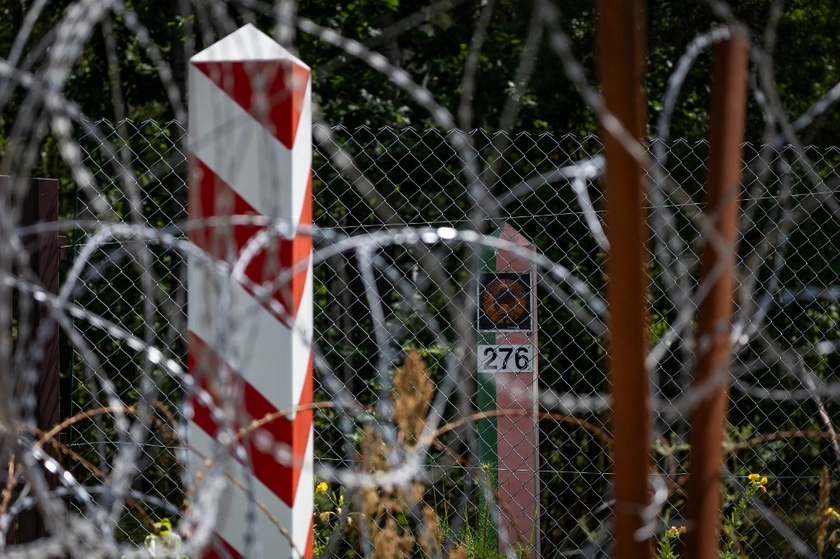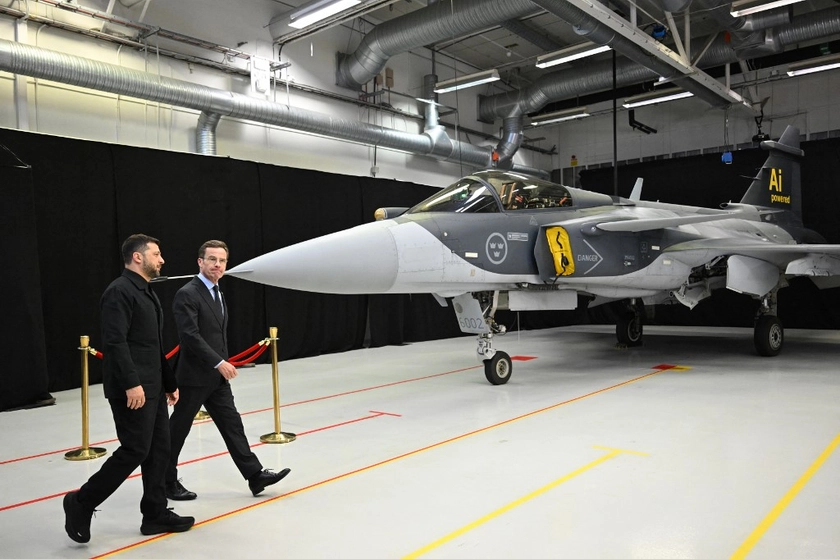
Apologies for putting this out a few days late. I was in the field talking to an Armed Forces of Ukraine (AFU) unit, eastern sector, looking at their ops center, training, checking out the food, and so on. Much useful conversation – the best probably with a battalion cook and an M113A3 armored personnel carrier crew. But officers got their brains picked on tactics as well. My hope is that some decent news articles will come of it.
The front
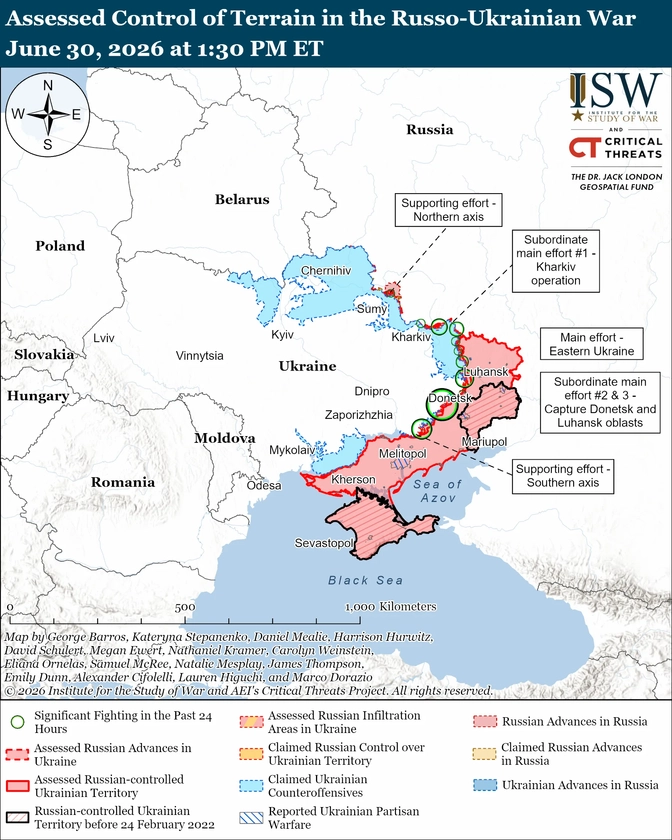
Stationary but not static. The numbers came in for May: Russia captured 14 square kilometers (5.4 square miles) in a month of fighting for an estimated loss of 30,000 men (numbers claimed seem to be between 25,000 and 33,000) killed and wounded. Most observers think that isn’t sustainable. The AFU front guys I talked to said that’s entirely credible from what they’ve seen in their sector.
JOIN US ON TELEGRAM
Follow our coverage of the war on the @Kyivpost_official.
But really, what matters is what the people in Russia think. Many can do math and read a map. And even the moderate Russians are saying Russia “must” conquer the remainder of Ukraine’s Donetsk and Luhansk regions before there can be talk of ending the attacks.
If you figure there are about 8,800 square kilometers (3,398 square miles) of Ukraine’s Donetsk and Luhansk left under Ukrainian control, at 14 square kilometers (5.4 square miles) a month, it would take Russia about a half-century to conquer at the price of between 18.2 and 19.2 million men killed and wounded. The Kremlin would have us believe it is ready for that sacrifice. There are those who question the realism of that plan.
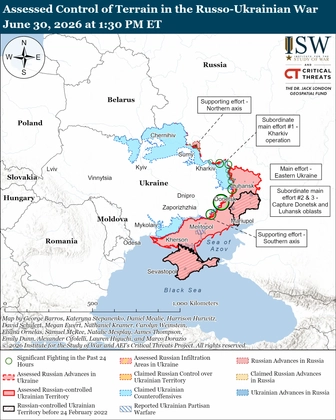
ISW Russian Offensive Campaign Assessment, June 30, 2026
From the point of view of sources on the ground, the Ukrainians (soldiers and milbloggers in public) are talking very confidently about being able to hold the line and maintain Russian casualty rates. Meanwhile, the Russians (soldiers and milbloggers in public) are without exception – and I really do mean without exception – writing openly that the present Russian offensive strategy is not sustainable.
Opinions vary on when a Russian collapse might come (guesses seem to be between fall and one to two years), and how it might come. The main theories seem to be (1) evaporation of offensive capacity and army mutiny, (2) oligarch coup vs. Putin (3) civilian disorder leading to mass protests (4) Putin is assassinated by his inner circle or less likely the Ukrainians and (5) the Ukrainians develop combined arms tactics based on drones sufficiently to break the Russian line and inflict a major battlefield defeat, which would then trigger some combination of 1-4.
But nowhere, and I mean nowhere, can you find Russians talking about “victory” unless it is a person salaried directly by the Russian state, and sometimes not even all of them.
The greatest Russian pressure remains around Kostiantynivka and Dobropillia. I can’t see a more sophisticated Russian plan than to push troops in bit by bit into those areas and accept casualties, so that someday in the distant future, Kostiantynivka will fall under Russian control. Then the process might be repeated, just as slowly, against Sloviansk.
Indirectly over the weekend I was told this about Kostiantynivka by some officers who are doing defensive/offensive operations in a sector nearby: In general, Kostiantynivka isn’t “falling” so much as more and more becoming a gray zone in which Russian troops, if they are careful, can move about fairly freely, but, Russian troops moving around Kostiantynivka isn’t per se a sign the city is going to “fall,” because the more Russian troops moving around, the more that will be spotted and can be hit. From the AFU perspective, Kostiantynivka is a battleground that is useful because the Russians will keep on sending troops to conquer it, and in this war, if you know where the enemy is going, you can usually get a drone in front of them.
Everyone I talked to seemed very confident in their ability in their sector to contain Russian attacks. They were very frank that the objective across the front is attrition, just kill and wound the enemy. No one I talked to seemed concerned about an AFU collapse, and when I asked about Kostiantynivka, the collective response is that civilians worrying about Kostiantynivka overmuch need to understand attrition tactics better. Passing that on for what it’s worth
Also, I asked about friendly casualties, that was – for the officers, sergeants, junior enlisted, everyone. Again, I wasn’t on the battlefield counting fallen soldiers, but everything I heard, press officer present, press officer absent, educated, didn’t finish high school, mobilized from prison, they all told me the Russians shoot a great deal but hit very few Ukrainian troops.
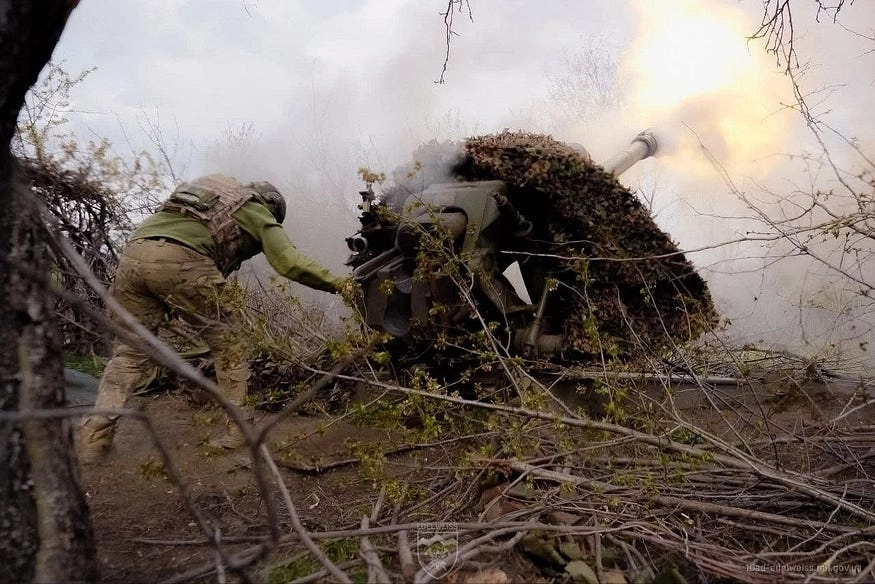
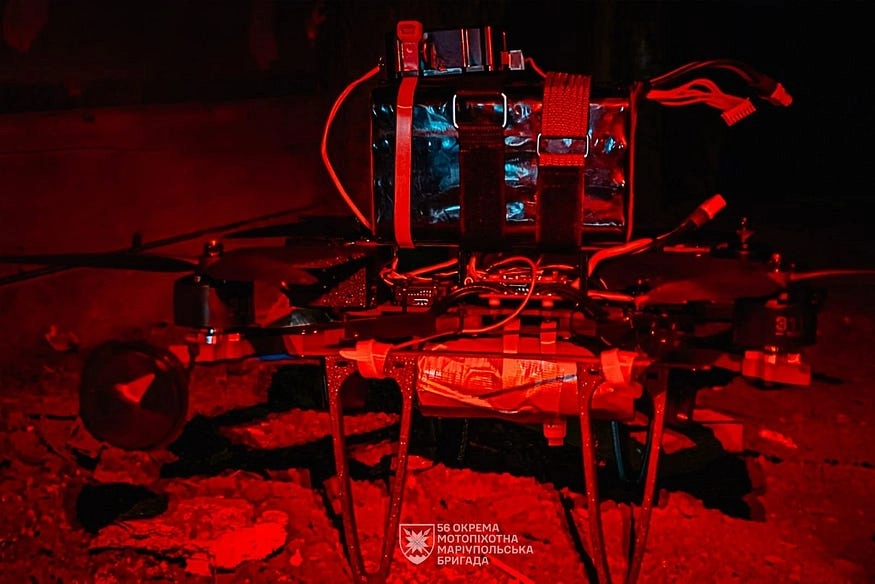
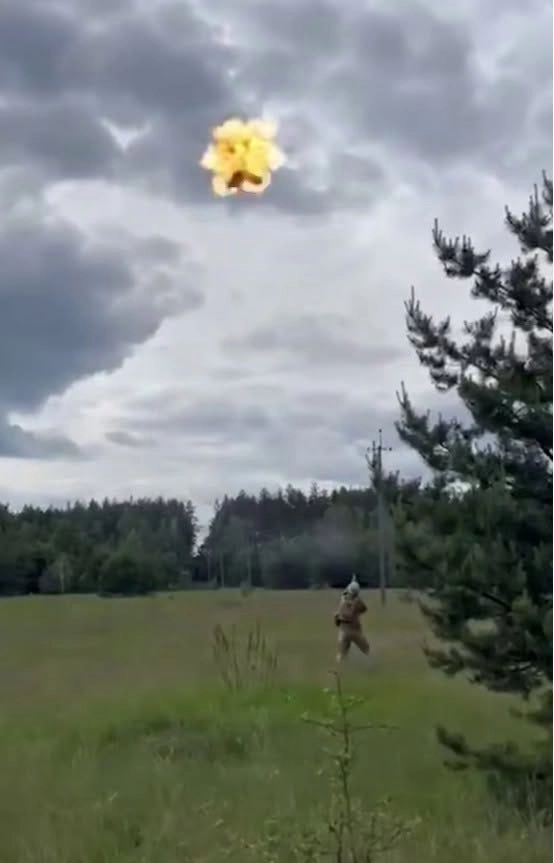
Russia bombarding Ukraine
The weekly big strike everyone had been waiting for over all of last week and the weekend came a bit late, overnight on Monday-Tuesday, June 1-2. It was a top-five strike by size for the entire war.
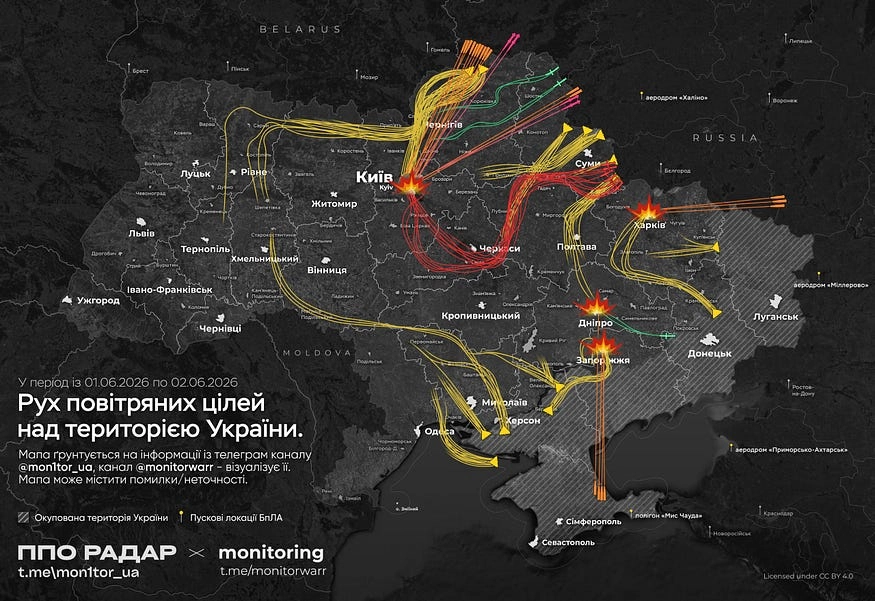
The main targets were Kyiv, Dnipro, Kharkiv, and Poltava civilian and military infrastructure. There were 23 killed, over 100 wounded. The highest kill count was in Dnipro. Several apartment buildings were destroyed by Russian missiles. There was a mother (29) and her two boys (5 and 3) who got caught by a Russian missile as they were running to cover. The mother died, one boy was hospitalized, the other got picked up by an adult and wasn’t hurt. This was in Kyiv’s Shevchenko region.

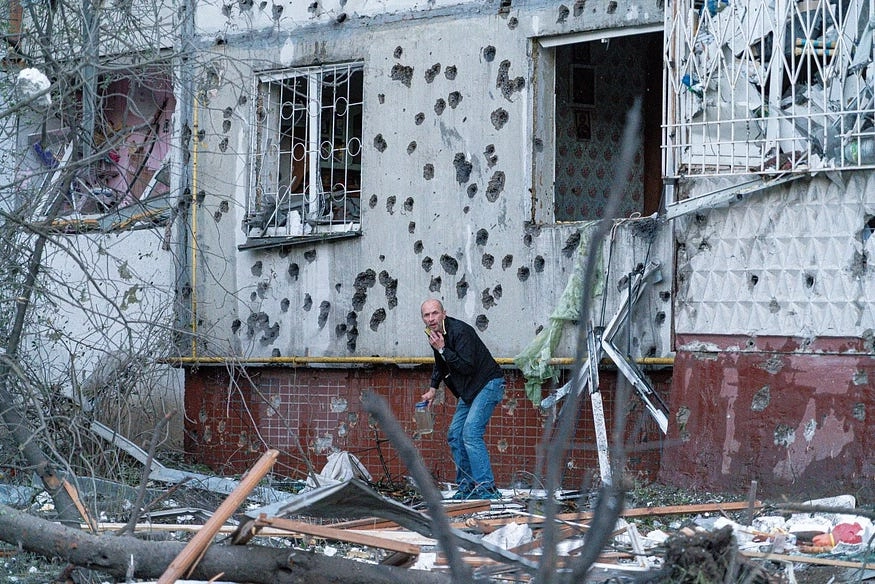
I direct your attention to the photograph below of the man standing next to the beat-up wall of a Kyiv apartment building. That is what it looks like if a warhead packed with anti-personnel cluster munitions goes off next to a wall; you can take that to the bank. There is hard, confirmed evidence that the Russians used cluster munitions in Kyiv and in Dnipro, against residential areas.
Some pro-Russia outlets have reported that several missiles hit central Kyiv because the Ukrainians were hiding Patriot missiles there, so that’s why there were unfortunate civilian casualties. This is a stupid argument. Ukraine has been so short of PAC-3 missiles for so long that if you see a launcher with more than half the launch slots actually loaded, that’s really rare. The idea that Ukraine has a warehouse full of PAC-3 missiles, never mind in the middle of a city, in a building on the surface, is absurd.
But “Russia must suppress Ukraine’s air defenses” was the narrative used to justify the Ukrainian civilians killed and injured. You might want to bear that narrative in mind when you get to the section lower down about Romania.
According to the Ukrainian Air Force, overall, the attack contained 73 missiles and 656 unmanned aerial vehicles (UAVs). This is, by the standards of this war, big, my estimate top 10 or so, but not absolutely the biggest.
The missile count was:
- Eight 3M22 Zircon anti-ship missiles
- 33 Iskander-M ballistic missiles
- 27 bomber-dropped Kh-101 cruise missiles
- Five Kalibr ship-launched cruise missiles
- 656 UAVs in the attack
This is about 50% more ballistic missiles than usual, par for cruise missiles.
I’m positive one missile intercept took place not far from where I wasn’t sleeping. There probably were two or three more, but I can’t confirm. I saw one cruise missile (or something resembling a cruise missile, with a trajectory I would associate with a cruise missile) come in LOW, about the height of an 18-story apartment building. Our apartment chat group later reported that the neighborhood health clinic got pretty badly smashed up.
The Ukrainian Air Force claimed shoot-downs of:
- 11 Iskander-M ballistic missiles
- 26 Kh-101 cruise missiles
- Three Kalibr cruise missiles
- 602 UAVs shot down or suppressed
All in all, if you are looking for evidence that Ukraine lacks Patriot interceptor missiles, the night was textbook evidence of that. If that wasn’t enough, on Thursday, Zelensky – again – appealed directly to European states to sell Ukraine their Patriot missiles.
According to Ukrainian civil authorities, 30 ballistic missiles impacted, as did three cruise missiles, and 33 attack UAVs, at a total of 38 locations. There was also falling debris at 15 locations. Medvedev last week threatened that Russia was going to rain down destruction and death on central Kyiv to destroy “the centers of decision-making.” In fact, it was a fairly generic Russian heavy attack seeming to target military manufacturing and civilian targets where big casualty counts might be generated.
Warning for the strike was excellent, the first indicators came in 72 hours prior, probable indicators at 24 hours prior, cruise missile launch timings seem to have gone public within minutes of taking place, as were ballistic missile launches. Heck, I was even reading reports about Ukrainian fighter jets taking off by type. For anyone wanting to stay up for it, the AFU reported some of the ballistic missile launches by location (Bryansk Oblast) down to the minute: from 2:15 a.m. to 2:20 a.m. So five to six minutes of warning time to get to cover, again, assuming a person wasn’t asleep.
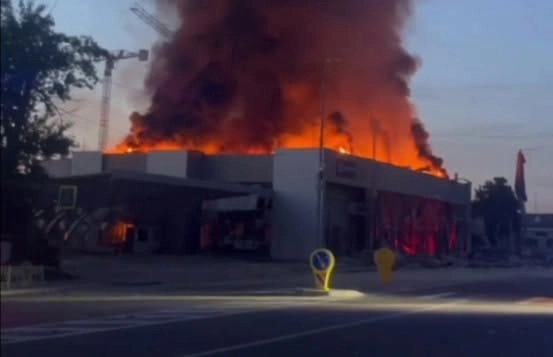
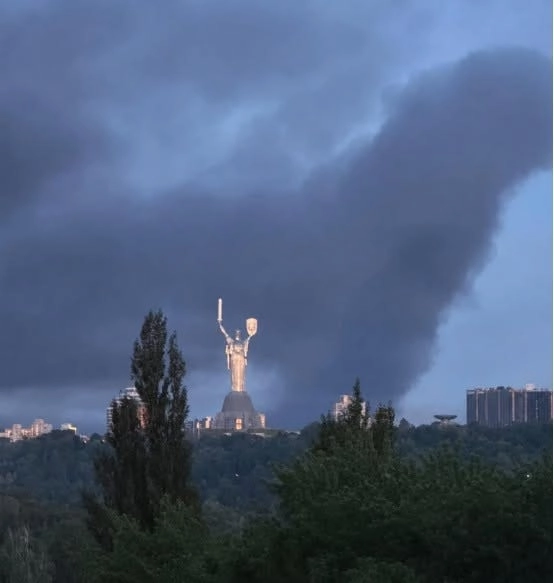
Also, by happenstance, this week I spent some time in Dnipro talking to people, so as it worked out, within three days of these big strikes, I was in and driving around both of the two cities targeted by the Russians. Civilian attitude was pretty much identical in both places: The war sucks, Putin is a monster, I really wish the war would end, but since Putin is Putin, thank God for the AFU, and if the Russians think blowing up apartment buildings will get us Ukrainians to quit, well, forget that. Dnipro is like Kharkiv, it’s predominantly Russian-speaking, but a lot of people are highly educated in tech and engineering, and this extremely Russian-speaking professional class detests, I say again, detests the Kremlin and those that infest it.


Ukraine bombards Russia – As goes Chonhar…
If anyone was in doubt that cutting overland supply to Crimea is a Ukrainian strategic objective, this week should have pushed many off the fence. This review decided it was happening more than a month ago.
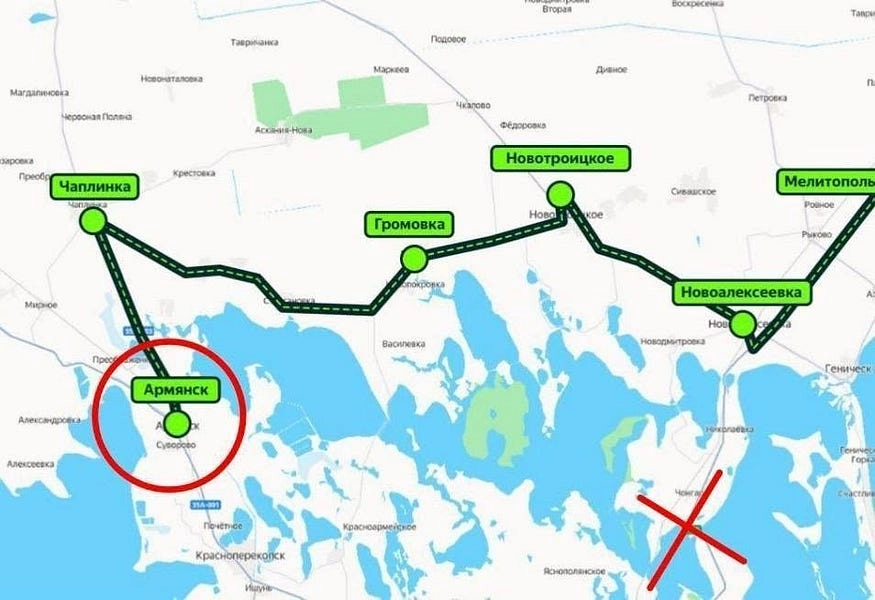
This week, most visibly, the Ukrainians returned to the old tactic of targeting bridges, or better put, causeways through marshes, that connect Crimea with occupied Ukraine and eventually the mainland. There are three bridge causeways, from west to east, usually referred to as Armyansk-Perekop, Chonhar, and Arabat. The Chonhar crossing is the most important, since all traffic moving through the rail hub Dzhankoi, farther south, connects with the Kherson region road network via Chonhar.
The Ukrainians, back when they had some British/French Storm Shadow/SCALP precision-guided rockets back in 2023-early 2024, had used those precision-guided weapons to blast holes in the roadway at Chonhar, forcing the Russians to do detours until the holes were fixed. The British and French had very few of these missiles to give, so the Ukrainians had to be very careful about what targets they fired them at. Some of you may recall that the Americans at the time thought that giving Ukraine too much military material might make the Russians angry and aggressive, so the hope was that the Americans would give the Ukrainians long-range missiles, of which the Americans had deeper supplies. The missiles came, but at a dribble, so in due time the Russians fixed the bottlenecks.
Then Donald Trump came to power, and Russia was designated America’s friend and excellent future business partner, and Ukraine became a parasite state run by a “dictator” that “started the war” (Trump’s words, not mine) that Americans shouldn’t care about – so long-range missile deliveries to Ukraine from America dried up pretty much completely after that.
That state of affairs – the northern neck of Crimea is vulnerable, the Ukrainians know it, but they don’t have weapons precise and powerful enough to blow a significant hole in a reinforced concrete bridge crossing the neck at long range, so the Ukrainians concentrated the weapons they had on other targets and left the Crimea northern road bottlenecks alone, generally speaking, for the next two years. Until Sunday, June 7.
Overnight Saturday-Sunday, at least one Ukrainian drone, with what appears to have been a 100+ kilogram (220+ pound) warhead, probably fused for a penetrating detonation, blew a refrigerator-sized hole in the automobile bridge over Lake Sivash in the Chonhar district.
Given the tech we’ve seen, the reasonable conclusion is that the Ukrainians developed a drone that traded range for extra payload and possibly used some of the gained weight to make the drone more jamming resistant. Maybe a specially trained pilot team flew the strike, because hitting a bridge with a big drone at the correct angle to blow a hole in it isn’t easy.
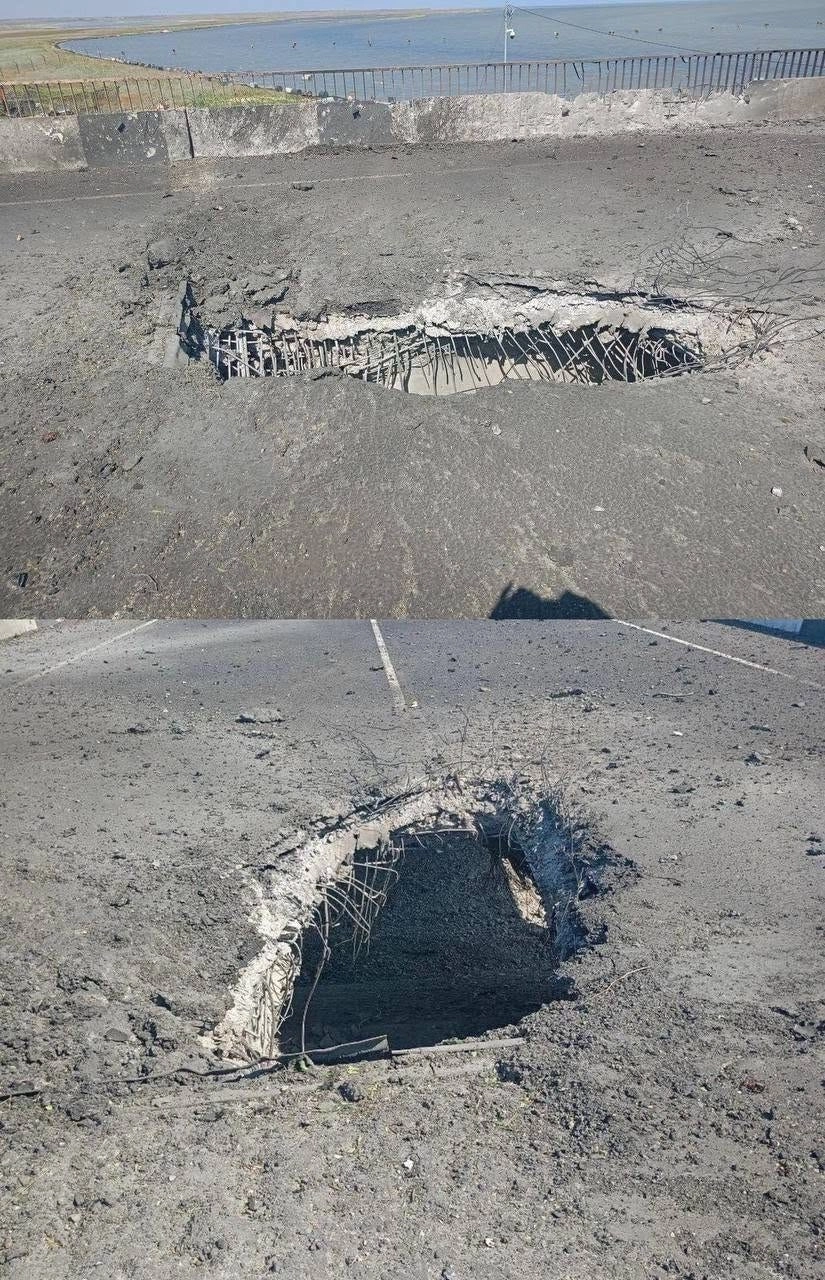
We know because Ukraine’s Unmanned Systems Forces (USF) told us that the 1st Special Center (formerly 414th USF Regiment) carried out the attack, and they are the AFU go-to unit for high-responsibility, high-value target attacks. So maybe it was just pilot skill.
The Russian-appointed “head” of the occupied part of the Kherson region, Vladimir Saldo, announced the bridge was unfortunately probably not going to be working again for a month, and traffic moving between Crimea and occupied Kherson territory would detour further west, via the Armyansk-Perekop route, which on your map is the Kherson-Simferopol highway, or (mostly) the N-05.
This would already have been a logistics problem for the Russian army, under any circumstances, because its forces in Kherson and especially the Zaporizhzhia region are supplied from bases in Crimea, and overnight that supply flow was reduced to one route to deliver beans and bullets to the front line: the N-05 (and its approach leg E-97). This means the entire supply for at least one (the 58th) Russian combined arms army, and part and possibly a lot of a combined arms army (the 5th), are being fueled, armed, receiving replacements, and getting crates of champagne and caviar delivered to the generals and some 25,000-30,000 men in southern occupied Ukraine, via a single causeway across a marsh. That’s not speculation, that’s just reality.
But as readers of this review and now even some mainstream readers understand, Ukraine isn’t just carrying out precision strikes on single, very vulnerable points on the Russian logistics network. Since early May, a pack (am avoiding the obvious “swarm”) of other elite USF long-range strike units (among them Nemesis, Ptakhy Madyara, Luftwaffe) have pushed the drone kill zone out of the 0-to-25-kilometer (0-to-15.5-mile) envelope from the front lines, to up to 100-150 kilometers (62.1-93.2 miles), and they have been concentrating on roads and particularly roads in the southern, occupied, Ukraine leading to and from Crimea. The primary target is fuel trucks, followed by military vehicles, followed by civilian heavy trucks.
So, the unwanted for the Russians outcome next: Air operations attacking Russian logistics just became twice as easy, because now more targets are crowded on less road.
Since traffic moves both ways, the problem of getting supplies INTO Crimea is similarly complicated; as we noted in our last review, the Ukrainians are hunting ferries moving between Crimea and the Russian mainland. June 1 is the traditional launch date of Russia’s summer vacation season, so, along with the trucks being concentrated on a smaller space of road, because the way the Ukrainians timed it, the Chonhar strike makes it even worse. Now, a tourist family wanting to visit from Crimea has to travel an extra 100 kilometers (62 miles).
And, since the top priority of the Ukrainian strikes is fuel trucks, this means that with more vehicles on less road, the chances of fuel shortages increase. And that’s already a fact too: right now, fuel in Crimea is basically being rationed at 20 liters a week, similar shortages are being reported across the Russia-controlled sides of Kherson and Zaporizhzhia regions, and spot shortages have surfaced as far away as Rostov, Moscow, and St. Petersburg.
Saldo on Sunday – without apologizing that he had promised to fix the fuel crisis by Wednesday – announced that civilian traffic will be banned from the entire highway route Rostov-Mariupol-Melitopol-Crimea.
Sure, there are probably some out there who still believe all these downstream effects are either Ukrainian lies or the Ukrainians just getting lucky by accident.
Me, I am seeing a calculating bombardment campaign aiming to:
The timeline is probably “by early winter or before,” but the launch date would be when the Ukrainians calculate Russian forces in the Zaporizhzhia-Kherson sector are so weakened, and their supply chains so degraded, that a major offensive is possible. That moment may never come, but certainly right now it looks like the Ukrainians are working towards that point.
Vladimir Putin’s hometown gets the drone treatment, exactly when a big conference praising Putin was being held
The Russians’ cheering about all the smoke and fire in Kyiv lasted about 24 hours. Single day, long-range strike-wise, Wednesday, June 3, was probably the single most embarrassing day for Russia, although depending on taste, it was Sunday.
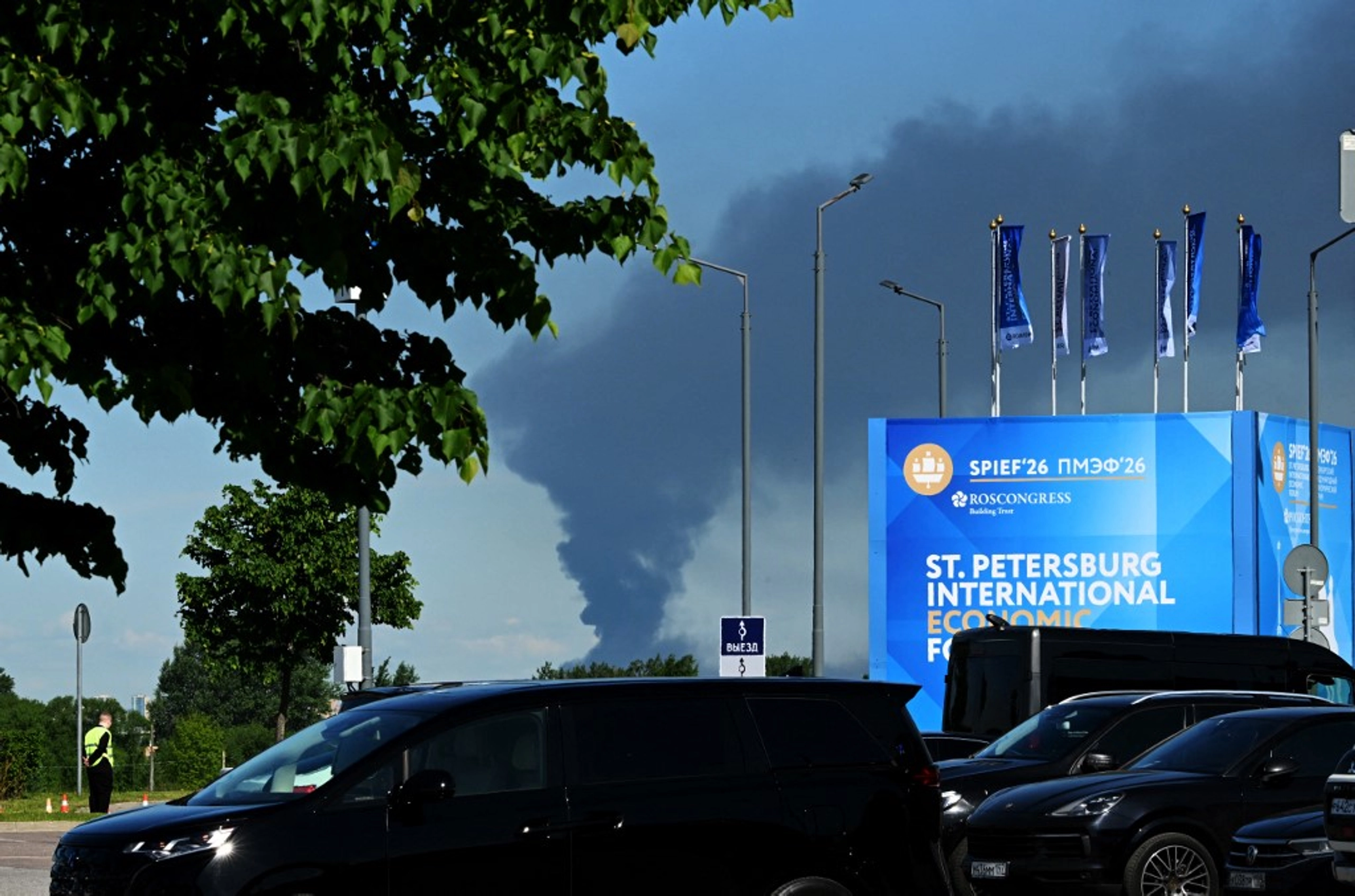
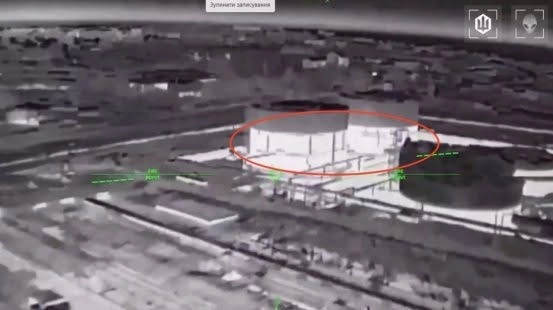
On Wednesday, literally as Russian state TV was crowing over the “damage to military targets” done in Kyiv and Dnipro, Ukrainian drones were winging their way to St. Petersburg, struck and set fire to the oil loading port there, plus at least two storage reservoirs were hit. Big fires, giant columns of smoke into the sky. This is the biggest oil loading terminal on the Baltic.
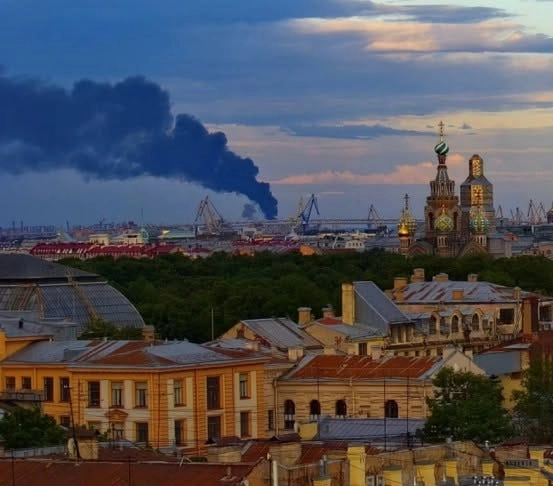
The funny part is that since the weather was so nice, the smoke got particularly substantial viewing by locals, because a clear, dry day is so rare in that city. The impression is that about every fourth Petersburg resident had a smartphone and wasn’t concerned about the law banning recording drone strikes or their damage. If CNN and a special forces team had been on the ground, you couldn’t have had better Battle Damage Assessment (BDA) of the attack and the damage it caused.
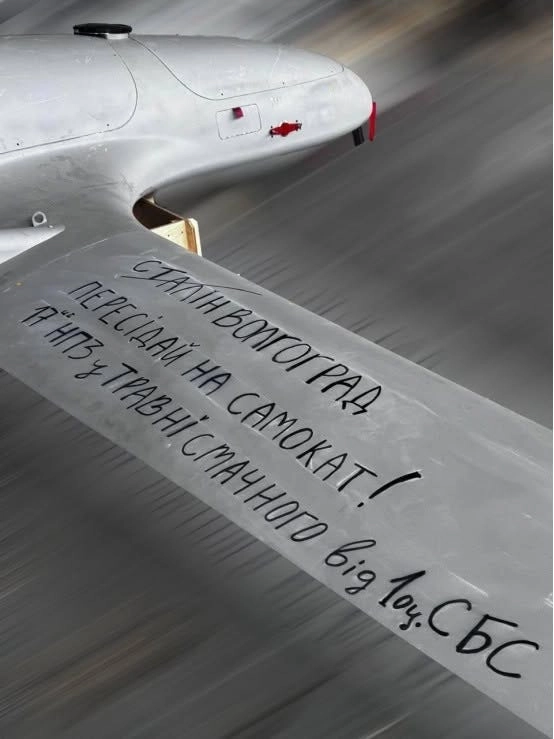
There are multiple – dozens – of videos of Ukrainian drones circling over the city with no air defenses seeming concerned about them, or explosions, or fires, or the horizon black with smoke. There are a few recordings of energetic small arms fire, but not of shoot-downs. Plus, of course, people are recording selfie videos in front of the fire and the smoke. Workhorse FP-1 drones carried out the attack. Some of the drones came in at wave-top, like, not more than 3 meters (9.8 feet) above the water height. Pretty amazing considering the pilot was back in Ukraine somewhere.
A parallel strike – supposedly this wasn’t possible because of the dense air defenses – flew to Kronshtadt Island and hit the shipyard. Preliminary reports were that four ships were hit, and a big column of black smoke from the island was sighted. The Ukrainians claimed a missile boat called the corvette Boikiy was badly damaged. The Russian internet said the Ukrainians lie, and then the USF published video of drones hitting the ship in drydock, including a follow-up drone aiming where the ship was burning from a previous hit. The next day, the Russian internet video-recorded the ship, still burning, with the ship’s main mast and primary radar collapsed onto the superstructure. This appears to have been from blast and fire; the ship will probably be out of action for months. My guess is that the 1st USF Center was the main strike group.
All in all, overnight, the Russians claimed 354 Ukrainian drones shot down, and it looks to me like Ukrainian long-range strike counts are slowly rising. An arms factory in Tambov was also hit.
Unsurprisingly, diesel on the St. Petersburg commodities market went up 3.5% in less than an hour of trading. A max 50-liter per fill-up order was ordered.
But the truly unpleasant part for the Russian national leadership was that Wednesday was also the start date of a big annual security forum in Petersburg that the Kremlin makes out to be sort of a “Russian Davos,” during which all toadies and satraps get invited to make speeches to tell each other about how the world is multi-polar and the West is evil. I read in the news that Candace Owens, the Tate brothers (Andrew and Tristan) and Steven Segal all showed up and told their legions of followers that Russia is great.
Unfortunately for the messaging that Russia is powerful and a rival to the West, the conference opened with epic smoke blotting out about half the sky above old Leningrad, and smearing what had been a rare, pretty, blue Baltic sunny day with a Dostoevskian helping of murk, gray, and pessimism (No apologies for the metaphor, I did the time and suffered more than enough, to earn the right to make fun of Leningrad like that.)
By lunchtime, the Russian Telegram channels were pointing out that the evening before the Ukrainians attacked, St Petersburg Governor Alexander Beglov told reporters security for the conference was in tip-top shape, and that “new challenges have been fully considered” and “exhaustive measures” had been taken.
“New challenges” is Russian politically correct terminology for “Ukrainian drones carrying explosives deep into Russia.” So, all in all, the Russian objectives of projecting peace, military might, and just basic competence didn’t go so well, what with Russia’s main oil terminal and the naval base on the Baltic burning when the conference kicked off.
Most armies at war with Russia would have quit at that point, declared a victory, and handed out medals.
Overnight on Friday, Saturday-Sunday, in Ukraine, 1st USF and some other drone regiments launched more drones at St. Petersburg, timed to hit around sunrise, a few hours before the big conference profiling Putin and Russia as a serious superpower was scheduled to close. So, second strike in about 60 hours. Seems like between 150-200 aircraft. Later Russian reports put the figure at 480+ aircraft, claimed shot down nationwide, which, if true, set a new record for Ukrainian drones launched into Russia in a day.
This time, one strike package hit a Russian naval stores warehouse identified as the 15th Naval Arsenal, ammunition inside, big explosions, and continuing secondary explosions audible as the conference attendees traveled to and from the closing event and its speeches about multi-polarity and Russia’s leading role in the world. Smoke all over the horizon. Authorities told civilians to stay inside.
A second-strike package seems to have ignored all the air defenses around Kronshtadt, but this time, instead of targeting a warship concentrated on a naval cadet school, according to some reports, a naval technical college. Authorities confirmed fires and injuries.
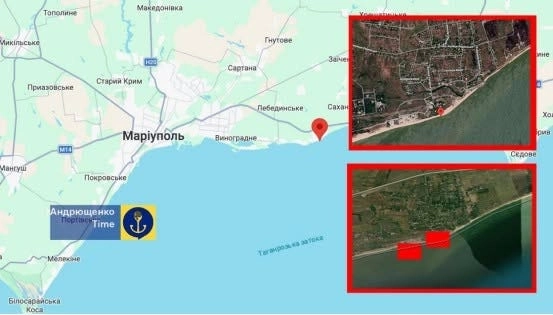
For good measure, another strike package hit the already beaten-up oil storage/tanker loading terminal Ust-Labinsk, on the Black Sea. All these attacks were at 1,000+ kilometers (621.4+ miles) range and per Ukrainian reports carried out by the USF and the SBU together.
Drones vs. boats and planes
This section is just Russian ships hit this week by Ukrainian drones.
Note that for practical purposes, every time damage is confirmed on a cargo ship, at least one and possibly more drones attack by hitting the bridge head-on with the apparent objectives of destroying control equipment and killing or wounding as many senior ship officers as possible.
On Monday in Berdiansk, the MV Leonid Pestrikov (flag Russia, dry cargo ship) was struck twice by drones while unloading ammunition or military cargo at berth number three. Significant hits near the bridge area were reported.
The Russian navy missile corvette tied up in Kronshtadt was hit on Wednesday.
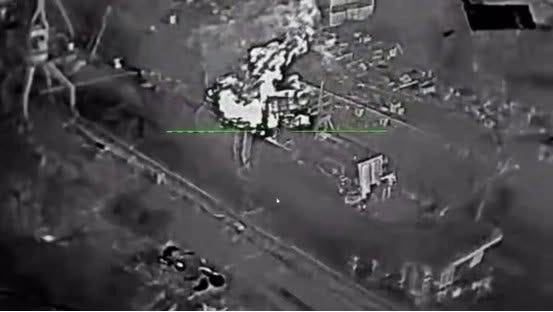
On Thursday, the Ukrainian special ops drone guys hit a patrol boat whose specific job was to prevent drones from approaching the Kerch Strait. So now the entire Ukrainian internet is sitting with fingers crossed on the next attack. Which may not be the Kerch Bridge, but at this point, I don’t think even the Kremlin is under the illusion that these attacks are going to stop.
The next day, there were a few unconfirmed and isolated reports that the Ukrainians had attacked the Kerch Bridge with Neptune missiles, which all had been shot down.
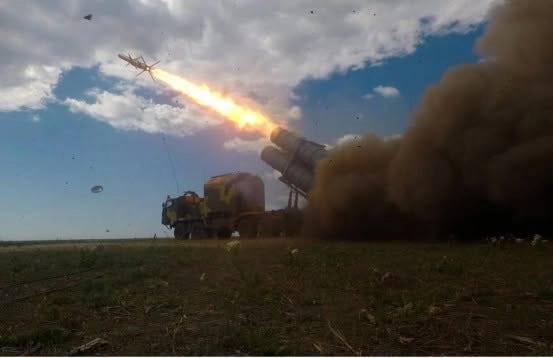
At the same time, the SBU (primarily 1st Centar) hit five ships in the Sea of Azov area:
- MV Natra (General cargo ship, Belize flag): Heading to Rostov-on-Don to load grain (allegedly stolen Ukrainian grain), hit by at least four drones near Taganrog Bay, Bridge/superstructure heavily damaged, fires. Drones hit as the watch was being exchanged. Two crew members killed, several injured.
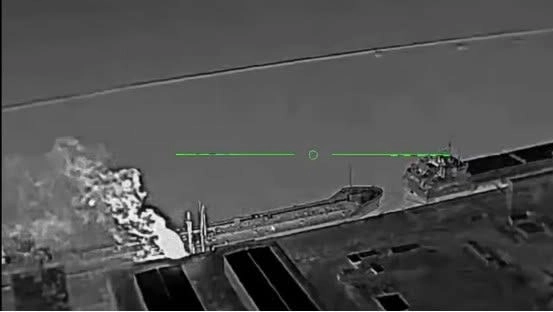
- MV Zircon (Cargo ship, Palau flag), probably carrying stolen grain, was hit by at least four drones in the superstructure, fire, serious damage, ship was abandoned.
- MV Bavly (Russian-flagged tanker): – struck and damaged, no info on damage. Strike in open water off Taganrog.
- Two Russian-flagged cargo ships/bulk carriers hit in ports or coastal waters between Mariupol and Berdiansk. Reportedly used for military supplies, fuel, or stolen grain. Strikes confirmed via footage, damage not clear.
Obviously, a strike campaign targeting Azov Sea ship traffic directly threatens sea links between the Russian mainland and Crimea.
Romanian tap dancing
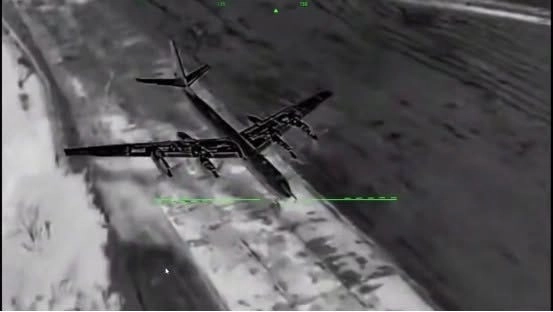
So last review as you may recall, on Friday, we had a Russian Shahed drone fly into Romania and blow up an apartment building, and in the process, injure two Romanian citizens. The Romanian government was still busy making excuses and explaining why it was that a Russia weapon flying into NATO air space and injuring Romanian citizens didn’t count as an act of aggression, and also, why Romania’s air defenses and indeed NATO air defenses are really excellent, and how the drone and the taxpayers injured from the drone blowing up their home doesn’t undermine NATO credibility as an alliance that can defend its air space. An article laying out all the double-talk and really shameless responsibility is here. Among other things, the Romanian President said the solution was for Russia to bombard Ukraine more accurately.
To be fair, the Romanians shut down the Russian consulate in Constanza and kicked out the consul, but given the state of Russian trade with Eastern Europe – basically none except oil to Slovakia and Hungary – the consulate shut down wasn’t exactly damaging to Russian interests.
After that, the Russia-drone-trying-to-kill-Romanians story fell off most people’s radar, but that’s not us.
First thing, exactly at the same time official Bucharest was equivocating and, among other things, explaining to voters the point was to be careful and moderate because otherwise Russia might get mad, none other than Dmitry Medvedev, former Russian president and hardline rah rah Russia guy, (May 29) decided to send his own message to European voters.
Remember, this is pretty much at the same time as the Romanian President is declaring himself reasonably OK with Russia blowing up Ukraine and Ukrainians, as long as the Russian weapons don’t go into Romania. I quote Medvedev in full:
“Citizens of EU countries, You should realize your authorities have unilaterally entered into a war with Russia. So be vigilant and don’t be surprised by anything. The peaceful sleep is over. But you know who to ask why!”
So, the early conclusion, the clever Romanian strategy not to make the Russians mad and prevent them from being aggressive and threatening, not working so well.
Then, about 12 hours later, a new report surfaced: It seems like there was a second drone. This one was uncovered near a village called Basesti, Maramures region, approximately 90 kilometers (56 miles) into Romanian airspace. Hard to call it an accident, this far away from the Danube, on both sides of the border, its forests, mountains, streams, mushroom pickers, and I am certain, smugglers and draft dodgers.
Villagers found it; it seems like it was a decoy drone that, for whatever reason, went into Romania. Remember, decoy drones force air defenses to turn on their radars just like real drones, and where Romanian air defense radars around the Maramures region is hard, legitimately useful military information for Russia, that’s intelligence you plan air and drone strikes on.
Romanian reaction? NATO reaction? Zip. Play in the Romanian media? Also Zip. So there’s a great lesson to teach the Kremlin. If you fly a drone into Romania and it injures Romanians, the president will gripe that you missed the Ukrainians, do better next time, but if your drone just hits a forest, Romania and NATO shrug, it’s OK.
If you’re wondering if any of that is an exaggeration, no, it’s not; it happened exactly like that. This is appeasement taking place, right now, we are seeing it, and we can identify the officials responsible (the article names them, for what it’s worth).
Reprinted from Kyiv Post’s Special Military Correspondent Stefan Korshak’s blog. You can read his blog here.
The views expressed in this opinion article are the author’s and not necessarily those of Kyiv Post.
You can also highlight the text and press Ctrl + Enter