BRUSSELS – The Trump administration will need European consent to lift any Russia sanctions in order to make a recently agreed Black Sea ceasefire deal work – but that might prove complicated.
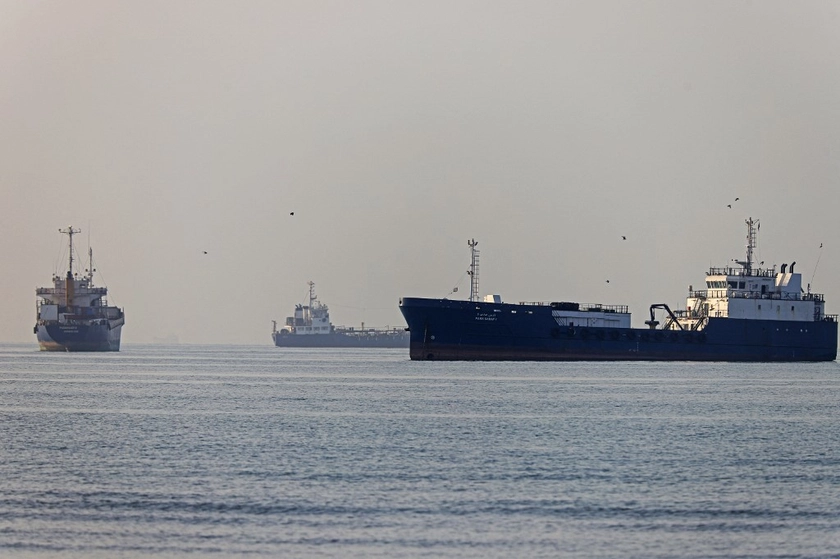
Under the Black Sea ceasefire deal negotiated by US President Donald Trump’s administration this week, Russia and Ukraine have agreed to a truce, though Moscow said its involvement would depend on a series of pre-conditions including sanctions relief.
JOIN US ON TELEGRAM
Follow our coverage of the war on the @Kyivpost_official.
According to a readout by the Kremlin, the deal was to include a rollback of some Western sanctions, specifically for banks and other services involved in agricultural exports, including fertilizer shipments.
While the Trump administration appears to agree with this, according to the Wall Street Journal, Kyiv said it had not agreed to any easing of measures on Moscow.
Russia’s double-gameExcluding Russian banks from the SWIFT international payment system was one of the early measures adopted by EU member states shortly after Russia’s invasion of Ukraine.
There are currently eight Russian banks impacted, excluding Gazprombank, which has been kept off the list to allow EU countries to pay for Russian gas and oil deliveries. Effectively, the latter is curtailed by US sanctions.
The Kremlin said its adherence to the Black Sea ceasefire deal would depend on reconnecting agricultural lender Rosselkhozbank and several other banks to the SWIFT system.

Iran Rebuilds Missile Arsenal During US Truce, Stockpiling Fresh Russian Munitions
Rosselkhozbank is key in financing food production and exports but was added to the blacklist for its operations supporting Moscow’s war machine.
Russia’s request, however, is partly misleading. When the EU imposed economic sanctions on Russia after February 2022, food products were explicitly excluded.
In other words, Russia does have access to the world market when it comes to grain and fertilizer and has been trading in those goods since.
A key reason for Moscow’s messaging was “to score some points with the Global South by stating that Russia wants stable or low food prices because Russian agriculture is not under sanctions,” said Alexander Kolyandr, a researcher at the Center for European Policy Analysis (CEPA).
No swift movement likely
While the Trump administration might want to roll back Russia sanctions in order to secure the deal, movement hinges on EU approval – and it’s unlikely this will come quickly.
“The end of the Russian unprovoked and unjustified aggression in Ukraine and unconditional withdrawal of all Russian military forces from the entire territory of Ukraine would be one of the main preconditions to amend or lift sanctions,” a European Commission spokesperson said.
Russia’s bargaining in the Black Sea grain deal is seen as Moscow wanting to feel out if it can start eroding the EU’s sanctions regime.
Kyiv and its European allies fear any concessions – even if seemingly minor - could start undoing the West’s sanctions frameworks on Russia since the Ukraine war began. Moscow also could be attempting to divide the US and Europe on the question of the correct sanctions policy.
As SWIFT is based in Belgium, it has to abide by EU regulations and sanctions legislation. Therefore, “at some point, we [Europeans] will have to be looped in”, one EU diplomat told Euractiv.
“SWIFT cannot connect Russian banks to the network unless the EU changes its sanctions’ legislation,” said Janis Kluge, senior associate at the German Institute for International and Security Affairs.
SWIFT did not respond to Euractiv’s request for comment.
The EU’s economic measures against Russia, which have to be renewed every six months by unanimity of all 27 member states, are up for renewal by 31 July.
Rolling back Russia sanctions before a complete ceasefire deal and Moscow’s troop withdrawal from Ukraine remains a no-go, EU diplomats say.
“Everyone is still analysing what this means or could mean. But so far, it’s a statement we have had no involvement in,” a second EU diplomat told Euractiv.
“Before the sanctions roll-over [in July], nothing changes, and we’ll work on nothing to be changed because Russia itself hasn’t changed nor have its goals,” the diplomat said.
Hungarian, US pressure
A majority of EU member states are concerned that Hungary, which was one of the first EU countries to respond to the Black Sea deal, has called for an end to the sanctions against Russia and repeatedly used their agreement for renewal as a political bargaining chip.
“In theory, an EU country could threaten to not prolong sanctions unless the SWIFT ban for Russian banks is taken out of sanctions legislation,” Kluge said.
Trump’s return to the White House in January has also emboldened Budapest to increasingly disrupt the periodic rollover. Trump might try to use the disarray in his favour.
The European Commission did not comment on whether US officials had been in touch on the issue.
There is also an option for a US workaround, at least theoretically.
Analysts say Washington could re-open corresponding accounts in the US for Russian banks under American jurisdiction.
“That means that I can trade in dollars, clear deals in dollars, and do whatever I like with the US dollars,” Kolyandr said. “[This] is possible without SWIFT. It would be extremely cumbersome, tedious and slow, but it is possible.”
Washington cannot, however, force SWIFT to reconnect the Russians, both analysts said.
“Trump could also potentially try and pressure SWIFT, which would make their lives very difficult, but it cannot go against EU rules,” Kluge said.
Asked what reaction Washington should expect if it tries to pressure the EU to lift the Russian measures quickly, a third diplomat quipped: “I can’t foresee this happening - at least when using a sane rationale.”
You can also highlight the text and press Ctrl + Enter