This big Ukraine news this week outside Ukraine seems to all have been inside the Beltway.
First, there was this “minerals/rare earth deal” between the US and Ukraine that got signed after several failed attempts.
JOIN US ON TELEGRAM
Follow our coverage of the war on the @Kyivpost_official.
The other not-in-Ukraine-about-Ukraine development was announcements from several White House officials that the US was kidding these past three months – a quick peace in Eastern Europe isn’t critical to American national security, America doesn’t care much about that anymore.
If you want more details about the Beltway stuff blow-by-blow, go here.
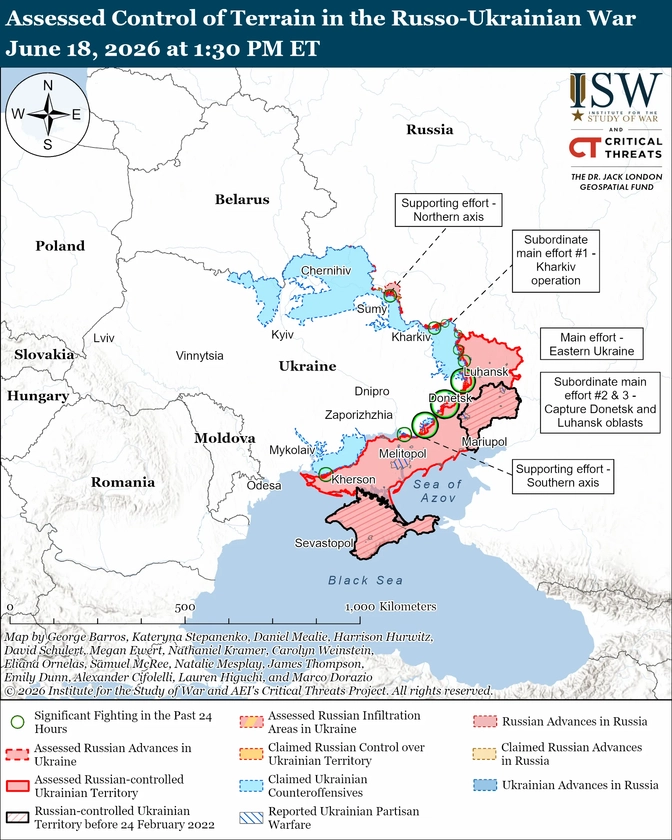
Meanwhile, and a lot more important, the actual war is still there, big time. The weather is warming and fighting is intensifying. This week, it was really easy to identify the big “real war” news: Long-range Ukrainian strikes against the Crimean peninsula and the Kuban shore have resumed with a vengeance.
Cry Havoc! and Let Slip the Drones of War
Fine, I get that’s kind of a hokey title for a section, but my generation gets extra points for working in Bard references. Image of the incomparable Chuck Heston dropping lines and preparing the chew scenery as Marc Antony, during a Hollywood production of Julius Caesar.


Macron: Trump Thought Ukraine Would Lose, Now Respects Its Resilience
This week, Ukrainians reopened their long-range bombardment campaign against Crimea and Russia’s Black Sea coast, among other things, driving a final nail into the coffin of the Great American Russo-Ukraine Ceasefire.
Information is still coming in, but clearly, the Ukrainians stayed true to type. They went after air defense systems first, and then they followed up with robot boats (confirmed) and heavy missiles (rumored), they sequenced strikes in time and space, and it all was impressively complex. They scored some clear, painful hits against the Russians, but total effect isn’t yet clear. The Ukrainians very obviously had been planning this for a while.
Precursors – Last week, so not this one, an early possible indicator that something was up was a pretty much unprecedented flight by a US Navy Poseidon recon plane the whole length of the Black Sea. This was on the 25th. A modified Boeing 737, the Poseidon’s main job is finding submarines – but it’s also good at figuring out where surface ships are.
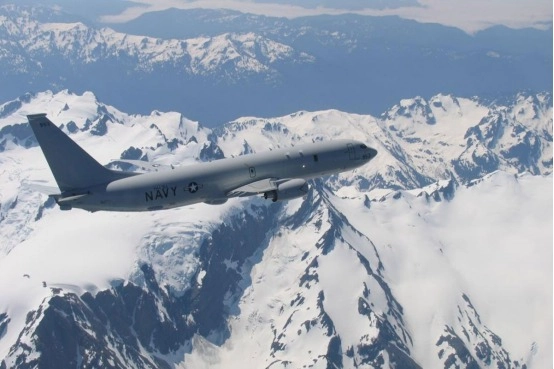
Why is US Navy maritime reconnaissance interesting? Well, two reasons. First, the US, in mid-2024, pretty much ended deep patrols over the Black Sea that approached Russia’s Krasnodar region – it was flying Global Hawk drones approximately once or twice a month – and once the Americans quit, that air space wasn’t patrolled by NATO aircraft at all until about January-March 2023, when the French and British Air Forces started doing the same thing, but using manned aircraft.
So for the fuddy-duddy United States Navy, whose big wars right now are with the Houthis in the Red Sea, and against cuts by DOGE in the Pentagon, it was definitely a change in operational behavior to send a Poseidon – apparently all by itself to go sniffing around Novorossiyisk and Sochi.
Again, the last time the Americans did something like this, it was with drones. Poseidon patrols on the east edge of NATO take place almost daily, but, in the past three years pretty much never have I seen a Poseidon track out of sight of the east Romanian coast. That’s the second thing.
I read in the DC trade reports that the Pentagon supposedly is pushing more authority down to regional commands – so perhaps the United States Europe command (USEUCOM), the headquarters from which a Navy Poseidon flying out of Sigonello, Sicily would get missions, has been itching to practice finding Russian or Turkish submarines in the Black Sea. I also read that the commander of USEUCOM, General Christopher Cavoli, is set to rotate out of that job this summer, so maybe he figured it was too late for him to get fired for taking risks with a Poseidon. Image of Cavoli doing a selfie with former Commander-in-Chief of the Ukrainian Armed Forces Valery Zaluzhny.

In any case, the Russian military blogosphere flagged the flight as a precursor for big Ukrainian long-range strikes in the area, because, according to them, the Americans are evil and help the Ukrainians all the time as much as they can. As far as they were concerned, it meant big Ukrainian attacks against Crimea were coming for sure.
The next week or so saw the Ukrainians fly drones in twos and threes to Crimea and across the Black Sea to Rostov and Krasnodar regions almost daily.
Even at the time, it was clear the Ukrainians were probing Russian air defenses, and if you looked you could find Ukrainian milbloggers joking that what was up was that the Ukrainians were planning for something big pretty soon, and the most obvious date was May 1, when in Russia you’re supposed to take the day off and go to your dacha and dig in your garden, grill shish-ka-bob or drink, as it suits you.
Jokes like “Maybe the Russians’ meat will get burnt,” and “their sausages will get overcooked,” or “probably a nap after eating isn’t going to work,” were easy to find. There haven’t been any big Ukrainian attacks against Crimea for a while, so naturally, the internet was suspicious that something was coming.
Day 1, Thursday – On May 1, things and air space in Crimea is relatively quiet, except, towards the end of the day, Ukraine army special operations, under army military intelligence (HUR) announces it had a really excellent day flying strike drones into Crimea.
By evening, we were treated to images of what very much looked like Ukrainian drones zeroing in on Russian S-300V air defense missile launchers, an Obzor-3 radar, a Kasta-2E2 radar, an ST-68 radar, and an Imbir radar. If you are a Russian and your job is defending airspace, these are exactly the systems you don’t want to lose.
We had to take HUR’s word that the strikes were where HUR said they were. However, it certainly fit a pattern: we have seen over and over, the Ukrainian long-range strike tactic is – take out the area air defenses first, and then follow up with strikes against high value targets the air defenses had been covering, and usually after that, try and leverage Russian confusion to help a new attack tactic. Most of us can name off-hand a half-dozen operations the Ukrainians ran pretty much by this template, for instance, for the strikes in October 2023 that took out the assault warship and the missile submarine in Sevastopol – the first step was a few days of strikes targeting air defense systems across Crimea.
Day 2, Friday – On May 2, shortly after 1 a.m., the Russian internet went into hyper-drive, and grandmothers, gopniks on stoops, officials worried about their jobs, housewives bored and upset, and legions of Russian teenagers with apparently nothing better to do, all across Crimea, looked out windows and got to work.
There was just an inundation of images and reports and personal recordings all testifying to waves of evil Ukrainian drones waking up babies and interfering with airspace and rattling windows and attacking targets all across the peninsula.
Timing-wise, this was at the outset of the resort season. Russia-controlled places traditionally don’t work at all from May 1-May 9, at least, and the first Friday of that period is usually a giant get-out-of-the-city time when people load up families and go somewhere.
Crimea is, in the Russian mindset, the Russian version of Florida, so the massive drone raid launched by the Ukrainians on the first Friday of the May holidays in Crimea was something like an attack on the causeways and roads leading to South Florida on the first day of spring break. The Kerch Bridge was shut down for an hour, and lines of cars waiting to cross stretched for about 5 kilometers (3.1 miles). Image of a Crimean beach.
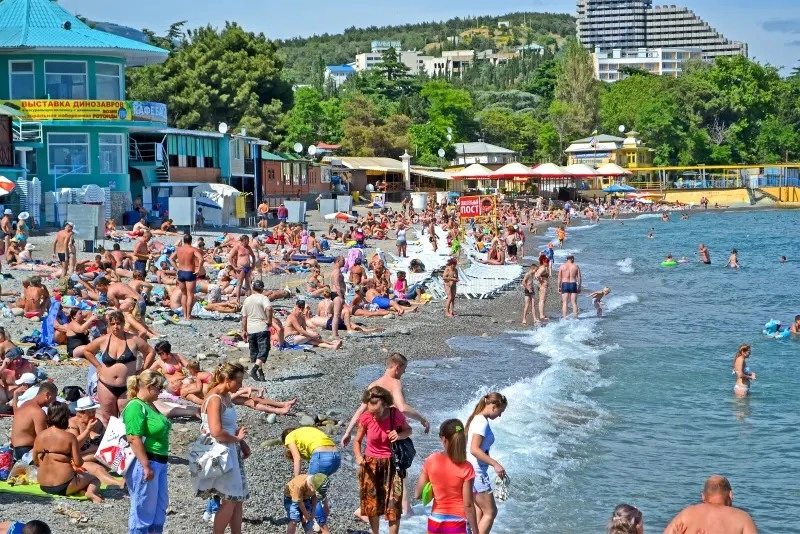
On Saturday morning, reports were surfacing that overnight, the Ukrainians had launched Storm Shadow missiles at something important in Crimea. No confirmation.
Educated guessing, it seems like the Ukrainians launched at least 150 attack drones, and they hit all across the peninsula.
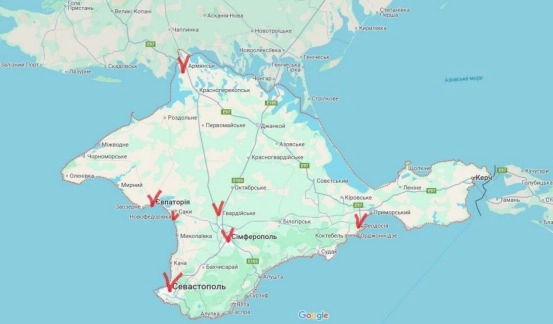
There were strikes or drones passing overhead reported in Kacha, Yevpatoria, Saky airfield, Dzhankoi, Belkbek, Novofedorovka, Armyansk, Inkerman, around Sevastopol, Gvardeyskoye airbase, (more or less the same place), Peschanoye (also, more or less the same place), Uglovoye, Andreyevka and Vilino. Map (of strikes Thursday-Friday) attached, this is not all the sites hit apparently.
Reports say the Russians opened up with everything from heavy anti-aircraft missiles to cops with sub-machine guns. There are dozens of reports or recordings of small arms fire, auto cannon, heavy machine guns and tracers, and big missiles whooshing into the sky and blowing up after not hitting anything. Fighters were launched at least at Saky and Gvardeyskoye (don’t know if this was to intercept drones or get them off the tarmac) and in Novorossiysk, what is left of the Black Sea Fleet sortied, I assume so as not to get caught in a follow-up strike (which the Ukrainians also have done at least twice). A “Neptune Warning” – this is Ukraine’s anti-ship missile – was announced as well.
Russian officials reported they observed and destroyed 85+ drones and admitted limited ground damage due to falling debris, however, about 7 kilometers (4.3 miles) from Saky at a place called Uglovoye, something caught fire, was burning for at least six hours, and it was pretty obvious missiles and other munitions were getting cooked off in the blaze. One report I saw said about 2 square kilometers (.8 square miles) of territory were burning, and because of the ammo, the firefighters can’t get close.
But also, there were definite Ukrainian attacks against air defenses, there was a chain of explosions reported on Cape Lukull, which has been an AAA emplacement for years, and the site around Olenivka, which is the far west tip of Crimea, got the treatment as well.
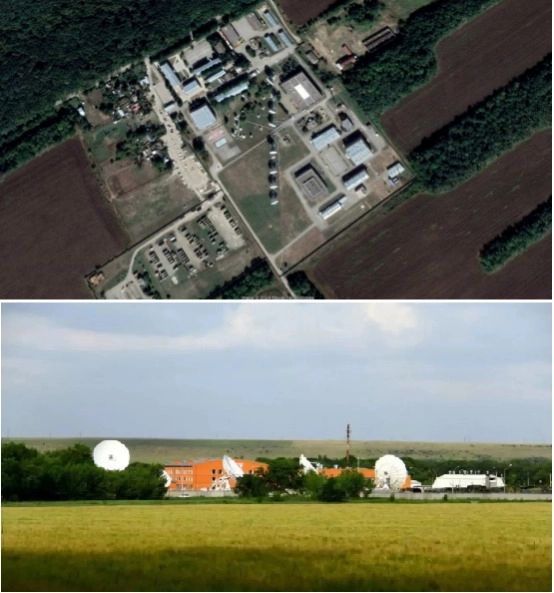
Parallel with all that, same time, Ukrainian drones flew all the way to Russia’s Black Sea coast, Stavropol Krai, to hit a place near the village Moskovskoe called unit number 33443. The facility there, code-named Zvezda, has antennae and eavesdropping technicians whose job is, and I quote, “global interception of signals from satellites, intercontinental communications, and exchanges between foreign military facilities. It specializes in electronic surveillance of signals from orbit and foreign satellite communication systems, including commercial ones.”
The facility has been in operation since the 1970s, but the Russians built it up in the 2010s. It reports to the very tippy top of Russian military intelligence, to the Main Intelligence Directorate of the General Staff of the Armed Forces of the Russian Federation (GRU).
According to the Center for Countering Disinformation, which is under the National Security and Defense Council of Ukraine, the “Zvezda” facility is designed for global interception of signals from satellites, intercontinental communications, and exchanges between foreign military facilities. It specializes in electronic surveillance of signals from orbit and foreign satellite communication systems, including commercial ones. The last time the Ukrainians hit this place was July 2024. Vladimir Vladimirov, Governor of Stavropol Krai, reported that falling drone fragments hit Moskovskoe, but there were no casualties.
Objectively, damaging or knocking out a major Russian listening facility aimed at Turkey and the Middle East is more in American interest than Ukrainian interest.
In any case, if the attacks in Crimea had anything to do with the strike against unit 33443, the Ukrainians, at minimum, really seem to have decided it’s worth working very hard to get explosions on that site. (Two images, clearly the Kremlin thinks its intercept techs deserve a nice place to work).
Day 3, Saturday – The night Friday-morning Saturday saw explosions and noise reported around Kerch, Feodosia, Anapa and Novorossiysk.
Impacts heard and observed in Novorossiysk. Anti-aircraft cannon firing and anti-aircraft missiles launched in the vicinity of Kerch. Fires were videotaped in an industrial district of Rostov: there, the delivery system, probably drones, was jet-propelled, not propeller-driven. A big fire that looks like fuel was recorded in Taman.
Analogous to the Storm Shadow reports from Thursday-Friday, overnight Friday-Saturday at about 2:30 a.m., a pair of Neptune missiles was reported “inbound on Sevastopol,” and once again, fighters launched from Belbek Airport. Drones were spotted in the vicinity of Krasniy Kurgan airport, near Anapa. I saw a report that three grain terminals there were hit.
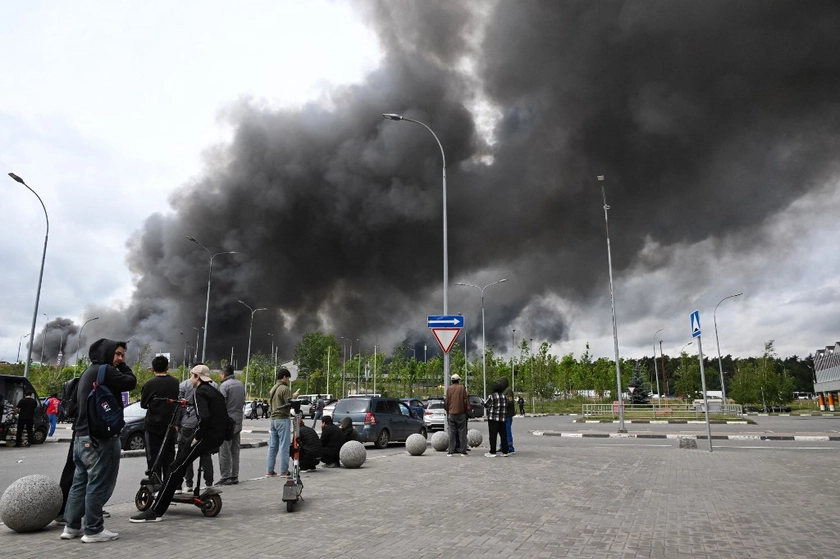
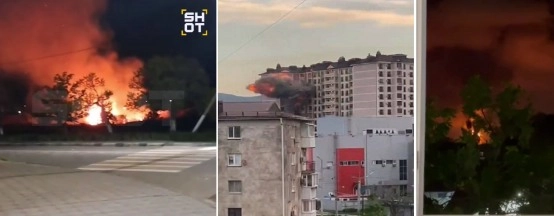
At least one drone rammed into an apartment building (the Kristall-5 complex, image) and blew up in Novorossiysk at some point after sunrise, four civilians reported injured, including two children.
Russian officialdom reported they “destroyed” 170 Ukrainian drones overnight, meaning about twice the night before. By mid-morning Saturday, the Russian MoD reported its forces had shot down eight (!) Storm Shadow missiles and three (!) Neptune missiles.
If that’s true – and according to its own numbers, the Russian MoD has shot down every aircraft in the Ukrainian Air Force at least three times, so grain of salt – then this was the most ambitious missile strike attempted by the Ukrainians in about eighteen months.
It is appropriate to point out that Russian drones and missiles had been flying in the opposite direction, and over the same night, the Ukrainians counted 183 Russian robot aircraft attacking targets in Ukraine. Worse hit was Kharkiv, which seems to have been the aim point for 40-50 drones. Homes were the main target, at least 46 people were injured. According to UNIAN, some Russian drones are now armed with cluster munitions, but this is general info, not necessarily in Kharkiv.
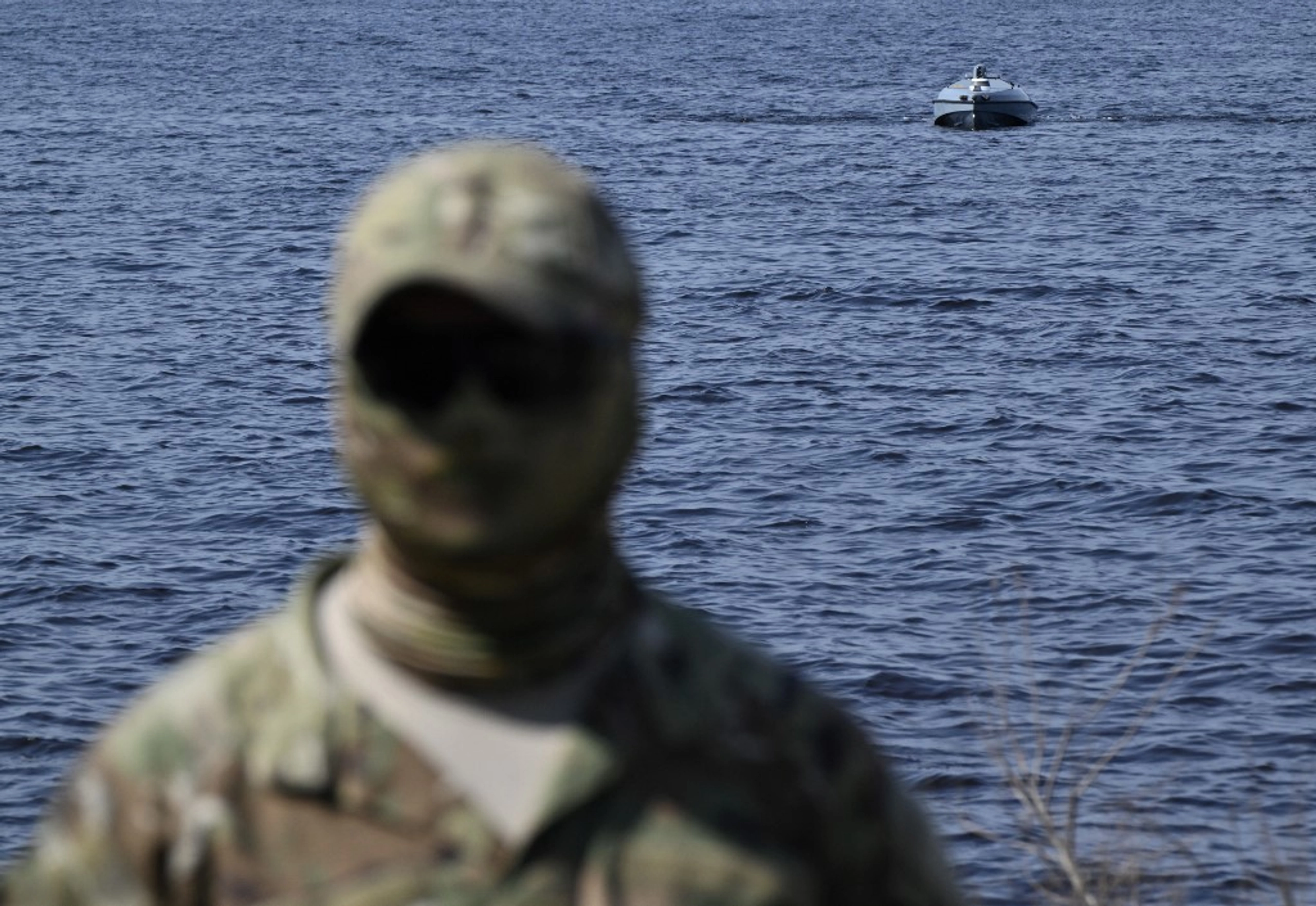
But this night, it wasn’t just drones in the air. Novorossiysk channels late Friday evening began reporting multiple Ukrainian sea drones offshore. According to Ukrainian mil-channels, Russian aircraft and boats “behaved cautiously” and tried to avoid direct contact with the area where the Ukrainian boats were operating. Stock image.
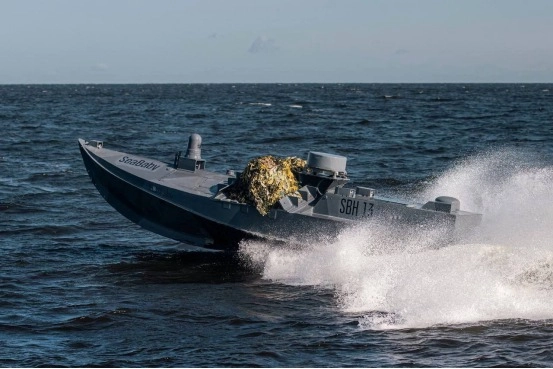
A naval Russian milblogger called Espanola, on Friday, wrote that it was two, then later, four, Ukrainian robot boats cruising around at some distance from a field of gas pumping platforms – currently Russian-occupied – in the eastern Black Sea, about 20 kilometers (12.4 miles) off the Crimean shore. A later report said the robot boats were 5 kilometers (3.1 miles) offshore Crimea, and at one point, the robot boats launched their own attack drones, and then opened fire on shoreside targets. In the past, this has been with heavy machine guns. The big-time Russian blogger Dva Mayora later said no, the robot boats were offshore in the vicinity of Novorossiysk.
By late evening, reports were appearing saying that at least one Russian aircraft flew into a missile trap and got shot down by one of the boats, which the Ukrainians had rigged with an air-to-air missile. It was a Ka-52 helicopter, according to a few sources, a Su-30CM fighter jet, according to most.
All agree that the pilots survived and a civilian ship pulled them out of the water. Espanola published video seeming to show four Ukrainian boats maneuvering, three hit by something, and two sizable explosions. The Russian MoD claimed there were 14 robot boats in total, all destroyed.
A synthesis of the foregoing sea battle might conclude that the Ukrainians sent four robot boats to mess around and draw fire in the vicinity of the Kerch Strait, and another two to four to do the same thing in the vicinity of Novorossiysk.
I am obliged to point out that the exact sea space this sea battle was fought out in, and the entire approach route used by the Ukrainian robot boats, was patrolled end-to-end by a US Navy Poseidon a bit more than a week previously. You can decide if there’s a link.
So far, I haven’t seen any confirmation on the Ukrainian side of actual cruise missiles launched or Russian things hit. Usually, this means either the HUR guys are still sifting through battle intelligence and deciding what to release to the public, or that more attacks are coming.
A possible indicator of Ukraine’s intent on that might be read into a statement from the Presidential Office released to Interfax Saturday morning: As of now, Ukraine is no longer observing the ceasefire the Americans tried to get into place last month, and specifically Putin’s call for a three-day ceasefire to observe WW2 end ceremonies in Moscow, Kyiv has been formally rejected.
An Ideal People’s Korrespondent
As evidence of the enthusiasm with which the Russian internet ignores law banning uploading images of stuff that shouldn’t be uploaded for security reasons, here’s a Telegram channel link to a video recorded by some suspicious Sevastopol residents, who observed some people walking on a sidewalk taking pictures of the Sevastopol port.
The security-conscious Sevastopol resident or residents recorded said possibly suspicious activity on his/her smartphone, and uploaded the content so the authorities might know better what nefarious activities were possibly in progress in the center of the Russian Black Sea naval forces and take appropriate action.
Also, the water seemed topped with an oil sheen and highly polluted, which people in charge might do something about as well, the civically minded poster added.
The video quickly reached the Ukrainian internet, where a Ukrainian milblogger pointed out that the patriotic Sevastopol smartphone user had uploaded excellent images not just of potentially suspicious activity by a potentially suspicious person, but high-res imagery of every building and ship in the very high security Southern Bay, Sevastopol port.
This, the Ukrainian internet found funny and, from the Russian perspective, pretty counter-productive.
The term for Russian citizen-busybodies contributing to Ukrainian military intelligence by sticking stuff willy-nilly on the internet is “People’s Correspondent” (Russian: «Народный корреспондент»). It’s a common expression these days.
I know it’s somewhat of a cheap move, but the image provided of a patriotic Sevastopol cat patriotically not spying on Russian navy military movements, including submarines, in Sevastopol harbor.

The Russian Spring Offensive Is in Full Swing
On Thursday, US Vice President JD Vance was among the senior US officials that announced Trump had brokered a major peace deal in Ukraine, during which announcement (on Fox) he said that Ukraine should be grateful to Donald J. Trump for his diplomatic finesse.
Vance said no one on Earth could have “gotten this deal done” and praised his boss for having “brokered one of the great peace deals of the 21st century.”
On that same Thursday, for the record, according to Armed Forces of Ukraine (AFU) statistics, Russian forces conducted ground attacks against Ukrainian forces 199 times across a 1,000-kilometer-long (621-mile-long) front.
Those of you who read about the war consistently will recognize this is a pretty substantial level of violence and about double the quiet period we saw at some points this winter.
Long-range Kremlin strikes over that 24 hours, by Ukrainian counts, were five surface-to-surface missiles and 172 guided bombs hitting Ukrainian territory, and another 21 guided bombs targeting Ukrainian forces invading Russia. There were 5,898 firing incidents, including 61 artillery rocket attacks, AFU data said. Calculated Russian losses for the day were more than 100 combat vehicles and 1,000 men, so, all in all, not as peaceful a 24 hours as the US Vice President had suggested the Ukrainians should be thankful for.
My read of open-source battle information feeds and reports from some frontline soldiers generally confirmed that Thursday was a day of medium-to-high intensity combat consistent with fighting intensity seen since Russia launched its spring offensive in early April.
This week, there seems to have been a falling off of big armored/mounted assaults, and a corresponding spike in dismounted attacks and Russian moves to infiltrate forward. There was a CNN report on Friday citing Ukrainian intelligence speculating the Russians will shift their strategy from continuing assaults to holding what they have – that may be the case, but so far, the reports from the front don’t support that.
Over the week, Pokrovsk and its environs were still the most dangerous area of the front. On Tuesday, Russian infiltrators were spotted in the southern suburbs of the city, which is worrying. Video and text reports are confirming that drones hunted them down.
The Russians declared the Kursk Oblast fully liberated from Ukrainian forces on May 1. The next day, the Kremlin admitted that, actually, there were some Ukrainian positions in the area.
Over the week in Belgorod Oblast – Ukraine’s latest invasion of Russia – there are multiple reports of the Russians assembling an attack force of infantry, marines, and volunteers to deal with the incursion. The Russians gained a little ground, but so did the Ukrainians.
The interesting factoid here is that the Russian containment force seems to be drawn from the southern military district, the Leningrad military district, the Pacific Fleet, and from local militia. This is an excellent indicator of the state of Russian combat reserves: this is what the bottom of the barrel looks like.
Of course, Russia can continue slapping formations together every time the Ukrainians take the initiative, but for anyone expecting a proper massed Russian offensive with combined arms and properly-trained troops, that looks very unlikely to me.
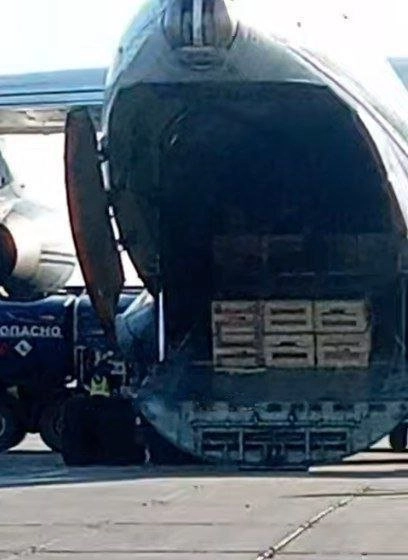
Over the week, it seems like the Russians using infantry infiltration picked up small, farm-field plots of ground in the Kupyansk/Kharkiv sector, Lyman/Serebriansky Lis sector, and the Pokrovsk/Toretsk sectors. The probing into Ukraine’s Sumy region is continuing – the Russians say they are succeeding, the Ukrainians say they are killing everything that moves. Attached is, illegal Russian internet image of a Russian I-76 cargo jet filled with coffins, Friday, Orenburg.
Apropos of that, attached is an excellent image from the Russian military internet, it is from the Kostyantynivka sector, so Pokrovsk area of operations, depicting a courier serving with the 33rd Motor Rifle Regiment, 20th Guards Motor Rifle Division. Image uploaded on April 8, I read.
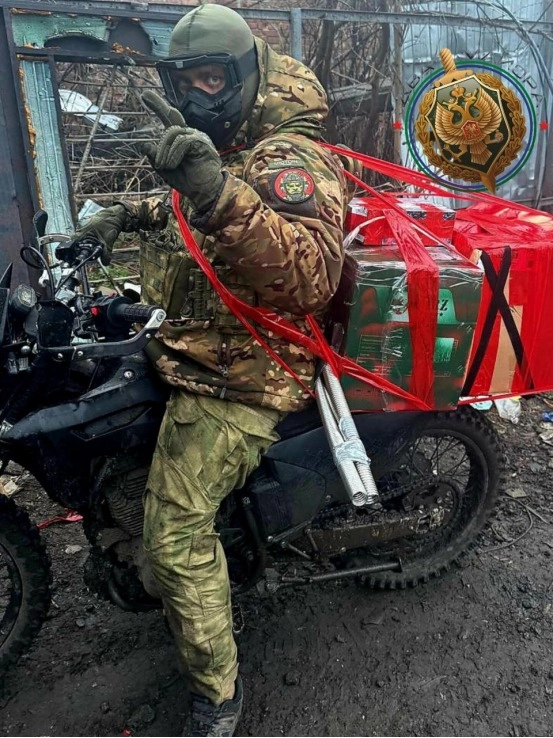
This is a pretty good illustration of modern war: Soldiers may dig in and jammers may be set up and anti-drone nets erected, but, you can’t have a front line unless your soldiers get food, water, and ammunition, and if drones are watching the supply routes then driving like hell on a motorcycle is one way – albeit a far from a perfect way – to get the beans and bullets through.
Elsewhere, the Ukrainians seem to have taken ground back in the Velyka Novoselivka and (eastern) Zaporizhzhia sectors. There have also been increased fire and drone strikes in the western Zaporizhzhia sector back and forth across the Dnipro River. There are claims of ground gained on both sides.
HUR Isn’t Upbeat on the Russian Economy
Ukraine’s national military intelligence directorate, HUR, is, as spy agencies go, forthcoming with information about operations and estimates about the enemy, which for the past decade or so has been the Russian military.
But evaluations about how the Russian economy is going, or how Russian society is holding together, and what’s the state of play in Kremlin internal snake pit politics, they don’t talk very much about that.
In general, I’ve found their information, when they give it, to be reliable.
On Friday, HUR economists pulled back the secrecy veil on their area of study, or maybe they figured Bloomberg needs the competition, or maybe the hearts and minds of people decided it was worth it to make the information public.
In any case, thanks to Ukraine’s army spy agency, we have a new readout of the state of the Russian economy. They used the same numbers the commercial agencies did – figures from Russia’s Ministry of Finance, but the readout, for better or worse, isn’t a news agency, it’s HUR.
Bottom line, the Russian national budget may triple in 2025 and reach $45 billion or 1.7% of GDP. Inflation will go from 4.5% to 7.6%, and the real inflation rate – now at about 10% – will go higher than that.
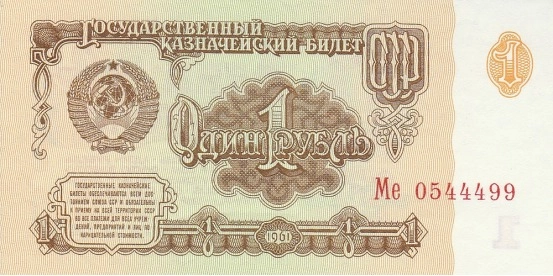
These not-maximum figures are already triple what the official 2025 state budget forecast. If they come to pass, it will be very dangerous for a country that can’t print currency other countries want – and this is a good place to remind everyone that “wooden ruble” (Ru: Деревянный рубль) is an expression that dates back to the Tsarist era. Image of a Soviet one ruble bank note.
The reasons are sanctions’ effect, overheating economy with too much government spending and not enough commerce, reduced from Russia’s big oil export markets, China and India, and even worse, falling oil prices. As noted in previous reviews, estimates vary, but rough figures somewhere between one-quarter and one-third of the entire Russian state budget is from oil and gas export sales.
The Russian budget is currently building its spending planning on a base of $56/bbl for oil exported, which is a serious drop from $69 in 2024. Since prices are falling to cover state expenditures, the Kremlin has the choices of raising taxes, cutting support to the military, or, short term, printing money and trying to deal with the inflation later.
The writing is so seriously on the wall, that the Finance Ministry isn’t even planning for the previous figures to stand, it already is planning to revise them in September. That is betting things won’t go out of control before then. Moscow food market, 1992 attached.

Currently, Brent oil, which basically is the European price, is sitting at $60 and falling. This is already a four-year low.
Why? Well, according to a Friday Reuters report, Saudi Arabia has decided it is tired of losing revenue by restricting production so that higher-cost producers can have share of the world market and OPEC can keep on pretending it controls world oil production volumes, and as the cheapest producer of oil in the world, it’s time to squeeze high-cost producers out and grab more market share for the Kingdom.
As an aside, this is almost certainly driven by the White House’s declaration of tariff war with the world and economic contraction for everyone, but that’s not the point.
What is the point is that, per Reuters, Riyadh is so mad at Kazakhstan and Iraq for violating OPEC quotas that Saudi Arabia has decided to open pumps and depress prices worldwide. As far as Saudi Arabia is concerned, if there’s falling demand and flow volume stays unchanged, that will ruin the higher-cost producers faster and earn the Saud family more money more quickly. After all, oil comes out of the Saudi desert at about $10/bbl.
As another aside, the world’s biggest oil exporter, the US, depends on oil costing at least $55 because that’s the at-best break-even figure for US producers, who get their oil after much work and expense fracking shale and reworking old wells. So now is not a good time to buy a house in Dallas or Albuquerque.
For Russia, that kind of future isn’t even a question of producing oil profitably (I’ve seen estimates that the out-of-ground production cost is $20-40), but rather, how much will Russian oil have to be discounted, in order not to lose significant market share to the Saudis?
Equally worrying, if the world economy tanks, how much less Russian oil will China and India (and Europe) consume? Image of difficult cold conditions in which Russia produces much of its oil.
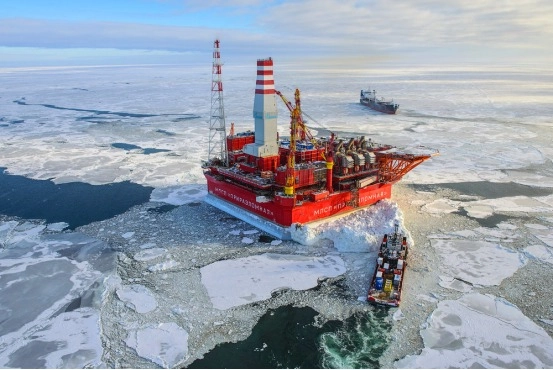
This is not a scenario that points to the Russian economy collapsing by September. But it is pointing to big problems that are already causing social problems, and that are going to get worse and worse.
Bonus at the End for Airplane Geeks
This week my newspaper did two pieces on air traffic via Rzeszów Airport, among which was a monster – An-140 loaded with F-16 fuselages – and a bunch of other stuff. For the non-aviation-minded the important factoid is that US military deliveries seem still to be coming in for Ukraine, but at limited volumes.
Mothballed US F-16 Fighters Dispatched to Ukraine
ANALYSIS: Military Cargo Flights to NATO’s Rzeszów Poland Hub Are Spiking
LATE ADDITION: On Friday evening, news came down the pike that the US has agreed to sell to Ukraine $310 million worth of training and related equipment for F-16 fighter jets, including aircraft modernization, maintenance, repairs, spare parts and ground equipment.
All in all I take this to mean the F-16s the Ukrainians are operating will be maintained in Romania and Poland like other NATO F-16s. This is not full-on US active support to Ukrainian independence, this is the US DoD graciously agreeing to accept European money, particularly Dutch, donated to Ukraine in the past. But it’s better than an embargo.
Also, news wires were reporting US is “preparing” new economic sanctions against Russia.
Reprinted from Kyiv Post’s Special Military Correspondent Stefan Korshak’s blog. You can read his blog here.
The views expressed in this opinion article are the author’s and not necessarily those of Kyiv Post.
You can also highlight the text and press Ctrl + Enter