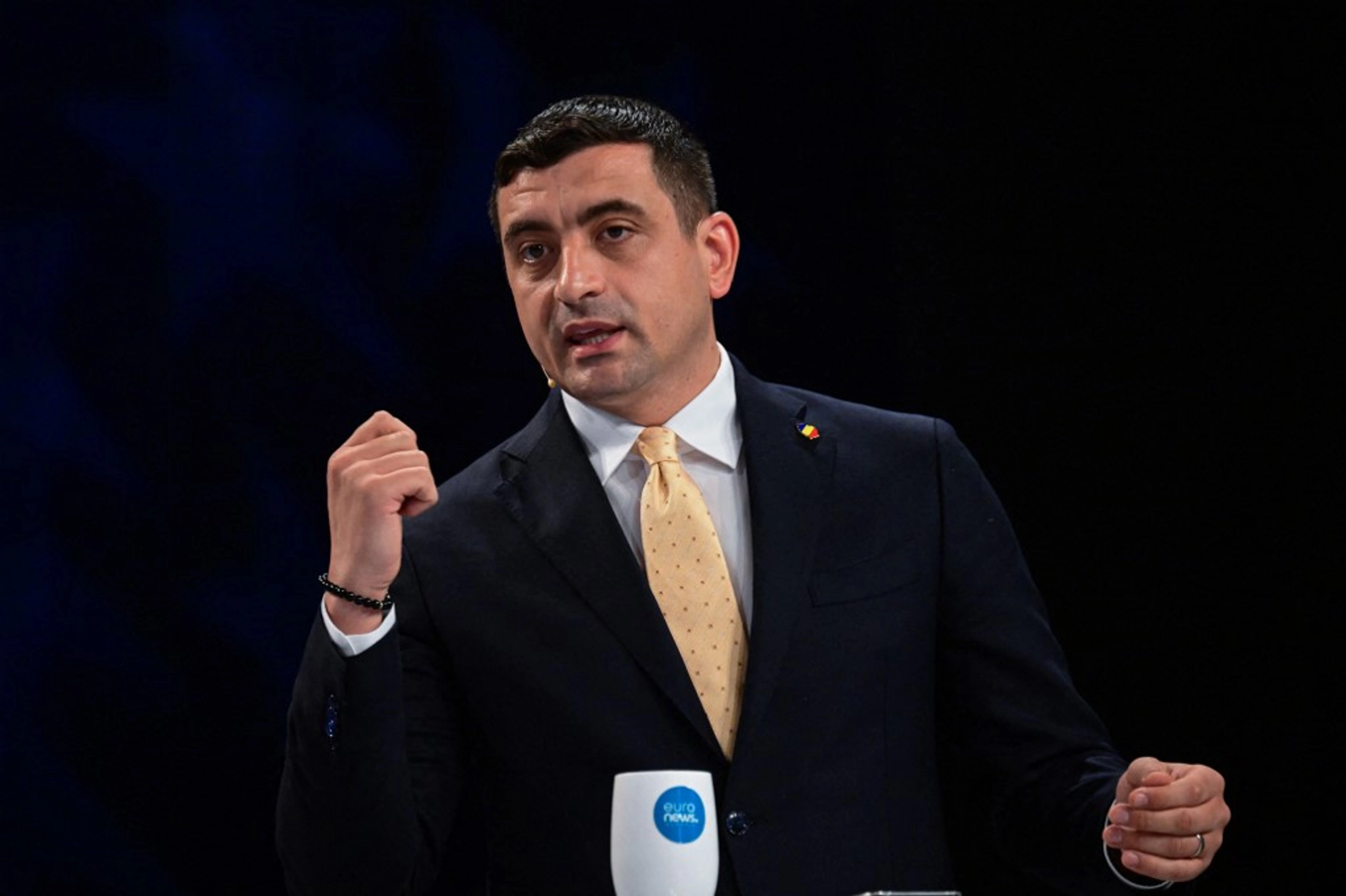
The European Union is bracing for yet another far-right politician to join the 27-nation club of leaders, with George Simion the favourite to win Romania’s presidential election on Sunday.
Yet, while many in Brussels are wary of Simion’s brand of politics -- the nationalist eurosceptic is a big fan of US President Donald Trump -- there is also a keenness not to overplay the impact of a potential victory.
JOIN US ON TELEGRAM
Follow our coverage of the war on the @Kyivpost_official.
“It wouldn’t be good news to have a Europhobe but that doesn’t mean it’s going to bring the (EU) machine to a standstill,” said one European diplomat.
The vote will be closely watched internationally following the rare annulment of last November’s election in the key NATO country of 19 million people.
“Naturally we all keep an eye on that,” said another European diplomat.
Simion gained almost 41 percent of votes in the contest’s first round -- double the score of his rival in Sunday’s run-off, pro-EU centrist candidate Nicusor Dan.
His victory would boost the EU’s nationalist camp, already championed by the likes of Hungary’s Viktor Orban, Slovakia’s Robert Fico, and Italy’s Giorgia Meloni.
“The populist side will rejoice in having a new unruly kid on the block,” said Florent Parmentier, a political analyst at the Jacques Delors Institute, a think-tank.
- ‘Not Hungary’ -
Ahead of the vote, Simion burnished his hard-right credentials meeting Meloni in Rome and Poland’s outgoing conservative President Andrzej Duda in Warsaw Wednesday.
Hungary Rejects EU Plan to Exclude Ukrainian Men of Military Age From Temporary Protection
And on Thursday, the 38-year-old presidential hopeful was mingling with right-wing European lawmakers in Brussels.
While the presidential office is largely ceremonial in Romania, the president does represent the country at EU leaders’ summits.
Opposed to any military aid to Ukraine and a critic of the “absurd policies” of the bloc, Simion would thus wield veto power on key foreign policy or defence topics -- something Hungary’s Orban has long been using to the irritation of other members.
Yet, “Romania is not Hungary”, cautioned the second European diplomat. “Neither internally, with regard to state capture of media... nor externally, with regard to its willingness and ability to take a stand against the EU mainstream”.
And Simion is “much more in the business of denouncing Brussels, and a group of technocrats, than the European Union” itself, added Parmentier.
The European Commission, the bloc’s executive body, for its part, has adopted a cautious stance.
“There’s still going to be a second round, allow us not to speculate on what might happen or not happen in the future,” said commission spokesman Stefan de Keersmaecker.
- Nationalist’s Ukraine-sceptic stance seduces Romanian border region -
In the Danube Delta in Romania, near the border with Ukraine, a pledge by nationalist presidential candidate George Simion’s campaign to stop aid to Kyiv has fallen on fertile ground.
The far-right leader, who goes into a second-round vote on Sunday, advocates Romania becoming “neutral”, cutting military aid to Ukraine, and to have Kyiv pay up for Bucharest’s contributions so far.
“Simion is right. We have to mind our own business, not those of other people,” said one Delta local, Lavinel Florea, owner of a guesthouse and a fisherman.
“He is patriotic. He is young. He wants to do something.... And for sure, he will not get us into war,” Florea, 39, told AFP in Dunavatu de Jos, one of several villages in the Murighiol administrative area.
Simion performed better in the Delta region than anywhere else in Romania. In Murighiol, some 50 percent voted for the nationalist, almost 10 percentage points above the national average.
The ardent Donald Trump fan, who has at times sported a MAGA cap while campaigning, has also called for Ukrainian territories to be returned to Romania, something that has earned him a ban on entering Ukraine.
In Sunday’s run-off he faces Bucharest’s mayor Nicusor Dan, who is solidly pro-EU and who opinion polls suggested had recently closed the gap on his rival.
Dan has vowed to continue support for Ukraine, saying a Kyiv capitulation would be “the worst-case scenario”, and urging voters to reject Simion’s “isolationist” approach.
While several locals told AFP the war played no role in their political choice, others said they were afraid Romania could end up being dragged into it.
These fears have been amplified by Simion, who during a TV debate last week appealed to mothers to do everything possible “not to send their children to war”.
You can also highlight the text and press Ctrl + Enter

EU Investigates von der Leyen Over Zelensky Chat
Baltic States Urge EU to Accelerate Russian Oil Ban