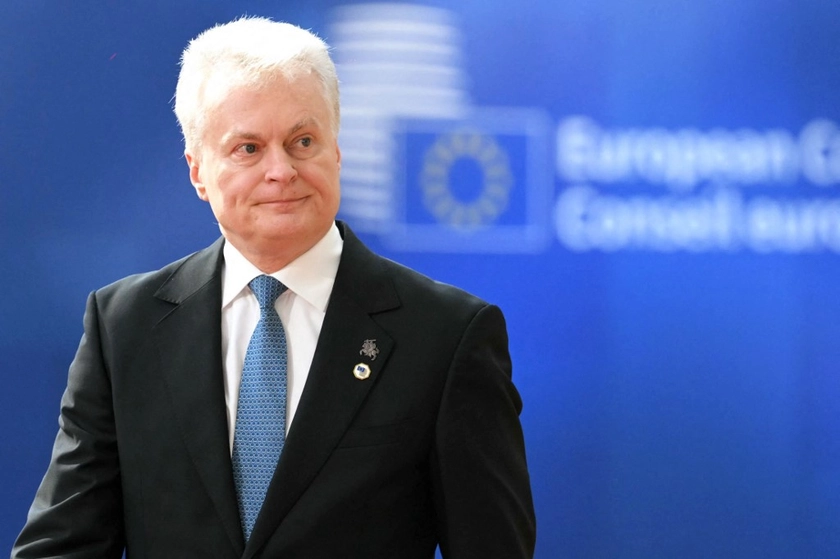
At a meeting in Vilnius on Sunday, Lithuanian President Gitanas Nauseda and his German counterpart Frank-Walter Steinmeier discussed support for Ukraine, increasing pressure on Russia, and defense cooperation.
“Discussed Lithuanian-German close cooperation on defense, support for Ukraine, pressure on Russia, and strategic investment in military mobility with President Steinmeier. Germany remains a key ally in ensuring security, resilience, and peace in Europe,” Nauseda wrote on social media.
JOIN US ON TELEGRAM
Follow our coverage of the war on the @Kyivpost_official.
Steinmeier, for his part, stated that Germany’s decision to deploy a military brigade in Lithuania represents Berlin’s commitment to the country’s security.
“By stationing a German brigade in Lithuania, we are making a long-term promise: your security is our security. This new brigade underscores our shared responsibility and demonstrates our commitment to the Alliance. We understand that defending Lithuania means defending Europe and European values,” Steinmeier said during a flag-raising ceremony on July 6.
In summer 2022, Berlin pledged to deploy a military unit of brigade strength to Lithuania. In total, around 5,000 German troops and civilian personnel are expected to be relocated, with some arriving with their families.
The majority of the brigade is expected to be stationed in Lithuania by 2026. According to German Defense Minister Boris Pistorius, the brigade is expected to reach full operational capability by 2027.
Syrsky: Russian Maps Show False Advances to Please Top Command
The brigade’s permanent base will be located at a military training ground near the towns of Rudninkai and Rukla.
Separately, Berlin has confirmed that German Chancellor Friedrich Merz will take part in the Fourth Ukraine Recovery Conference (URC2025), to be held in Rome on July 10 and 11.
Government spokesperson Stefan Kornelius announced Merz’s participation on July 4, noting that the Chancellor will speak at the high-level opening session and hold a series of bilateral meetings on the sidelines.
“At the conference, he will present Germany’s support for reforms in Ukraine, as well as efforts to strengthen the country’s economy and society in preparation for reconstruction,” Kornelius said.
The goal of the Rome summit is to rally broad international support for rebuilding Ukraine, with a focus on mobilizing investment, developing skilled labor, and boosting the private sector.
The event will build on the outcomes of previous recovery conferences, including the 2024 summit in Berlin. It is expected to highlight reconstruction as a task for society as a whole, drawing participants from governments, civil society, business, international organizations, and local communities.
Also attending will be German Minister for Economic Cooperation and Development Reem Alabali Radovan.
Her ministry’s spokesperson, Katharina Koufen, emphasized the urgent needs in Ukraine, including housing and infrastructure for over 300,000 internally displaced persons.
“There’s a critical shortage of skilled workers, as many Ukrainians are either on the front lines or have fled abroad. To address this, we’ve launched a skilled labor alliance and are supporting small and medium-sized enterprises to keep the economy going. We’re also backing Ukraine’s energy supply,” Koufen said.
Discussed 🇱🇹🇩🇪 close cooperation on defense, support for Ukraine, pressure on Russia, and strategic investment in military mobility with President Steinmeier.
— Gitanas Nausėda (@GitanasNauseda) July 6, 2025
Germany remains a key ally in ensuring security, resilience, and peace in Europe. pic.twitter.com/0hJuqpLZl7
You can also highlight the text and press Ctrl + Enter

OPINION: The New Line Kyiv Quietly Built Into NATO