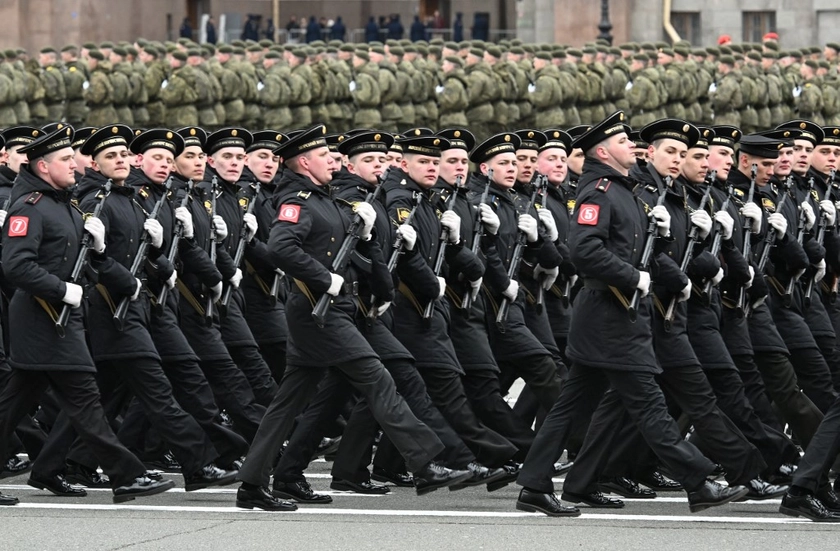
Friday was the day of the “Big Summit” between Putin and Trump in Alaska. It was a dumb piece of theater that will have no effect on the war, so last week’s plan AFAIAC holds true here: Ignore it, it’s a waste of time, the whole thing is an insult to a reasonable person’s intelligence.
As if to prove my point, the internet yesterday barfed up an absolutely embarrassing, lickspittle video profiling US-Russian friendship. Two screen grabs attached. I observe that in the present times we live in, we cannot be sure that the video was produced in the White House or in the Kremlin.
JOIN US ON TELEGRAM
Follow our coverage of the war on the @Kyivpost_official.

However, in real war news, it’s been quite an eventful and interesting week. There was the Russian “penetration” in the vicinity of Dobropillya and Pokrovsk. It gets its own section lower down. I think there are some interesting conclusions to draw but, to anticipate things, I’m in the “Don’t panic I’m pretty sure the ZSU [Ukrainian military] has this” camp.
For me, without question, the main development of the week has been the intensification – yes, intensified from last week, which was an intensification of the week before – of the Ukrainian deep strike campaign against Russia. Ukraine has been hammering the Russian Federation – there’s really no other way to put it. As you read the next section, ask yourself: How much is the scale and ambition of this bombardment reaching news feeds outside Ukraine?
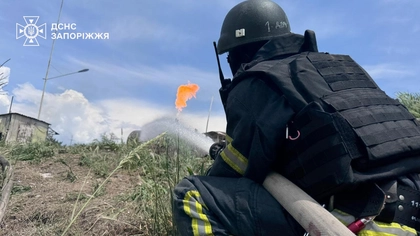
Russian Guided Bomb Strike Kills Three in Zaporizhzhia
Still, first respect needs to go to the ground guys, so attached is an official image of a British Challenger 2 tank doing something in Joint Forces Dnipro’s sector.
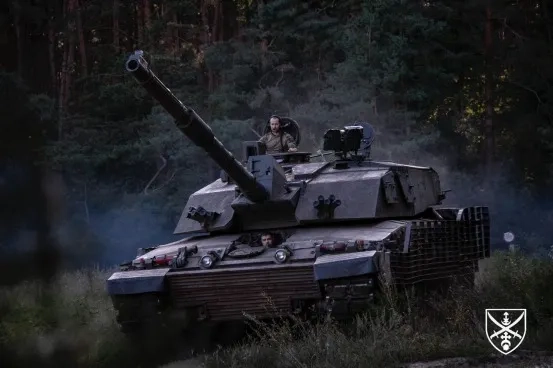
Blam Blam Blam Blam Blam Blam
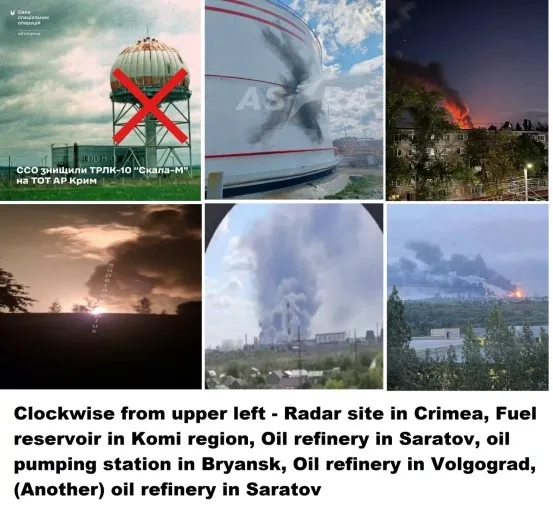
This is not exhaustive, but below is a laundry list of what Ukraine’s long range attack assets — this is the Security Service of Ukraine (SBU), Ukrainian Military Intelligence Agency (HUR), 14th Unmanned Aerial Vehicle (UAV) Regiment, and Ukraine’s Missile Forces Command — have been up to this week (Combined graphic shows about six images recorded 100s and sometimes thousands of kilometers apart across Russia this week):
Thursday, Aug. 7 (technically more than a week ago but useful reference)
- Krasnodar Krai, Afipsky oil refinery, massive fire, long-range drones.
Friday, Aug. 8
- Krasnodar Krai, Afipsky anti-aircraft installation, 90th Air Defense Brigade, fires, probably drones
Saturday Aug. 9
- Shahed drone warehouse “Deng Xioping” Tatarstan, Kzyl-Yul near Alabuga, up to 45 (!) drones attacking, building fires.
Sunday Aug. 10
- Krasnodar Krai, Slavyansk-na-Kubani, air defense very probable target, maybe drones.
- Crimea, Saky airfield, TRLK-10 Skala-M radar complex, Ukraine special ops and drones involved.
- Komi Region (by Arctic Circle), fuel storage plant, big hole punched in a storage tank by long-range drones.
- Saratov, oil refinery hit, cracking tower and reservoir destroyed, massive fires. Long-range drones.
Monday, Aug. 11
- Arzamas, which is producing Kh-32/Kh-101 (cruise missile) components, Nizhny Novgorod. Strike by long-range drones. Corporate announcement reports two hits to an assembly building, one hit to a manufacturing building. One dead, three injured.
- Millerovo airfield vicinity, Rostov region, possible drone shoot-down. Theory is air defense attacked, but little hard evidence.
- Orenburg, West Siberia, helium plant critical for missile, space and aviation tech hit, only such plant in all Russia. No info on damage.
Tuesday, Aug. 12 (120–150+ drones reported, a possible record)
- Repeat strike from July vs. Monokristall, Stavropol, military electronics. Fires.
Wednesday, Aug. 13
- Unecha oil pumping station (Druzhba pipeline), Bryansk region, substantial fires, six (!) HIMARS strikes
- Unspecified target, Tartarstan Republic
- Yaroslav, paint factory catches on fire, not clear if this was drones or something else.
- Southern front, Dnipro shore, Melitopol, Tokmak, Berdyansk — massed HIMARS/Hrim strikes? Little info on damage.
Thursday. Aug. 14
- Volgograd oil refinery, multiple hits, two big fires
- Rostov city, kamikaze plane hits a two-story office building or apartment building
Friday, Aug. 15
- Yenakivo, Donetsk region. Really powerful explosion inside city. Missile (s) widely suspected. Ukraine General Staff by midday reports target was HQ for 132 Motor Rifle Brigade 51st Combined Arms Army.
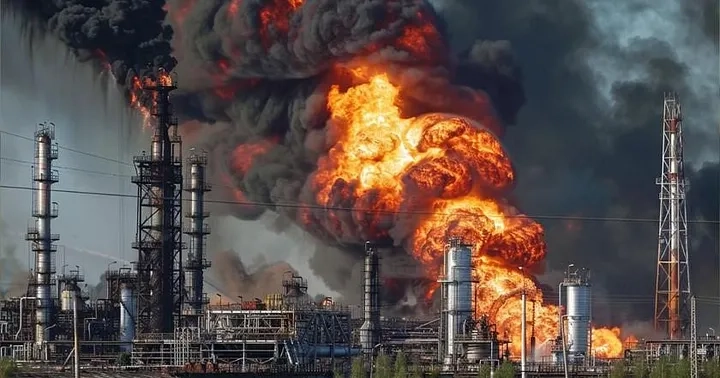
- Syrzan oil refinery, Samara region. At least four hits, two big fires, one very big fire. Long-range drones.
- Ryazan region, plastics and gunpowder factory blows up, five dead, 100+ injured, info still coming in. Russians are saying it was an accident, a worker supposedly disobeyed safety rules.
Also on Friday, there were two more strikes that deserve their own sub-section:
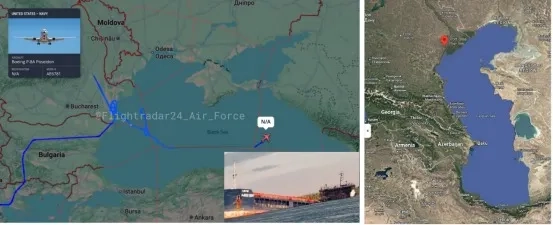
- Olya seaport, Astrakhan region. Shahed storage site, this for sea deliveries from Iran. Ukraine’s special ops claims a ship named “Port Olya 4” was hit and sunk. Inset image. That’s right, this in the Volga delta on the Caspian Sea. Map. The Ukrainian drones came at their target, I read, from Azerbaijani (!) airspace.
The official statement from the Astrakhan governor (who possibly did not see the photograph of the sunk ship in his news feed) was: “UAVs were suppressed by electronic warfare or destroyed. There were no casualties. No damage was caused to the port infrastructure. As a result of countering the attacks, a ship was damaged by debris from the downed UAV.”
- Port Kavkaz, Taman peninsula, big fire. Possible targets are the fuel storage base and the ferry terminal. As I write this, still not clear what got hit, but, air defenses are strong in that area (Kerch Strait) so best to be skeptical on this one.
NOTE: A US Navy Poseidon, you know, the sub and surface warship hunting plane, was over the eastern Black Sea effectively immediately after these two strikes went in. By my calculation, the squids aboard the Poseidon probably were able to watch the Port Kavkaz strike in real time, front row seat. I doubt the Kremlin was pleased. Map.
ADDITIONAL NOTE: On Friday, there was confirmed use of jet-propelled drones by the Ukrainians, by reports, the most likely target being the Syrzan refinery.
YET ANOTHER ADDITIONAL NOTE: On Friday, the Russian Federal Security Service (FSB) published a warning saying Ukraine is now operating the surface-to-surface missile Sapsan (roughly, this is the Ukrainian version of Iskander-M), which can reach out to 750 kilometers (466 miles) and has a maneuverable re-entry vehicle/warhead.
The main qualification to make before going on to observations and conclusions, is that the Ukrainians have to maintain this strike pace or intensify it, for the bombardment to have a long-term effect.
But, that being said:
- My back-of-the-envelope estimate, west and central Russia just lost about 15% of their gasoline, diesel, and lubricants capacity, in the space of a week. Last week they lost 6-8%, this is in addition to that. This is bad for the Russian state budget, and if it continues, it’s disastrous.
- Russian air defense resistance to these strikes has been visibly weak. In I would say 2/3 of the foregoing attacks, Russian air defense has been dudes with AKs — or nothing. It’s anyone’s guess as to why. Maybe the Russians are running low on proper air defense systems, maybe the Ukrainians have figured out a way to make their drones harder to detect, and maybe the Ukrainians are getting better intelligence on where the Russian air defenses are, so as to avoid them.
- I am willing to bet the ship strike got a big assist from US intelligence, which received the actual ship location and cargo from Israeli intelligence. But I can’t prove it.
- Going the other way, this week the Russians have been restrained, sending 40-100 Shaheds each night, about half the time with one or two ballistic missiles. So a very modest bombardment if you count launching robot planes with explosives at a peaceful country as “minimal.” All Ukraine is convinced the Russians are saving up missiles and Shaheds and they will cut loose after the Alaska talks.
- If Russia doesn’t do something to stop this, and again, providing Ukraine keeps obtaining/building more drones with which to attack Russia, then the Kremlin already is facing an honest-to-Douhet threat to its war-making and income-generating capacity. Theoretically, at this pace of strikes, Ukraine is on track to shut down the great majority of Russia’s oil processing capacity in four to six months.
- I’m not predicting the shutdown and it’s logical to expect a point of diminishing returns for the strikes. But so far, what Ukraine has been doing to Russian energy infrastructure is way beyond pin-pricks, and for the past three weeks, it has ramped up every week.
- A serious barrier to the Russians’ dealing effectively with that threat is that military and civilian institutions must admit to themselves, to the public, and to Putin that the threat exists and that Ukraine poses a real danger to Russian energy production. As we have seen, Russian institutions very much prefer pretending Ukraine is weak and Russia can do whatever it wants.
- Yesterday, I saw a report that gasoline was running short in Crimea which, as we have seen, is the first place to see price spikes and shortages when stocks run short.
- Today, the SBU estimated Ukrainian strikes against Russia’s oil and gas infrastructure have probably cut Russian GDP by 4%. That’s probably optimistic, but it certainly is a window into the Ukrainians’ way of thinking.
The Great Russian “Breakthrough” at Dobropillya and the Pokrovsk Operational Threat
This section leads off with an image of a pretty soggy bit of the Pripyat marsh, in west Belarus, in lowlands drained (not very efficiently) by a waterway called the Drut, or Druts River. I think some military history that took place there a little more than 81 years ago is massively relevant to Russian offensive operations right now, and the “Dobropillya breakthrough” in particular.

But be warned, this is a historical side-trip; you have to actually like reading and military history for it to be worth your time.
If you just want to get updated, here are links to the situation as it looked on Monday, and a follow-up published on Friday.
OK, way back in June 1944, the Red Army was fighting the German army, and the Red Army was up against some real tactical disadvantages. Soviet troops were less well-trained, Soviet officers were an order of magnitude less professional than their German counterparts, the Germans were defending, the Germans had more sophisticated and higher-tech weapons, and the Germans were fighting with the knowledge that if they failed, the Russians would physically invade Germany.
The Soviets had the superior numbers, capacity to take casualties, the classic Russian advantage that Russia can win wars against more sophisticated opponents, and a military tradition of seeking unconventional solutions to conventional military problems.
In one piece of the Red Army at that time, a major formation called 1st Belorussian Front, and for our purposes the more interesting tactical formation 3rd Combined Arms Army (commander Lieutenant General Alexander Gorbatov, pictured) were facing the problem of how to break into prepared German defensive positions, that were heavily fortified, in a section of the Pripyat Marshes (then called Pripet) and not just defeat the Germans, but do it quickly and decisively enough for the Red Army to pour tanks through the gap and charge into Poland. The main defending unit in the sector, 134th Infantry Division, was a longstanding, combat-seasoned Wehrmacht formation that had been digging in for months. However, this being World War II, the 134th was short personnel.
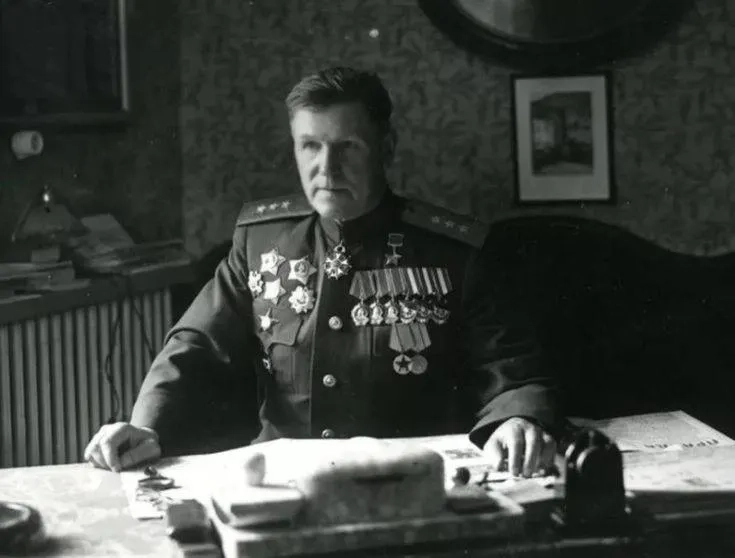
General Gorbatov and his staff thought about how to attack and concluded the right approach was massed infiltration of German positions by Red infantry, usually by walking through the nastiest, wettest terrain they could find.
Since major units, say a battalion of 500 men, couldn’t sneak anywhere even in a swamp, the solution chosen by 3rd Army was to push men forward in small groups, even by twos and threes depending on where the Germans were, and then once past German frontline positions, the small teams would coalesce into groups, and the groups would have simple but important missions like grabbing crossroads, preventing bridges from being blown up, and shutting down German supply routes. The idea was that when the big offensive kicked off, the Germans on the frontline would be isolated, and the Germans in the German rear areas wouldn’t know what direction to fight in. Then, when Soviet tanks rolled, they would pass through cleared minefields and across bridges secured by 3rd Army infantrymen.
D-day for the big offensive (Operation Bagration) was June 22. So the infiltration started three weeks before that. When the Soviets launched their big attack to break the Drut River line, it was wildly successful; German defenses collapsed, 1st Belorussian Front’s tanks reached Poland in a week, and 3rd Army got promoted to 3rd Guards Army. Their attack became, in Russian military history, one of the greatest examples of a drip-drip infiltration into an enemy position, as a precursor for a major attack, ever. This is why the swampy Drut River image is tied to a heroic Soviet poster of a Red Army reconnaissance man: this is the legacy and history the modern army starts from.
It took place in 1944, but my argument is we can see the exact same tactics in Pokrovsk and Dobropillya, right now. If you want to make an educated guess as to how the Russians got behind Ukrainian lines and what was their intent, my suggestion is read about 3rd Army and the Drut River.
I’ve attached two maps, the first published by Bild when the first reports surfaced that “somehow” masses of Russian infantry had “broken through” 10-15 kilometers (6.2-9.3 miles) or even more behind Ukrainian lines and now unknown numbers of them were raising Hell in the Ukrainian rear areas.
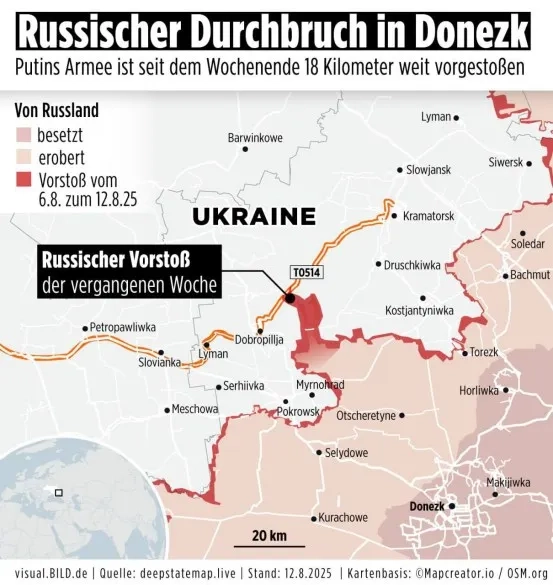
The second map is basically the same terrain and sector, but from Thursday. The black arrows are the Ukrainian counterattacks.
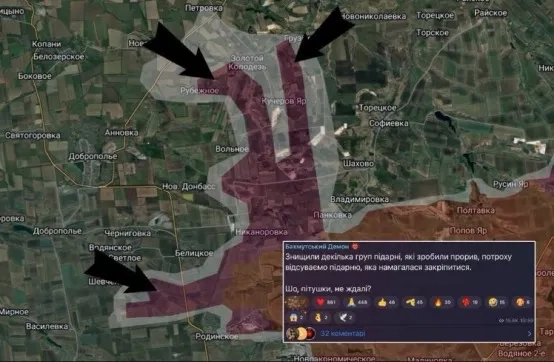
Again, if you’re looking for a detailed read-out of units involved, dudes on the ground commenting, and a general feel for what information is out there, check out the news articles; hopefully the information is laid out clearly enough there.
But for the purposes of this review, the thing I think is worth paying attention to is that the most successful Russian push into Ukrainian lines in at least six months, and if it stands for more than a year, the Russians executed using infantry tactics dating back to the first half of the 20th century – at least. Reports are the Russians picked young soldiers, there were about 300 of them, and they walked for about two weeks before they got to their jump-off positions.
On July 20, we saw a smaller version of this “infiltrate a good-sized unit in bits and pieces with the appearance of “sabotage groups” operating in Pokrovsk. I saw a news report today, published by the Air Assault Corps, that the city is now officially secure from Russians because several solid air assault units combed it out, among them elements of our old friend, the 25th Airborne Brigade.
As to what the Ukrainians are doing now, my count, there are elements of at least six high-performing brigades in the area of this Russian penetration, and my read is the Ukrainians are intent and confident that they will hunt these Russian foot soldiers down. Zelensky today singled out 82nd and 79th air assault, but there are several more including the 93rd Mech and 1st Azov Corps. It’s clear some Russians have surrendered and the Russian plan to supply these guys with drones isn’t working so well.
Friday evening update: Open sources are showing the Ukrainians have sliced the Russian salient into three pieces. Azov alone cleared six villages, which, if I know Azov, means they have two infantry battalions and the UAV battalion in the ground in that sector. I’ve also seen confirmation that 79th and 82nd cleared villages as well. So, unless the Russians can pull some reserves out of a hat somewhere, it looks like the Ukrainians are going to lower the boom on the Russians here.
The question, of course, is what sectors got weakened elsewhere to get the good results in the Dobropillya area.
Ukrainian Assault Infantry: Stosstruppen und v. Hutier Wiederbesucht
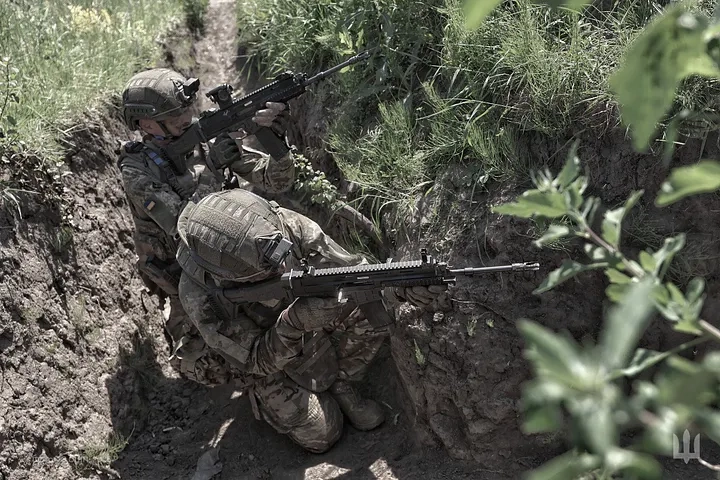
Image of a 210th Assault Regiment patrol, almost certainly in training, from the unit.
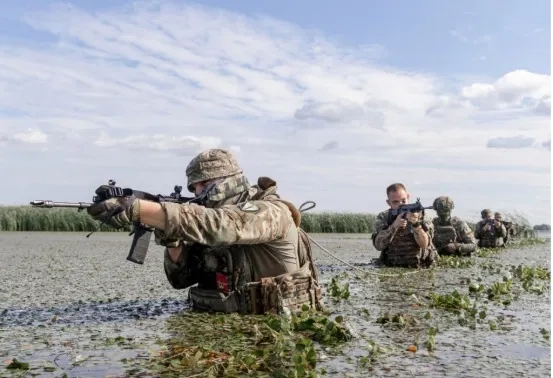
A pretty long-term theme of these reviews and indeed Russo-Ukraine War watchers for about 18 months now, is that with drones so dense on the battlefield that classic armored assaults pretty much aren’t viable because the armored vehicles get swarmed by FPV drones (and equally important, so do the artillery pieces trying to support the armored assault), how can units attack? Is this WWI trench warfare all over again, like the pundits who like to slop around quick and easy explanations say? It’s pretty pat and fun to say the Russo-Ukraine War is endless attrition, but is that accurate? Of course, as we have seen with the Dobropillya operation, the Russians don’t subscribe to the proposition that the Russo-Ukraine War is static and the only way to advance is by throwing soldiers away. Both sides are constantly seeking better tactics and ways to break enemy defenses.
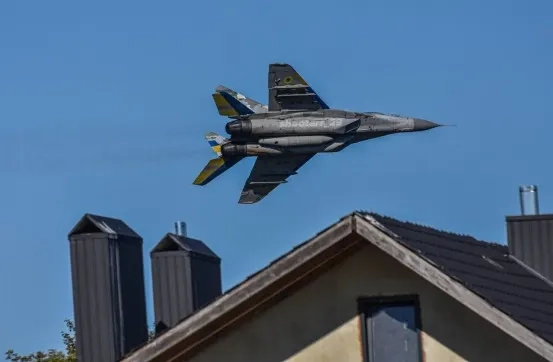
On the Ukrainian side, this week, we saw the combination of assault infantry (a unit specially trained to capture a Russian position) along with drones and artillery working closely with teams on the ground, push the Russians back at multiple locations. It’s careful, well-observed attacking where the infantry doesn’t take a step anywhere until the drones clear the route and hopefully the enemy is found, and in which an actual infantry assault is an option; the commander might paste the Russian position with mortars, he might call in FPVs, he might tell his guys to go to ground so the Russians come out of their holes, and give their positions away. He might even call in a – Ukrainian – air strike, they are taking place, it seems like in Sumy sector there were several this week. Low-level MiG pass image attached.
This is the basic Ukrainian infantry attack doctrine that has evolved in three years of war. Anyone who says the Ukrainians are only defending isn’t looking closely enough. Still, to be clear, by square kilometers grabbed, the Russians won this week, and the Ukrainian gains were limited.
But, in the Zaporizhzhia sector, the Russians got pushed back by Ukrainian assault infantry, and in the Kharkiv-Kupyansk sector, and especially in the Sumy sector, the Russians were pushed out of defensive positions and lost ground and prisoners. There is a report from today – unconfirmed as far as I know – that the Ukrainians have cleared out the entire Russian incursion in Sumy region. Here’s a link to an article from three days ago in that sector.
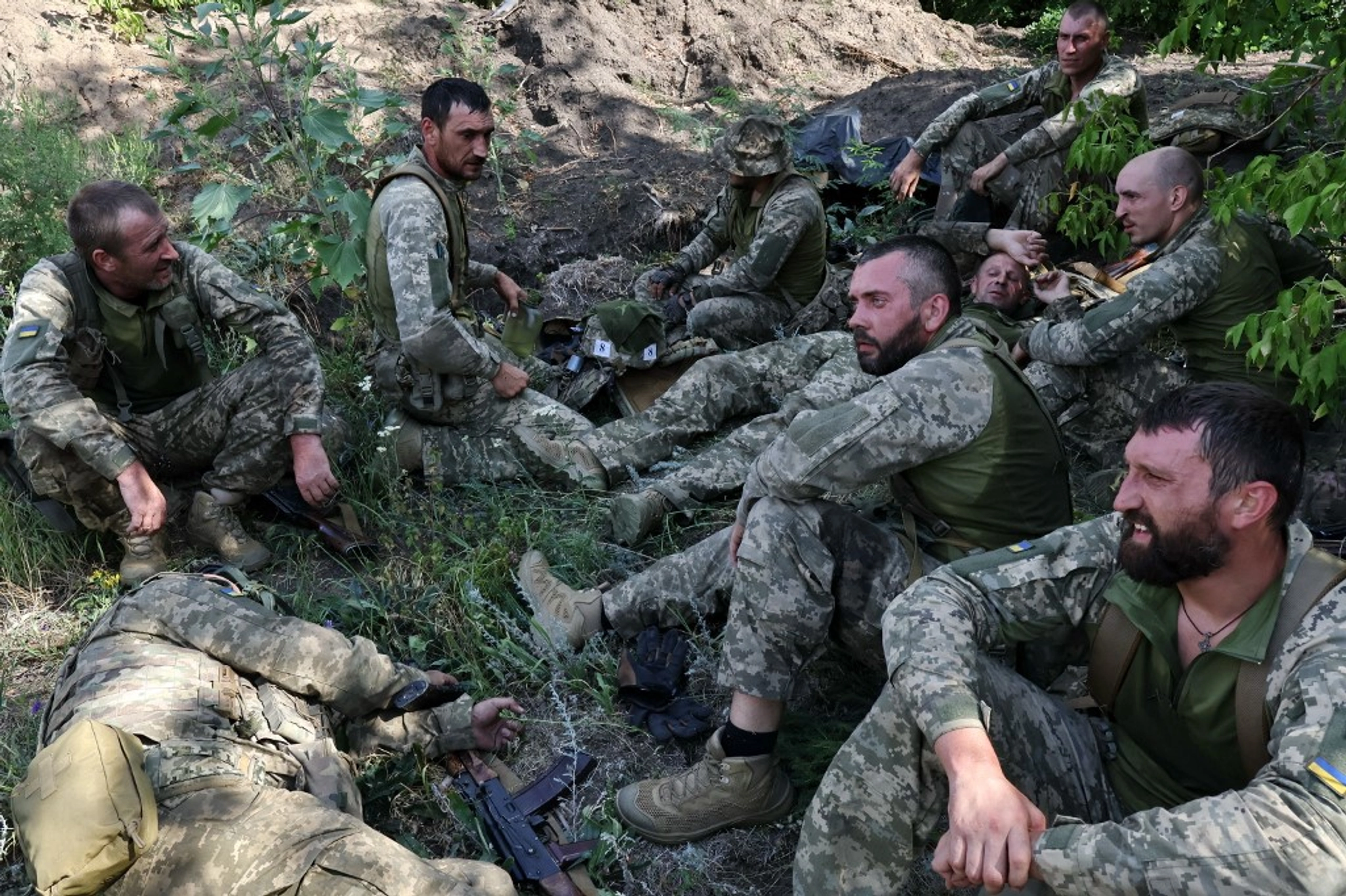
If you read the news feeds it’s clear these assault regiments, or elements of them, are the spear-tips. But I’m seeing reports from regular, conventional units doing the same thing: 128th Territorials, 66th Motorized, pretty much any of the air assault brigades, and of course the usual suspects like 3rd Assault, 92nd Mech, and Azov. Again, this is not to argue the ZSU is about to go over to a general offensive. It is rather to say that both sides are still developing better ways to attack, that process is still very much, er, progressing.
Some Smaller Items You Might Not Have Seen
Kerch Bridge Is Done? — General Maliuk of the SBU on Wednesday said the Kerch Bridge is militarily useless, it’s been hit three times and the Russians aren’t able to move train cars or trucks weighing more than five tons across it.
Over the weekend, a bunch of Ukrainian, mostly young men, decided to unfurl a UPA red-and-black flag at a Polish rock concert. 53 deported. Two platoons.
Saki Radar Hits Confirmed — Discussions about what the Ukrainians did or did not hit with a series of SBU/HUR strikes around Saki airfield in Crimea last week came to an end on Tuesday with the publication of images showing the destruction, by drone, of a very rare and expensive 48YAB-K1 “Podlyot” radar on the edge of the airfield. It seems like the Ukrainians attacked on July 26-27 and got partial damage. This is a radar designed specifically to detect low-flying targets like cruise missiles, and pass on the data to air defense. A follow-up attack on Aug. 10–11 took it out for good.
Upbeat 155mm Shell Production Numbers — On Wednesday news appeared that the Czech-led coalition to deliver shells to Ukraine had met its target of one million shells and that partner nations were committed to keep the ammo coming. Also this week, Germany’s Rheinmetall announced it is on track to set up 155mm shell production in Ukraine and that output won’t be 150,000 shells/year but 300,000/year. Company head Armin Papperger said the main brake at this point is Ukrainian government certifications and permissions. Manufacturing expansion outside Ukraine is accelerating and Rheinmetall hopes to be producing more than a half million shells a year by 2027, thanks to new plants in Germany, he said.
Ukraine support tracker and Kiel Institute renew the data, and what comes next — This week another top US official, this time Vice President JD Vance, complained once again that the US was doing way too much to support Ukraine and Europe wasn’t doing much at all. In a serendipitous bit of timing, our old and reliable source Kiel Research Institute updated its numbers on international support to Ukraine and (again) demonstrated conclusively the US Vice President was lying, in fact Europe is by any measure Ukraine’s most important source of support, and what’s more, for the last six months new US support has been effectively nil.
Su-30SM Down over the Black Sea southeast of Zemyniy — On Friday, reports appeared that an advanced jet hit the water and search helicopters found debris, but no pilot. This is potentially interesting not because of the aircraft loss, which happens to the Russian air force regularly, but because of where the plane went down: in the western Black Sea, not far from Zmeyniy Island. This is normally air space in which the Russian air force operates only with care, because the Ukrainians always could place a Patriot or an IRIS-T on the island, or indeed on a robot boat or a cargo ship (this is the Ukrainians) and ambush the Russian jet. We don’t know why it went down, and so far, the Ukrainian military sources haven’t claimed the kill.
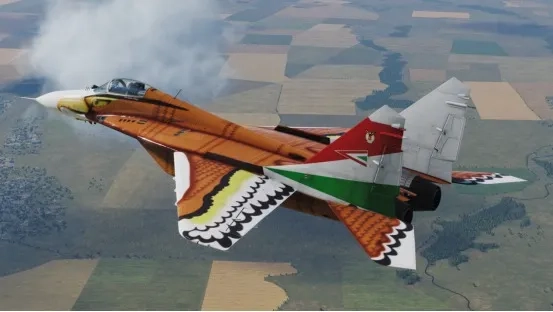
I Wonder Who Broke Into That Hungarian Air Base — Hungarian news platforms (Block and Telex) reported on Friday: “Two weeks ago, unknown individuals stole spare parts from decommissioned MiG-29 fighter jets directly from a military airfield in the Hungarian city of Kecskemét.” This is a base in south-central Hungary. According to the report, someone opened up the “nose” of multiple planes and made off with components, including tracking radars. Hungary supposedly has 28 MiG-29s on balance, but stopped flying them in the 2010s. Ukraine flies MiG-29s, a lot, and probably would love to get its hands on Hungary’s unused MiG-29s, but unfortunately for the Ukrainians, the Hungarian government is loyal to Putin and Russia. It’s about 260 kilometers (162 miles) from Kecskemét and the Ukrainian border, and no, I have no proof whatsoever the Ukrainians were the thieves. But if I were a cop, I would call them suspects with a real motive. Image of a Hungarian MiG-29.
Zelensky Made Public Even More Detailed Casualty Estimates — On Tuesday he told media that in a recent day of combat the casualty rate in personnel was three Russians for one Ukrainian, and more specifically on the day Russian losses were 968 total, 532 killed, 428 wounded and nine captured; while Ukrainian losses were 340 total, 18 killed, 243 wounded and 79 missing. The Ukrainian military blogosphere generally decided that sounds pretty accurate.
I would say the very high Russian killed numbers are without question down to poor Russian medical evacuation, plus, Ukrainian FPV doctrine that targets a soldier’s upper legs and hips: pilots seem to agree this is the most reliable way to inflict injuries leading to major blood loss, and untreated casualties almost always bleed out. The military blogosphere is still debating as to whether 3–1 is Ukraine winning or losing. My take is, it’s proof that if and when Ukraine attacks on scale, the ratio will very likely shift to 6-or-more-to-1 in Ukraine’s favor.
I couldn’t just pick one screen grab from the US-Russia propaganda video, so I added a second one featuring the two countries’ Presidents.

Reprinted from Kyiv Post’s Special Military Correspondent Stefan Korshak’s blog. You can read his blog here.
The views expressed in this opinion article are the author’s and not necessarily those of Kyiv Post.
You can also highlight the text and press Ctrl + Enter