Ukrainian unmanned aerial vehicle (UAV) pilots and ground crews on Thursday, Aug. 21, launched a new round of nighttime drone strikes against Kremlin assets hundreds of kilometers behind the fighting front, in one attack scoring multiple hits on a base belonging to Russia’s army intelligence agency – the GRU.
Attack on GRU compound in Crimea
JOIN US ON TELEGRAM
Follow our coverage of the war on the @Kyivpost_official.
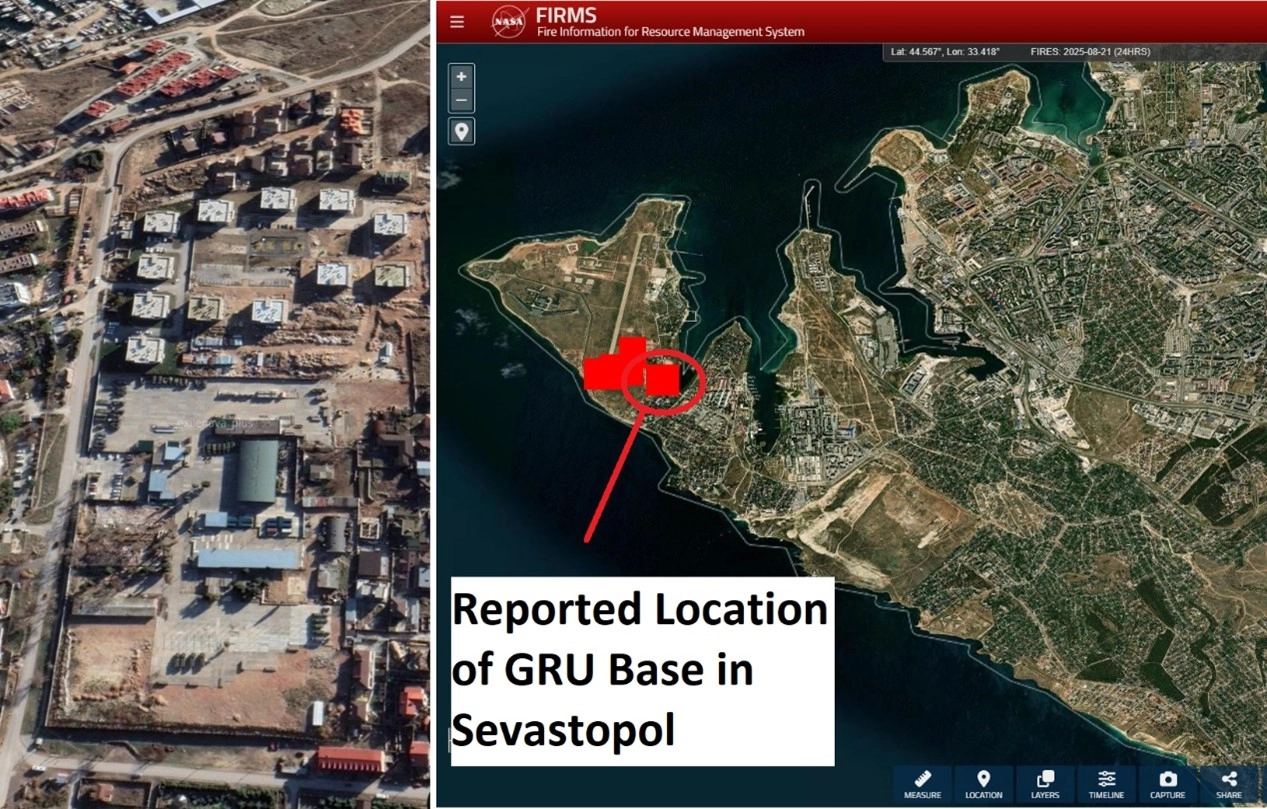
The air raid, by a reported 10-15 unmanned aircraft, per local news reports, attacked a GRU compound adjacent to a military airport in the port city of Sevastopol, in the Russian-occupied Crimea region.
Taken over by the Russian military in 2014, Sevastopol is 300 kilometers (186 miles) from the nearest probable safe sites for a Ukrainian drone launch.
Crimean news feeds and social media reported air defense units in the vicinity firing and two heavy ground explosions within the premises of a closed facility reportedly used by Russian military intelligence operatives. Ukrainian media in 2024, citing pro-Ukraine partisans in Crimea, reported an elite Russian naval reconnaissance unit with the identifier number 95408 being based at the site.
Russian Guided Bomb Strike Kills Three in Zaporizhzhia
Mikhail Razvozhaev, the Moscow-appointed head of the Russian occupation authority in Crimea, in a post placed on his official Telegram channel, confirmed “loud sounds” had been heard in the vicinity of the base and a fire had broken out, adding that emergency responders were en route. Authorities have the situation under control and Sevastopol residents should remain calm, he said.
Most Crimean social media on Thursday posted video and audio seeming to document an actual hit, by that content showing a single heavy explosion with orange flames lighting up the horizon. Still images showed possible ground fires. Russian air defense engagements of unidentified aircraft were reported flying over the Crimean cities of Feodosia and Dzhankoi, each 120 kilometers (75 miles) from Sevastopol.
Some pro-Russia milbloggers claimed the Sevastopol strike was a training exercise.
The NASA-operated world fire watch satellite network FIRMS, showed a hot spot consistent with a major fire covering about 2 square kilometers (0.8 square miles) of ground at the south end of the runway. Other satellite images showed office and storage buildings in the center of the hot spot.
Oil refinery attack in Rostov
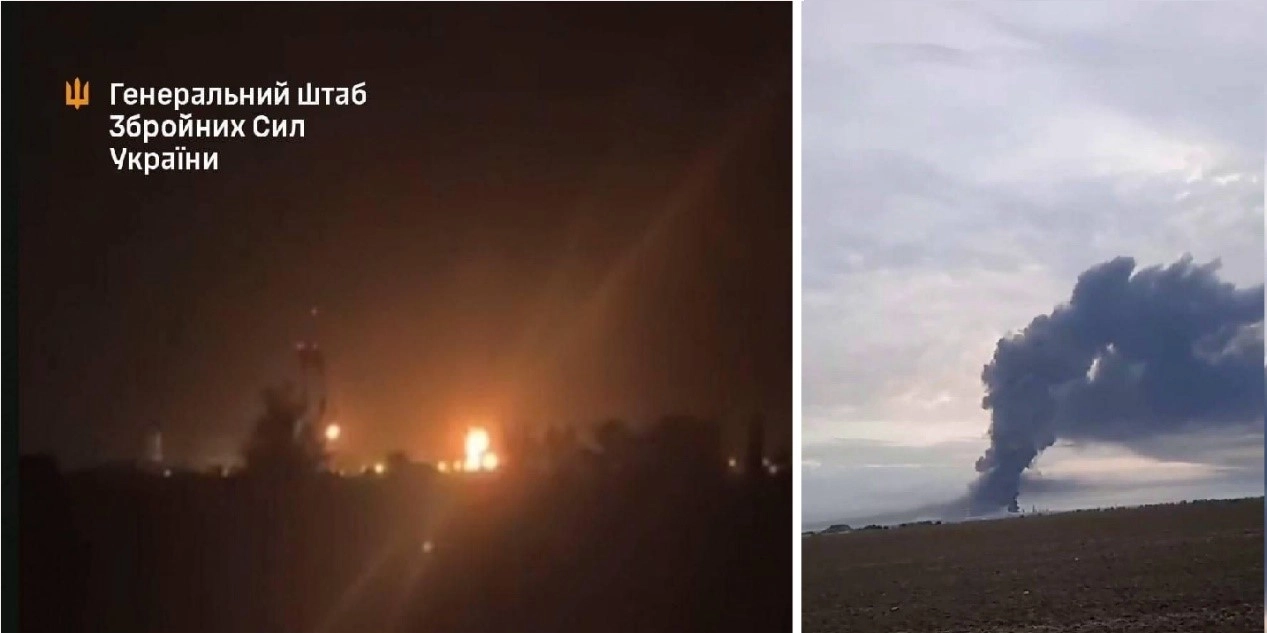
Russia’s mainland region Rostov, a Black Sea shore territory, was the target of a second Ukrainian drone swarm on Thursday, with both official and social media sources reporting aircraft targeting a major oil refinery near the town of Novoshakhtinsk.
Some Ukrainian milbloggers claimed rare jet-propelled drones had made the attack, hitting some 170-180 kilometers (106-111 miles) east of the fighting front, but there was no local confirmation. Ukraine’s General Staff, in a Thursday statement, credited the elite 14th Unmanned Aircraft Regiment for flying the Thursday strike.
Rostov region news platforms reported at least a single ground strike and, after sunrise, showed a single black smoke cloud reaching into the sky for kilometers. Images purportedly recording shortly after the drones struck showed multiple fires burning on the refinery premises.
Ukrainian milbloggers reported two Russian Pantsir short-range air defense systems and one medium-range Tor air defense system deployed to protect the refinery engaged but missed the incoming drones. NASA satellites showed major fires covering about 4 square kilometers (1.5 square miles) in the western half of the refinery premises.
The Novoshakhtinsk plant has a reported capacity of processing 5-7.5 million tons of oil into fuel oil, heating oil, marine and diesel fuel, and straight-run gasoline. Located near Ukraine’s eastern border, the refinery was first attacked by Ukrainian drones in June 2022. Before the Thursday strike, the most recent round of Ukrainian strikes against the plant was on Aug. 16 and 17.
Ukrainian strike planners since early August appear to have opened a campaign targeting Russian fuel processing capacity. By mid-August, fuel shortages and price spikes had been reported in some parts of Russia, and gas stations with no more fuel to sell in a few cities.
In the hours following the strikes, two NATO reconnaissance aircraft were visible operating in the vicinity of Crimea, according to open-source flight tracking platforms. One was a Turkish Air Force Bombardier maritime patrol plane flying a track between the Bulgarian and north Turkish coasts.
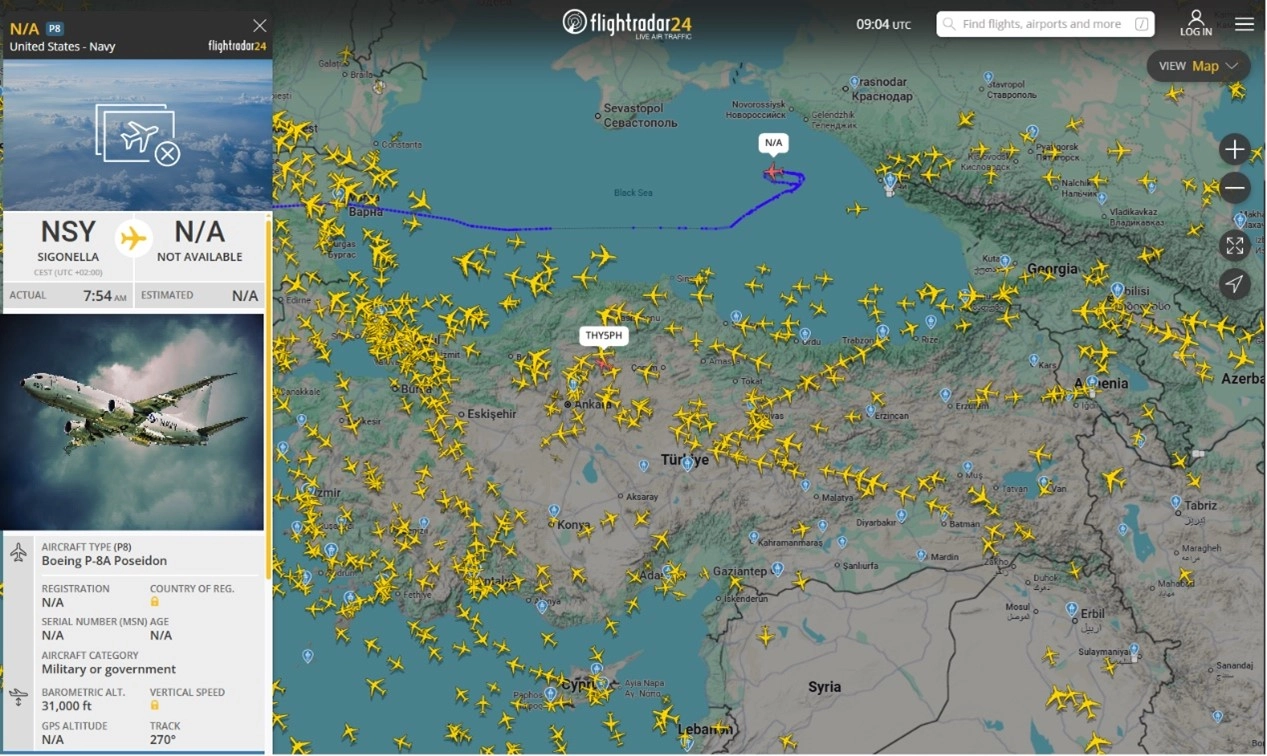
The second was a US Navy Poseidon naval reconnaissance airplane approaching to about 100-110 kilometers from the Crimean coast, and 90-100 kilometers (56-62 miles) from the Russian mainland and the important Russian Black Sea naval base at Novorossiysk.
The Kremlin has accused NATO of passing data collected by Black Sea air patrols to Ukraine’s military for targeting purposes. NATO officials have stated the alliance is not an active participant in the Russo-Ukrainian War.
Railroad infrastructure strike in Voronezh
A third covey of Ukrainian long-range drones hit and damaged railroad power transmission infrastructure in Russia’s western Voronezh region. The overnight strikes hitting in and around a transformer station near the village of Zhuravka. The facility’s main function is delivering electricity to the regional rail network. Local news platforms reported damage to a transformer station and delays to 19 trains transiting the Voronezh region rail network.
According to Ukrainian news media, the Thursday strike was the 17th attack of the war by Ukrainian drone forces against Zhuravka station.
Ukraine’s long-range drone strike planners in July kicked off a campaign targeting both Russian railroad infrastructure and individual trains, particularly in southwest Russia. The likely objectives of those attacks, still ongoing, are to degrade Russian military transport capacity and to inconvenience Russian travelers moving between central and northern Russia, and the relatively warm Black Sea coast resort region.
Russian Defense Ministry statement
According to a Russian Defense Ministry statement, Russian air defenses on the night shot down 49 Ukrainian drones, including 21 over the Rostov region, seven over the Voronezh region, and four over Russian-occupied Crimean territory. That official statement reported a fire linked to a drone shoot down in the Rostov region, and damage to power grid infrastructure in the Voronezh region.
You can also highlight the text and press Ctrl + Enter