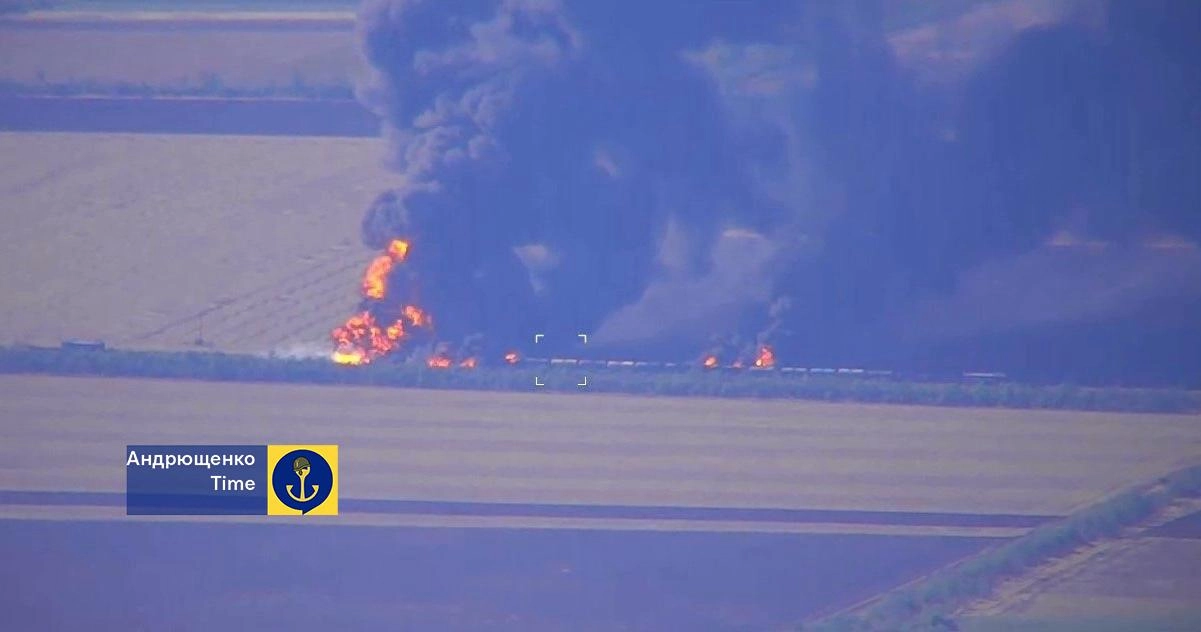
Deep in the open steppe of the Russia-occupied Zaporizhzhia region, on Tuesday, Aug. 19, Ukrainian drones blew up a train hauling at least 30 fuel cars, torching nine of them immediately and igniting a blaze visible from space.
Also on Tuesday, deep inside Russia, near the major city of Volgograd, Ukrainian long-range kamikaze strike aircraft struck a major oil refinery, smashing production equipment and setting multiple fuel reservoirs on fire. It was the second time explosives-toting robot planes had hit that particular facility in five days.
JOIN US ON TELEGRAM
Follow our coverage of the war on the @Kyivpost_official.
Ukrainian milbloggers and mainstream media reported that a train attack took place between the Russian-occupied city of Tokmak and the occupied village of Urozhaine and variously identified pro-Kyiv partisans or operators from Ukraine’s main military intelligence agency HUR as having launched drones.
The train attack
Attacking aircraft first stopped the train’s locomotive. Later, drones blew up individual fuel cars, reports said.
Traffic on the single line right of way was, per both Russian and Ukrainian reports, at a total halt.
Most sources pointed to drone images and precise grid coordinates first made public by Petro Andriushchenko, a Ukrainian government official reporting on military operations and Russian occupation activities in the Zaporizhzhia region.
A Kyiv Post review geo-located the images to that location. The NASA-operated FIRMS world fire watch satellite network, at midday on Tuesday, showed fires burning in the general vicinity. Tokmak social media channels run by occupation authorities ignored the strike while Kyiv-supporting platforms confirmed it.

You Realize How Valuable Life Is When Death Feels Possible Every Day
Andriushchenko said of the attack: “The train has derailed and is now being finished off by anything that can fly. It’s burning beautifully. The Ukrainian Defense Forces in Zaporizhzhia are once again reducing Russian logistics to zero…and it looks just epic from the ground.”
The Zaporizhzhia region fuel train attack, taking place shortly after sunrise about 45-50 kilometers (28-31 miles) behind Russian lines, was preceded by about six hours by the massed drone raid attacking a giant Russian oil refinery near the city Volgograd, some 450 kilometers (280 miles) deep inside Russian Federation territory.
The oil refinery attack
Local chat groups and social media shortly after 4 a.m. local time reported multiple explosions in the vicinity of a refinery and fuel storage complex operated by the major Russian energy corporation Lukoil and quickly posted video of orange fireballs rising above the refinery premises, and audio of blasts. Images of the refinery posted on the Russian internet throughout the morning showed two major fires and black smoke reaching hundreds of meters into a clear sky.
Authorities issued an order grounding all air traffic in the region. Volgograd Governor Andrey Bocharev, in a statement, confirmed Ukrainian drones had attempted an attack on the plant and claimed local air defense forces had shot all the Ukrainian robot planes down.
“Falling debris” damaged and set afire the roof of a refinery building used as a hospital, he said. Firefighters were on the scene and the blaze would soon be extinguished, Bocharev said.
NASA’s overwatch satellite imagery showed eight significant hot spots within the perimeters of the plant. Some probably were flares from ongoing fuel processing, but others appeared to be in the vicinity of fuel storage reservoirs that under normal circumstances should not give off substantial heat, Kyiv Post review of the imagery found. Volgograd social media showed images of a massive smoke plume rising from the refinery premises, some 12 hours after the attack.
The Volgograd oil refinery, according to industry media, has a refining capacity of approximately 14.8 million tons of crude oil per year or about 300,000 barrels per day. A 14-drone air strike hit the plant on Aug. 14, forcing a shutdown. According to open sources, the facility produces about 5.6% of all of Russia’s refined fuel products.
The campaign against Russian energy production
Ukrainian strike planners in early August opened a probable campaign to damage Russian fuel production capacity, launching a flurry of attacks against refineries sometimes hundreds of kilometers inside the Russian Federation.
Ukrainian kamikaze robot plane attacks since Aug. 2 have struck fuel processing plants in Russia’s Ryazan, Samara, Krasnodar, Saratov, and most recently Volgograd regions. The attacks halted production at all the refineries, but since then, at least two have come back online. Taken together, the sites process about 51 million tons of crude oil a year to produce about 20% of all fuel products manufactured in the Russian Federation, both for foreign sale and domestic consumption.
The probable Ukrainian objectives are to reduce tax receipts paid by Russian fuel producers to the Russian state, and to increase war-related economic discomfort on consumers supporting Russia’s invasion of Ukraine.
Russian energy markets on Monday posted record high wholesale prices for 92 octane gasoline, breaking the previous record set in September 2023. Traders also recorded dramatic price spikes for 95 octane and diesel. Russia’s government on Aug. 1 imposed a ban, effective on Sept. 1, on most fuel exports.
The move, intended to keep fuel prices down for Russian consumers, had the probably unintended effect of incentivizing fuel traders to sell as much fuel abroad as possible in August ahead of the ban, causing shortages and even spot outages across Russia’s eleven time zones.
The energy market watch group Iterbin.ua, in a Sunday review of retail fuel deliveries, reported probable spot shortages of 95-octane gasoline in the Siberian city of Chita and practically no 92- or 95-octane fuel available at all in the major Far Eastern port city Vladivostok. Retail prices had spiked 10% in some locations, the report said.
In Russian-occupied Crimea, on Tuesday, gasoline shortages were being reported across the peninsula. In the regional capital of Simferopol, most fuel stations had run out of both 92 and 95 octane gasoline, and drivers were queuing up for still-available diesel, the Krymsky Veter news website reported. Media in the main Crimea port and resort city of Sevastopol, on Monday, reported 95 octane was completely unavailable and big queues for 92 octane and diesel.
In the Russian-occupied Luhansk region, on Monday, authorities acknowledged most fuel stations had run out of gasoline of all octanes. Andrei Eliseev, an official employed by the occupation authority government, in a statement, said fuel stations across the region, for the time being, would limit sales of 95 octane gasoline to a fixed maximum per driver, and claimed that the shortages were “temporary.”
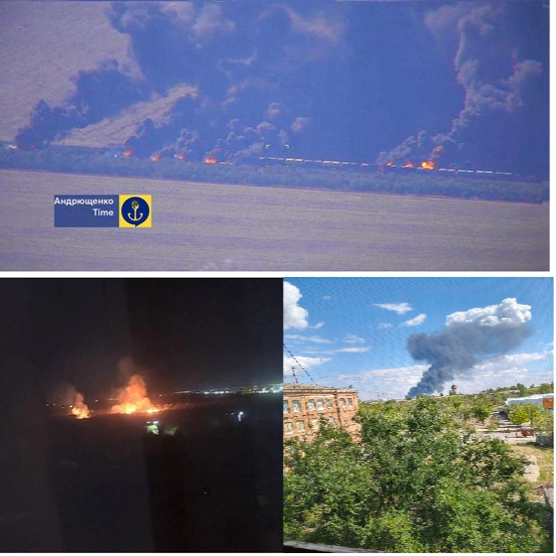
Top: Russian fuel train burns following Ukrainian drone strike to the east of the Russia-occupied city of Tokmak, Zaporizhzhia region. Image published by Petro Andriushchenko, a Ukrainian official reporting on the Russian occupation of Ukraine’s southern territories.
Bottom left: Ukrainian drone detonates during a night air raid of an oil refinery near the Russian city of Volgograd. Authorities said there was little damage, while local social media and independent sources reported major damage.
Bottom right: Smoke from major fire visible in the vicinity of the Volgograd oil refinery. Bottom two images from local social media.
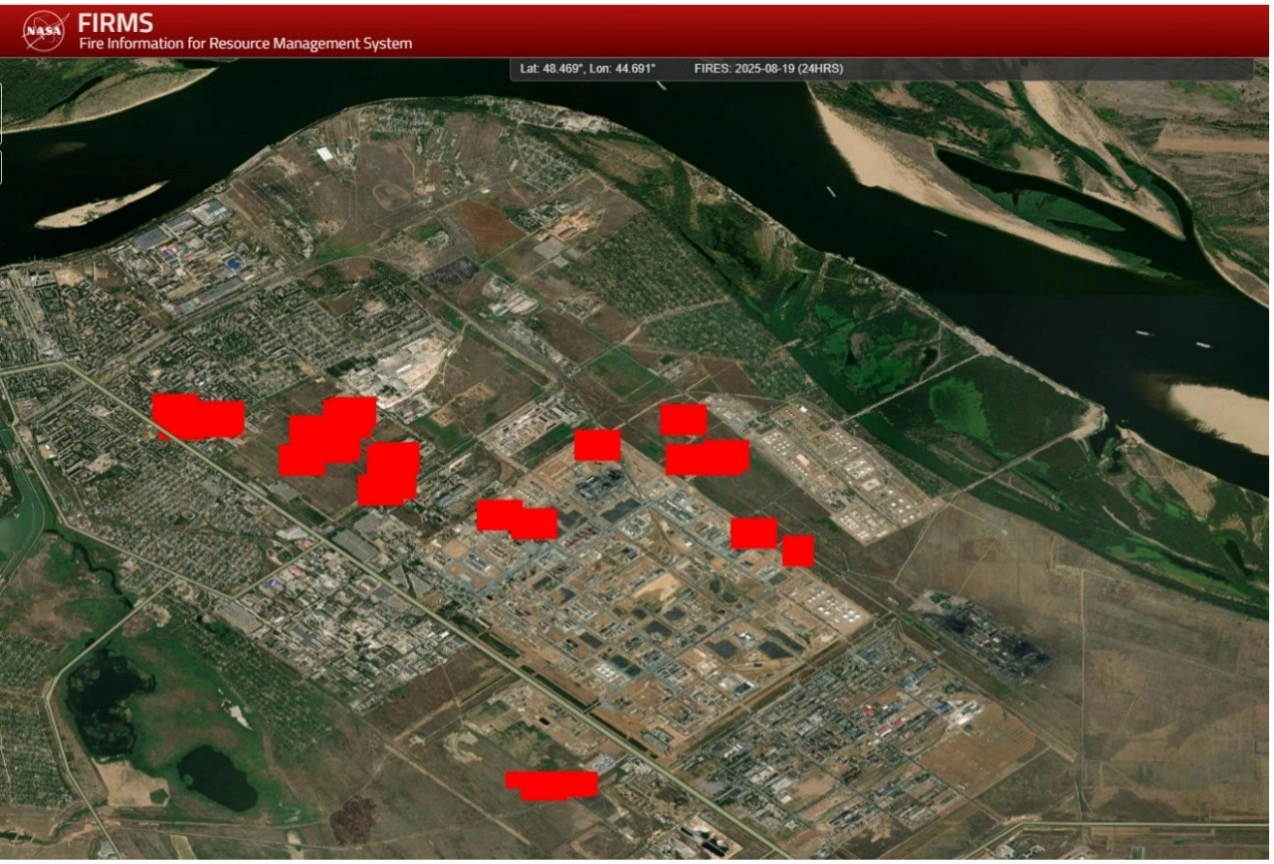
Kyiv Post screengrab of satellite imagery published by NASA of hot spots visible from space in the vicinity of a fuel refinery adjacent to the Russian city Volgograd. Some hot spots are likely flares from fuel processing; however, some are in the vicinity of fuel reservoirs that under normal circumstances should not be producing significant heat.
You can also highlight the text and press Ctrl + Enter