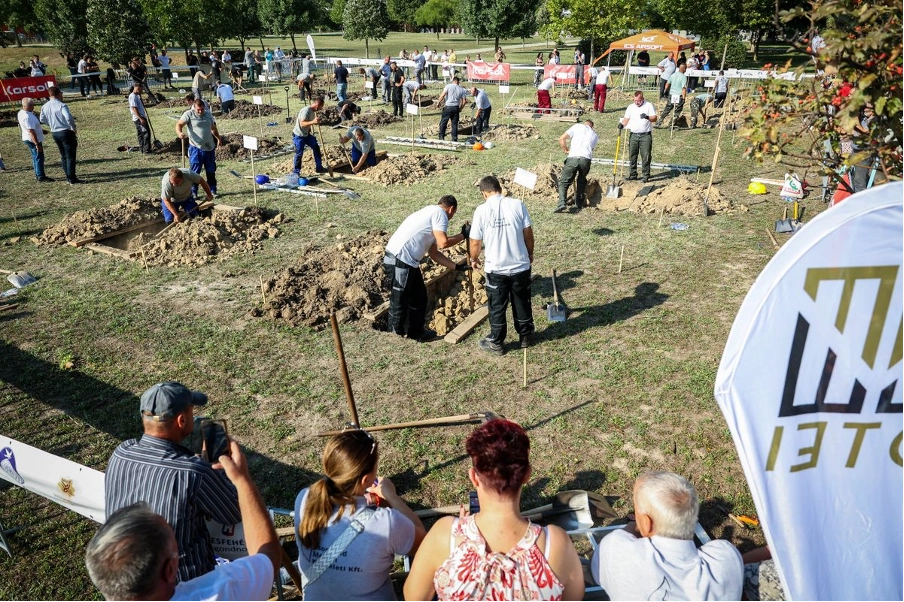
The eighteenth iteration of the Hungarian Association of Cemetery Operators and Servicers (MTFE) annual international grave-digging competition was held last weekend in the Hungarian city of Szekszárd, some 130 kilometers (80 miles) south of Budapest.
The city has hosted the event since 2016, which saw more than 20 two-man teams taking on the challenge this year. For the first time, a Russian pair – employees of Siberia’s Novosibirsk crematorium – took part alongside shovel-wielding Hungarians, and entries from Serbia and Croatia.
JOIN US ON TELEGRAM
Follow our coverage of the war on the @Kyivpost_official.
The rules are pretty straightforward: competitors have a maximum of two hours to construct a “standard” 1.6-meter (5.25 feet) deep by 80 centimeters (2.6 feet) wide and 2 meters (9.8 feet) long; a total of 2.5 cubic meters (88.3 cubic feet) of soil. Once the resulting pits have been carefully measured, the teams have 15 minutes to backfill them.
The results are based on a combination of the speed with which the task is completed, the accuracy of the final dimensions, and the appearance of the grave – its walls must be perfectly vertical and the bottom flawlessly horizontal.
József Varga, the president of MTFE, said, “We work for the recognition of the grave-digging profession,” which in Hungary not only includes preparing the deceased’s final resting place but can also include working with undertakers to prepare the body for internment as well as lowering the coffin into the grave and burying it.
Hungary Rejects EU Plan to Exclude Ukrainian Men of Military Age From Temporary Protection
Varga added that the competition aimed to raise the profession’s prestige by showcasing the skills involved and to attract new, younger talent to the industry.
The winners this year were the Hungarian team of László Kiss and Róbert Nagy from the Hajdúböszörmény funeral company, who took the title for the third time in a total time of 1 hour 33 minutes – “silver and bronze” also went to Hungarian diggers.
The Russian team, which struggled with the heavy clay soil, came last.
You can also highlight the text and press Ctrl + Enter

Russia Hit by 660-Drone Overnight Barrage Targeting Moscow, Crimea and Key Military Sites