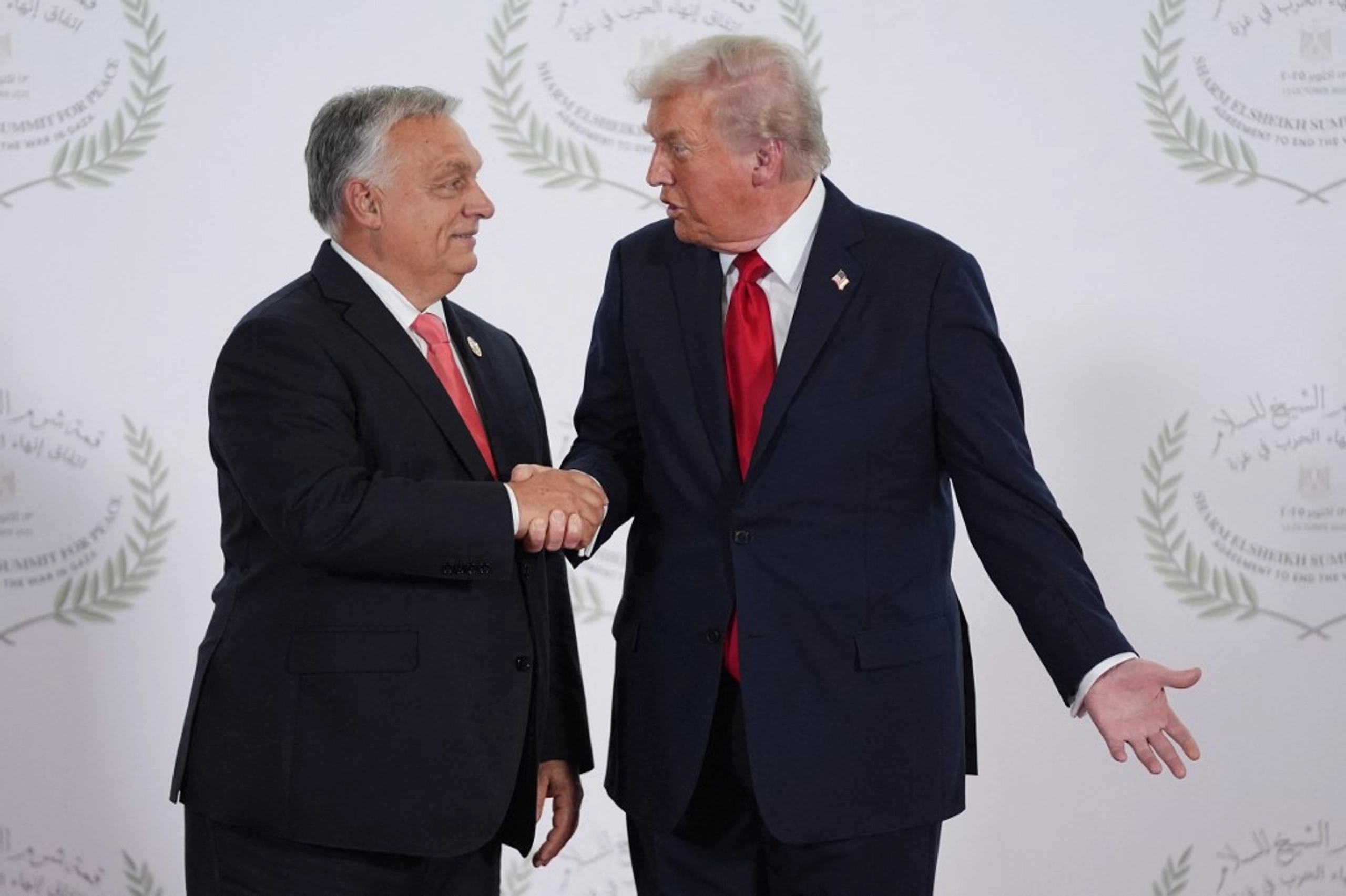
When Viktor Orbán lands in Washington next week, he won’t just be meeting an old ally. He’ll be meeting his political student who is putting his teacher’s lessons into practice.
The Hungarian prime minister’s visit to see Donald Trump comes at a moment when both leaders are at different points on a similar journey.
JOIN US ON TELEGRAM
Follow our coverage of the war on the @Kyivpost_official.
For Orbán, the handshake will project strength at home before next year’s election, the first in more than a decade to seriously test his hold on power. Trump, on the other hand, less than a year on his Orbán-inspired path, will want to show that his vision of power already works somewhere in the world.
On the surface, Orbán will be seeking a carve-out from Trump’s oil and gas sanctions, arguing that Hungary’s dependence on Russian energy makes it a special case. But on a deeper level, what he really wants is endorsement, a seal of approval for his “peace and sovereignty” narrative before next year’s key election in which he will face down Fidesz defector-turned-nemesis Péter Magyar.
Orbán’s claim is that Hungary alone stands apart from the West’s wars and pressures, that only his leadership can keep the country safe and independent.
For Trump, Orbán represents something more strategic: proof of concept for a model of an illiberal democracy based on managed elections, media control, and cultural nationalism.
Infantry Up Close, More and Better Bombardment, Helping America ‘Win’
Trump’s own allies have said as much. At last year’s CPAC in Budapest, the Heritage Foundation’s president, Kevin Roberts, called Hungary “the laboratory of the conservative future,” and promised that “what you have achieved here will be implemented in Washington.”
Peace and sovereignty
Orbán’s visit on November 7 will reinforce the story he has been telling at home for months, that only his leadership can keep the country out of the Ukraine conflict and that any alternative would turn Hungary into a “puppet of foreign powers”.
That message reached its purest form on October 23 when he marked the anniversary of the 1956 Hungarian Uprising against the Soviet Union with a speech that equated the European Union with the Soviet Union.
Speaking before tens of thousands at Kossuth Square in Budapest, Orbán declared: “Once again, we have two choices. In 1956 it was freedom or slavery. Today it is war or peace. In 1956 they came with tanks; today they come with financial sanctions.”
He went on to claim that Hungary “stands in the way of the warmongers in Brussels” and that “Hungary is the only country in Europe standing up for peace.”
His line “we shall not give our money, we shall not hand over our weapons, and we shall not die for Ukraine, but we shall live for Hungary” has become a campaign slogan repeated across state media and on billboards.
Orbán links that defiance directly to national survival: “Brussels has not yet been able to occupy Budapest. We are not a people to be used as pawns by an empire, sent to the front lines as cannon fodder.”
By tying his “peace and sovereignty” rhetoric to the upcoming Washington visit, Orbán can now tell voters that while others bow to foreign powers, he alone can keep Hungary safe by staying neutral.
Orbán’s narrative dovetails neatly with Trump’s own stance on Ukraine. Both men frame the war not as a struggle for democracy but as a needless confrontation prolonged by liberal elites.
Orbán insists that “if Donald Trump had been president, the war would never have broken out, and if they were not obstructing him now, there would already be peace.”
Illiberal Inspiration
In the Oval Office, Trump will look on Orbán as the man who once taught him the script, and whose lessons he is now putting into practice. In Budapest, the American right sees an illiberal state that works.
Over 15 years in power, Orbán has done what Trump’s allies now openly plan in his second term: capture the institutions of knowledge, law, and communication to ensure permanent control without formal rupture.
The Heritage Foundation’s Project 2025, widely considered the central policy blueprint for Trump’s second term, proposes sweeping political control over the civil service, the Justice Department, public broadcasting, and education, just as Orbán has done at home.
Its authors have repeatedly praised Orbán’s system as proof that such control can be achieved legally. Heritage president Kevin Roberts has said “what you have achieved here will be implemented in Washington.”
At the 2023 CPAC Budapest conference of MAGA Republicans, Orbán himself told delegates, “We have already done it; you can do it too.”
Fidesz dominates 80% of the news market through direct ownership and state advertising, for example. Independent media survive only online. The Constitutional Court is packed with loyalists, while the judicial council that appoints judges has been brought under political supervision.
University boards have been filled with Fidesz figures through so-called “foundations,” securing ideological control of higher education long after Orbán leaves office. Culture, education and the arts are policed through grants and licensing rules. The result, as Princeton’s Kim Lane Scheppele puts it, is “a one-party state maintained by legal means.”
Writers like Anne Applebaum describe this as the “Budapest model”: an exportable manual for governing indefinitely through partisan lawmaking and domination of the information space.
Budapest model in practice
Trump has moved far faster than his Hungarian counterpart did. Within a few months of returning to power, he has already implemented nearly half of the Project 2025 agenda, according to a policy-tracking analysis by the Brookings Institution.
The changes include dismantling federal diversity and inclusion programmes, cutting funding for “woke” education initiatives, and disbanding the Office of Special Education that enforced equality rules.
His administration has moved to reshape media oversight through politically aligned appointments at the Federal Communications Commission (FCC), the agency that regulates television, radio, and digital communications.
It has accelerated the confirmation of loyal judges drawn from Project 2025’s network and purged civil servants deemed ideologically hostile.
Much of what took Orbán more than a decade of slow political engineering, Trump has replicated in a single year by decree and appointment. When the two men meet in Washington next week, it will not be a teacher greeting his pupil, but two masters comparing notes on how to turn democracy inside out.
You can also highlight the text and press Ctrl + Enter

Russia Hit by 660-Drone Overnight Barrage Targeting Moscow, Crimea and Key Military Sites