President Volodymyr Zelensky is making major personnel changes to his senior team, and it likely doesn’t end here. Several more prominent dismissals are anticipated among the heads of the security agencies, as well as changes to several administrative officials across the regions.
The current wave of changes is significant, affecting numerous top officials and the movement of dozens of people.
JOIN US ON TELEGRAM
Follow our coverage of the war on the @Kyivpost_official.
Over the past week alone, Zelensky has replaced occupants of the following top jobs: head of the Office of the President and his deputy; the minister of defense, the minister of energy, the minister of digital transformation, the head of the Security Service of Ukraine (SBU), the head of the military’s Main Intelligence Directorate (HUR), and the governors of several regions. Zelensky has also appointed former Canadian Deputy Prime Minister Chrystia Freeland, who is of Ukrainian descent, as an advisor on economic development.
Zelensky has promised more changes. Some members of parliament are already talking about the imminent resignation of the current Secretary of the National Security and Defense Council (RNBO), Rustem Umerov, as well as possible dismissals within the security bloc.
So why is all this happening now, and how does this compare with the president’s past reshuffles, of which there have been at least two major instances? Kyiv Post examines the backstory behind the changes.
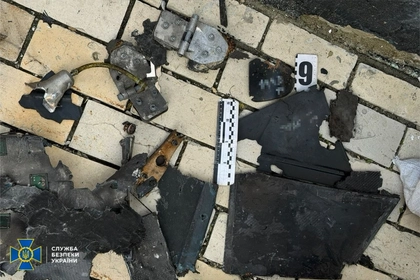
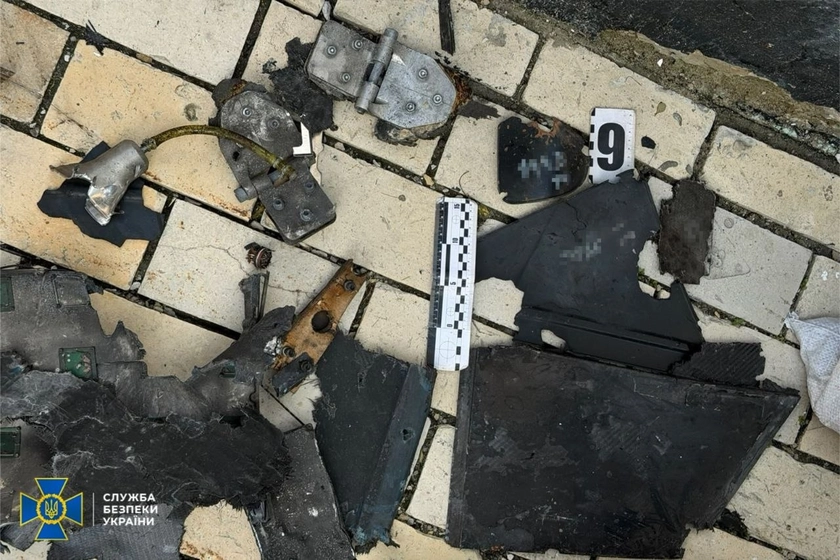
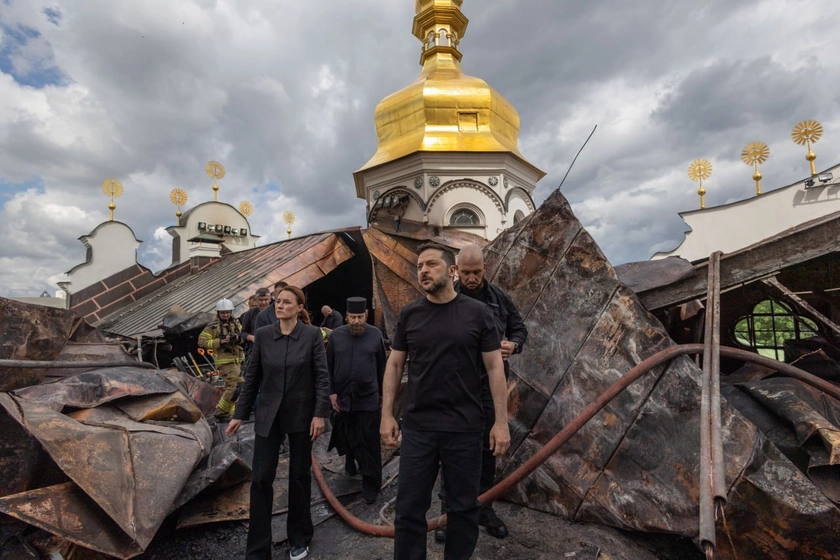
SBU Says Russia Used Geran Drone in Strike on Kyiv-Pechersk Lavra
Pragmatists replace idealists
Firstly, it must be acknowledged that Zelensky has been in office for almost seven years and is one of the longest serving in the top job. Since Ukraine gained independence, no one except for Leonid Kuchma (himself serving 10 years and beset by scandals and protests toward the end) has held onto office for more than a single 5-year term.
Other presidents – e.g., Leonid Kravchuk, the first, who was in charge for three years, and Viktor Yanukovych, overthrown during the Maidan events after four years in office – did not complete one full term.
Major changes to the senior team were a rare occurrence prior to the current president’s tenure.
Zelensky’s 2019 self-declared “Dream Team” (pictured below) has since fragmented. Oleksandr Danyliuk, former secretary of the RNBO, left in 2019. Ruslan Riaboshapka, prosecutor general, left in March 2020, while Ivan Bakanov, head of the SBU, left in 2022 at the start of the full-scale invasion.
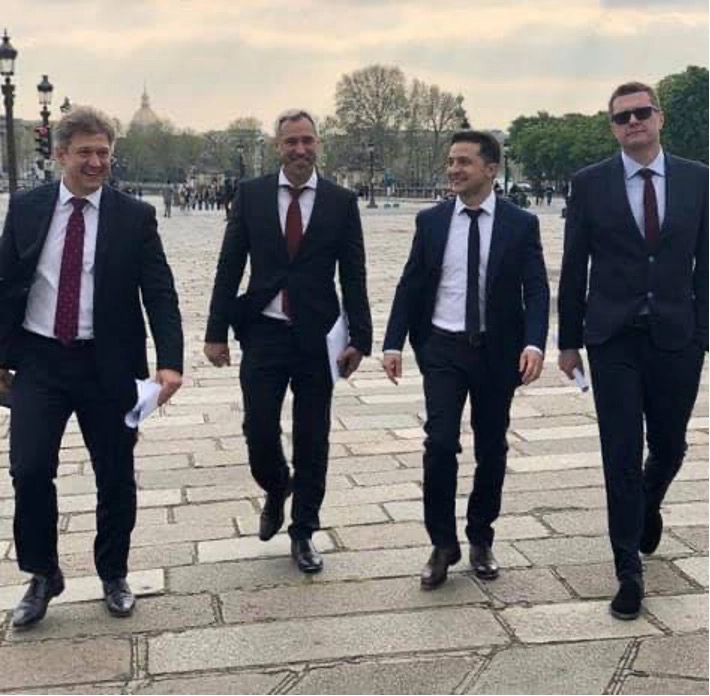
Several other prominent figures (shown below pictured at the president’s office on Bankova Street in 2019) did not last two years on Zelensky’s team.
Prime Minister Oleksiy Honcharuk was removed from office in March 2020 after a conflict with oligarch Ihor Kolomoisky. Several ministers from the old guard left with him, including economist Tymofiy Mylovanov, while Andriy Bohdan, head of the Office of the President, was replaced by Andriy Yermak a month earlier. Dmytro Razumkov – chief political adviser and spokesperson of Zelensky’s election headquarters – served as chairman of the Verkhovna Rada for two years and left his post in 2021.
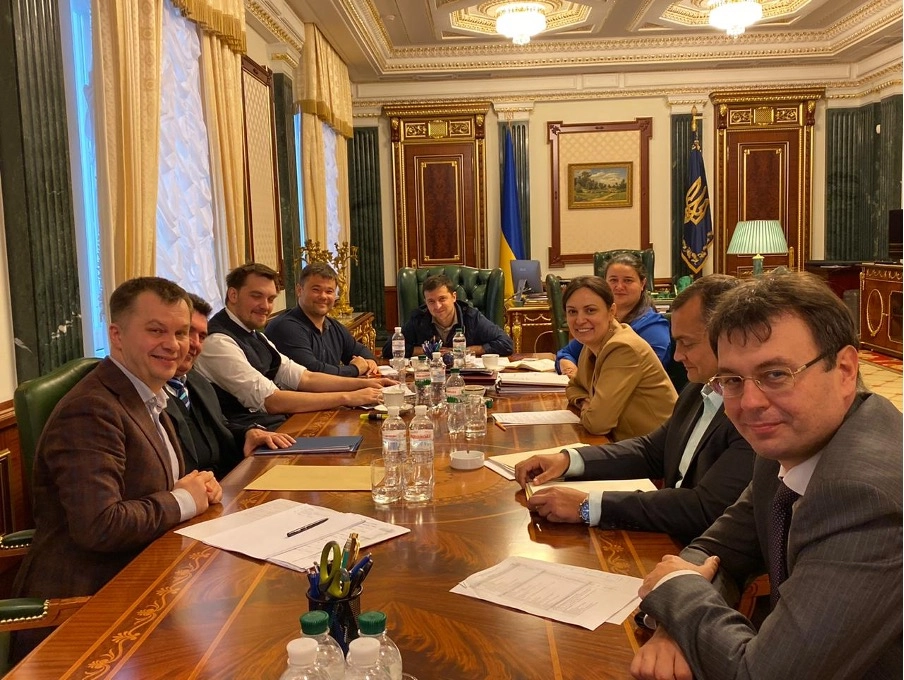
The last remaining member of the old team was Serhiy Shefir – director of the Kvartal-95 Studio, Zelensky’s TV production company – who held the position of Zelensky’s assistant and remained until 2024. However, this post is not part of the executive vertical.
These various officials were together at the Mariupol Economic Forum in 2019 – full of hopes and ambitions. In Ukraine they were often called “dreamers” or “idealists.” They nurtured many revolutionary ideas, some implemented. A key example would be Mykhailo Fedorov, minister of Digital Transformation from 2019 until 2023, who led a digital revolution by gradually moving administrative services online.
In the latest shake-up, on Jan. 2, Zelensky proposed Fedorov as the new Defense Minister.
But most managers either failed to deliver the expected results or – through the ambition of their ideas and decisions – risked destabilizing the power structure, creating an inevitable problem for the president. Riaboshapka, for example, was called “good but not effective” by Zelensky.
The president therefore began replacing these role-holders with calmer “pragmatists.” The post of prime minister was taken by the temperate technocrat Denys Shmyhal; the position of RNBO secretary by the experienced manager Oleksiy Danilov; and the post of head of the Office of the President by the composed, discreet and indefatigable Yermak. The latter’s influence would gradually turn the Office of the President into what many have described as a “shadow government.”
It was clear that Zelensky needed effective officials who demonstrated confidence and competence, but at the same time not flamboyant and to sufficiently predictable. It was then that everyone saw the values the president sought in state officials.
War
Russia’s full-scale invasion brought major changes to the president’s circle. Bakanov – who was a close childhood friend of Zelensky’s – was considered inappropriate for his task. Indeed, he was sacked for failing to root out Russian moles prior to the full-scale invasion. In the summer of 2022, Bakanov was officially replaced by Vasyl Malyuk, under whose leadership the SBU became a formidable force that carried out several unprecedented and daring operations deep in enemy territory.
Earlier this year, Malyuk himself remained loyal to the president’s inner circle and had SBU units carry out searches of anti-corruption bodies, which ended with large-scale protests by enraged young people in the center of Kyiv.
Oleksiy Danilov was removed from the post of head of the RNBO in 2024 – “he and the president grew tired of each other,” according to one well-informed heavyweight of Ukrainian politics in comments to Kyiv Post.
All these dismissals were replaced by new people in parallel to the growth of Yermak’s influence, under whom the Office of the President accrued unprecedented power. This was clearly evidenced by the government reboot in the summer of 2025, headed by the Deputy Head of the Office of the President, Yulia Svyrydenko.
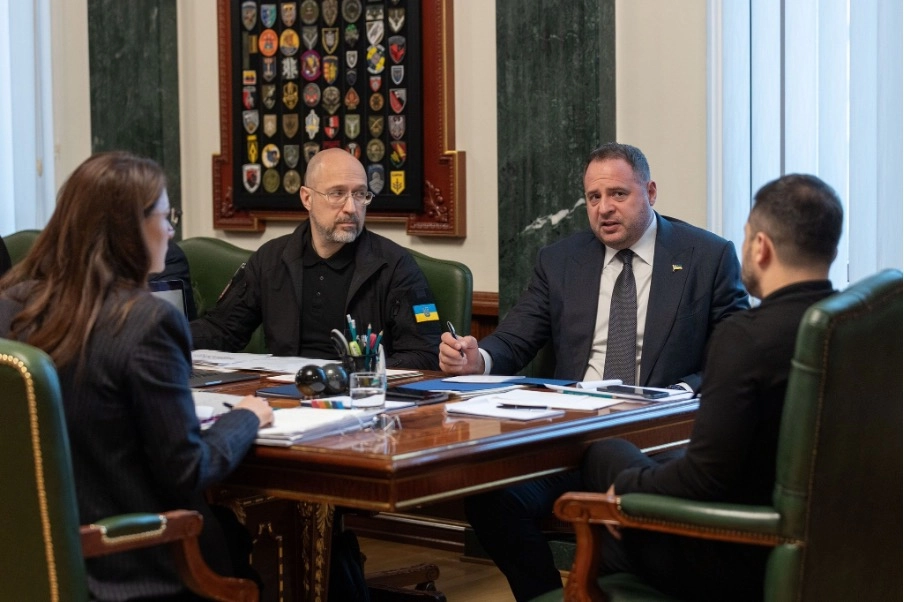
Minister for Development of Communities and Territories, Oleksiy Kuleba, headed the key body responsible for reconstruction. The Office exerted colossal influence over other security structures, some of whose leaders had long been considered by anti-corruption bodies and activists to be “Yermak’s people.” This was clearly demonstrated by the synchrony of actions during the attack on the National Anti-Corruption Bureau of Ukraine (NABU) in July 2025.
And yet, no one questioned Zelensky’s role as the sole leader. As war leader, he had emerged precisely as such, as someone who stood above the rest, rather than a “first among equals,” as it had seemed in 2019.
The omnipresent Yermak – who headed internal and external negotiation teams, participated alonside the president in meetings or frequenly represented him, and, according to sources, exerted pressure on those he considered Zelensky’s media competitors, for example HUR chief Kyrylo Budanov – greatly unnerved both the opposition and part of the pro-government deputies. They, however, never dared to oppose him openly.
The end of the “Yermak era” came when after the corruption scandal involving the “Mindich tapes” – an investigation by NABU into possible corruption schemes involving Mindich, politicians, ministers and senior members of the Ukrainian energy industry. NABU conducted searches of Yermak’s residence and although the results of the investigation have not yet been publicly declared, Zelensky, facing immense political pressure at home and abroad, finally dumped his gray cardinal.
Major changes have therefore taken place following Yermak’s “resignation.” So what do they indicate? More to follow in Part 2.
You can also highlight the text and press Ctrl + Enter