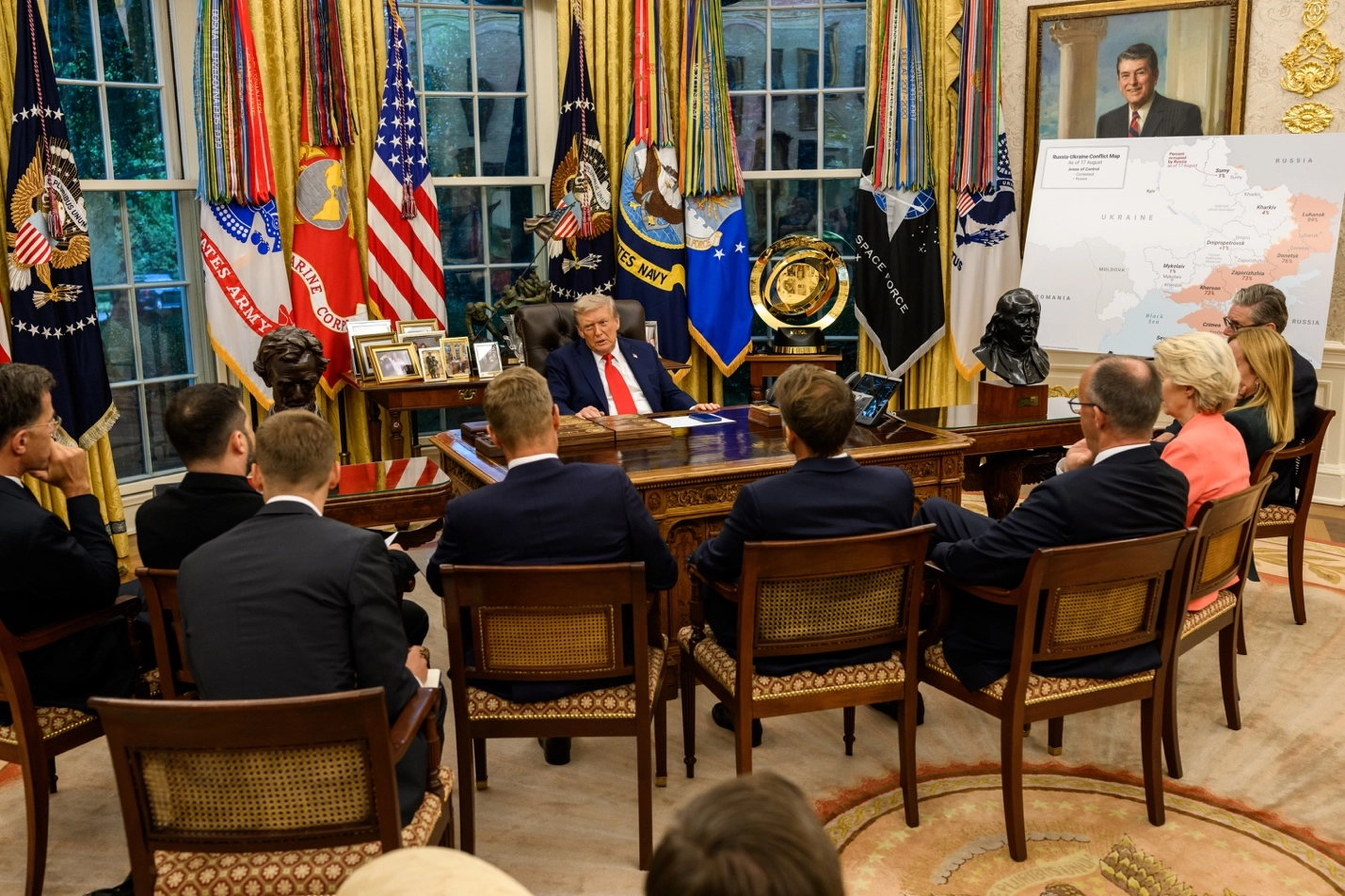
WASHINGTON DC – US President Donald Trump says Russia’s war in Ukraine is edging toward an end, claiming that diplomatic momentum is building.
“We’re making progress,” Trump told reporters aboard Air Force One on Sunday, emphasizing efforts to save lives in a conflict that has reshaped European security.
JOIN US ON TELEGRAM
Follow our coverage of the war on the @Kyivpost_official.
“I want to save the lives – the Russian and Ukrainian lives. That’s the only reason I’m doing it. This is Biden’s war – it’s not Trump’s war… All I can do is stop it, and I think we are making progress toward stopping it,” he said without offering further details.
Behind the scenes, Western diplomats say the diplomatic machinery is grinding back into motion – cautiously, unevenly and with deep skepticism about Moscow’s intentions and Washington’s long-term reliability.
“There is movement, but no one should confuse momentum with resolution,” a senior Western diplomat told Kyiv Post Sunday night, granted anonymity to speak candidly. “The political signals are real. The endgame is not.”
Rubio’s diplomatic sprint
As Trump talks up progress, Secretary of State Marco Rubio is quietly pressing allies.
On Sunday, he spoke with French Foreign Minister Jean-Noël Barrot, discussing diplomatic efforts to end the Russia-Ukraine war alongside broader transatlantic issues.
He also called Cyprus Foreign Minister Constantinos Kombos to coordinate priorities ahead of Cyprus’s January-June 2026 presidency of the EU Council.
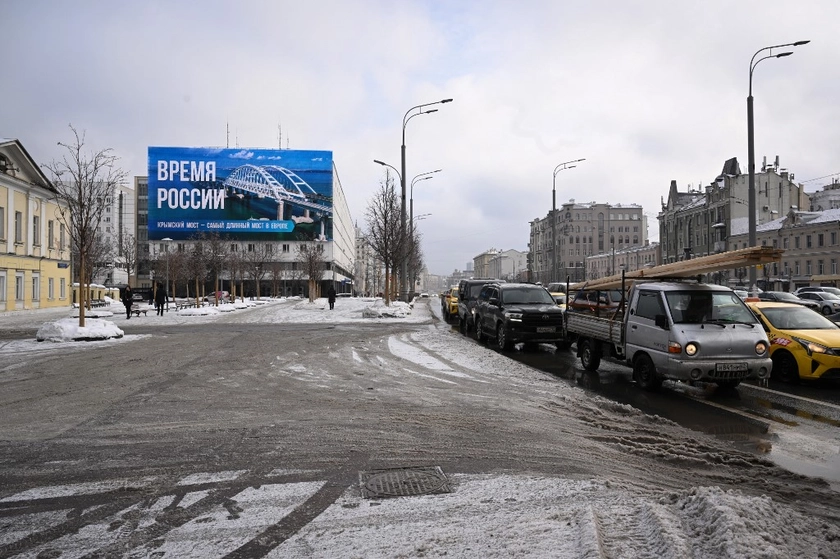
Russia Disguises Fuel Trucks as Milk Tankers to Reach Crimea
On Monday, Rubio is set to host German Foreign Minister Johann Wadephul at the State Department, with Ukraine “high on the agenda,” according to officials.
Wadephul’s visit comes at a delicate moment – not just because of the war, but because of growing transatlantic friction over Greenland and US global priorities.
Before arriving in Washington, Wadephul stopped in Reykjavik for US-hosted talks on Arctic security with Iceland’s foreign minister, underscoring how Ukraine, the Arctic and great-power competition are increasingly intertwined.
German Finance Minister Lars Klingbeil is also in Washington for US-hosted talks on access to critical raw materials – another issue diplomats privately say is inseparable from Ukraine’s reconstruction and Europe’s strategic autonomy.
“Never before has it been so crucial to invest in the transatlantic partnership in order to remain capable of shaping the world order,” Wadephul said in Berlin before departing.
He acknowledged “differences of opinion” with Washington, saying Germany wants to resolve them “through dialogue” to fulfill a shared responsibility for peace and security.
Trump, NATO – and Greenland
Those differences are becoming harder to ignore. Trump on Sunday again cast doubt on NATO’s value, even as allies prepare for a possible ceasefire in Ukraine.
“I like NATO,” he said. “I just wonder whether or not, if we needed NATO, if they’d be there for us. I’m not sure they will.”
Asked whether he would take the US out of the alliance, Trump said NATO “would be upset” and that it would “save a lot of money,” reinforcing fears in European capitals that Washington’s security guarantees are increasingly conditional.
Those fears deepened with Trump’s blunt remarks on Greenland. “If we don’t take Greenland, Russia or China will – and I’m not letting that happen,” he said.
Pressed on whether a deal was possible, Trump replied: “Sure, I’d love to make a deal with them. It’s easier. One way or another we’re going to have Greenland,” adding that the island’s defense amounted to “two dog sleds.”
A senior European diplomat called the comments “deeply destabilizing,” adding: “You cannot ask allies to risk troops in Ukraine while floating annexation rhetoric elsewhere.”
Europe debates boots on the ground
That tension is playing out most clearly in Europe’s debate over a postwar Ukraine.
In France, President Emmanuel Macron has encountered resistance across the political spectrum after proposing to station French forces in Ukraine following a potential ceasefire.
During a closed-door briefing with party leaders – from the far-right National Rally to the far-left La France Insoumise – Macron’s team outlined a possible French contribution of up to 6,000 troops.
A senior military official stressed the force would not be a “stabilization” mission but a “reassurance” contingent positioned well away from combat zones.
Still, skepticism ran deep. Multiple parties demanded a UN mandate – a near impossibility given Russia’s veto power at the Security Council.
National Rally leaders also raised concerns about US involvement, pointing to what they described as Washington’s damaged credibility after controversial actions in Venezuela.
The debate unfolded as the UK and France signed a declaration with Ukraine outlining plans to deploy forces and establish “military hubs” after a peace deal – a move experts say represents one of the clearest written security assurances Kyiv has received to date.
This also came just days after the high-profile meeting in Paris where allies from the so-called “coalition of the willing” – roughly 30 countries – worked to firm up security guarantees for Ukraine.
Trump’s peace envoys were present, a sign, diplomats say, that Washington still wants a seat at the table even as it keeps its distance.
Yet any US commitment to protect European troops if Russia threatens them remains absent.
Germany, for its part, is edging closer to a military role. Chancellor Friedrich Merz said Berlin could deploy “forces on NATO territory neighboring Ukraine” after a ceasefire.
The coalition has pledged to help build “defensive fortifications” inside Ukraine and to participate in a proposed US-led monitoring and verification mechanism after a ceasefire, using drones, sensors and satellites to track Russian violations.
Ukrainian forces, the group emphasized, would remain “the first line of defense and deterrence,” with coalition troops largely acting as trainers rather than combat forces.
Kyiv presses on
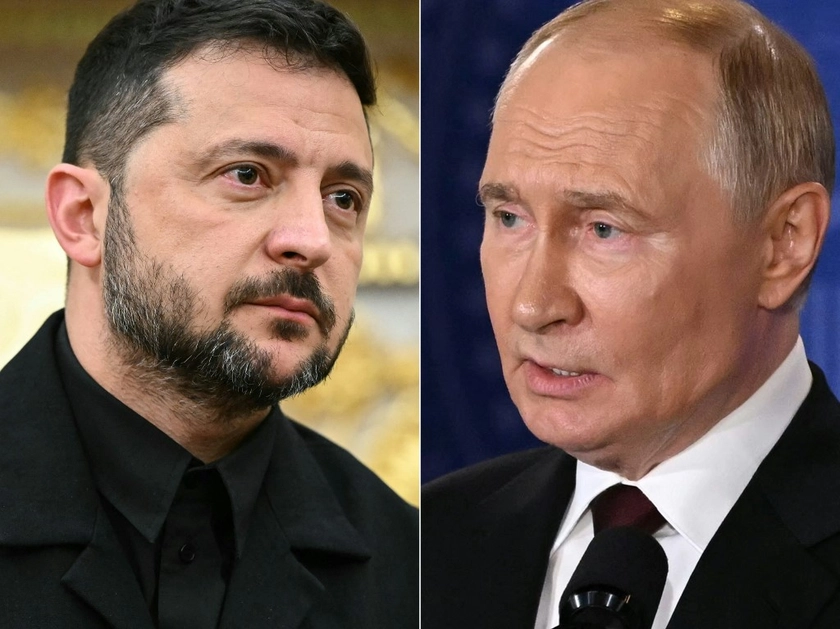
Ukraine, meanwhile, is not waiting. President Volodymyr Zelensky said over the weekend his forces are expanding deep-strike operations inside Russia.
“It is still too early to speak publicly about some of the operations – ones that the Russians have already felt,” Zelensky said. “Some of the operations are still underway. I also approved new ones.”
“We are actively defending ourselves, and every Russian loss brings the end of the war closer,” he added.
For now, Trump’s claim of progress hangs over a fragile diplomatic landscape – one where Europe is preparing for peace without certainty of American backing, and where Washington’s own signals remain contradictory.
As one senior Western diplomat put it: “Everyone wants this war to end. The question is what kind of order comes after – and whether the US will still be standing at the center of it.”
You can also highlight the text and press Ctrl + Enter
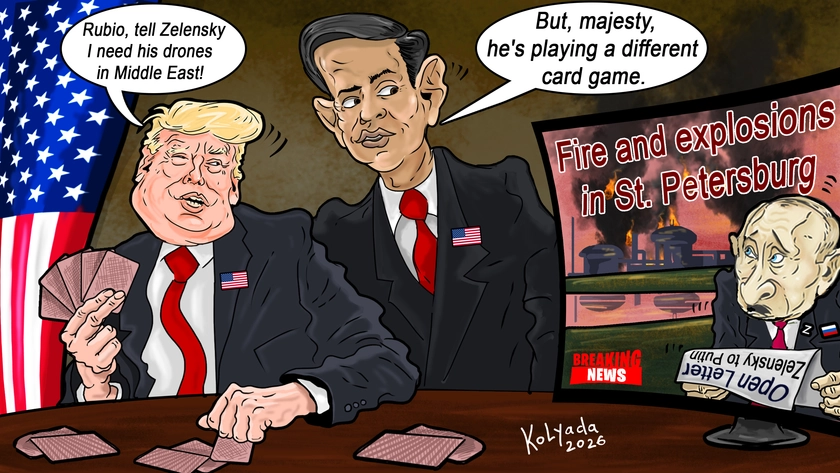
CARTOON: Who Has the Cards Now?
FACT-CHECK: Is Donald J. Trump Truthful About Ukraine?
OPINION: Crimea Cuts, St. Pete Double Tap, Boats Bashed