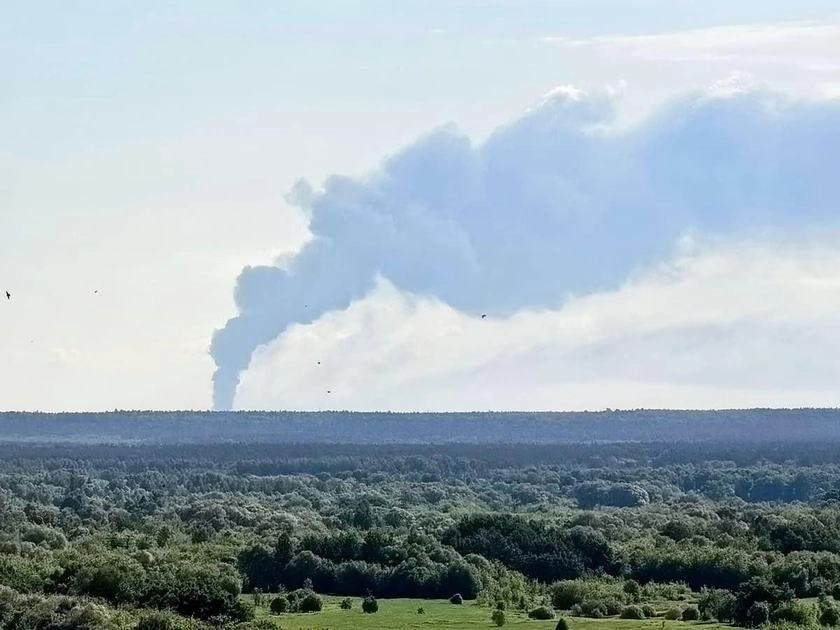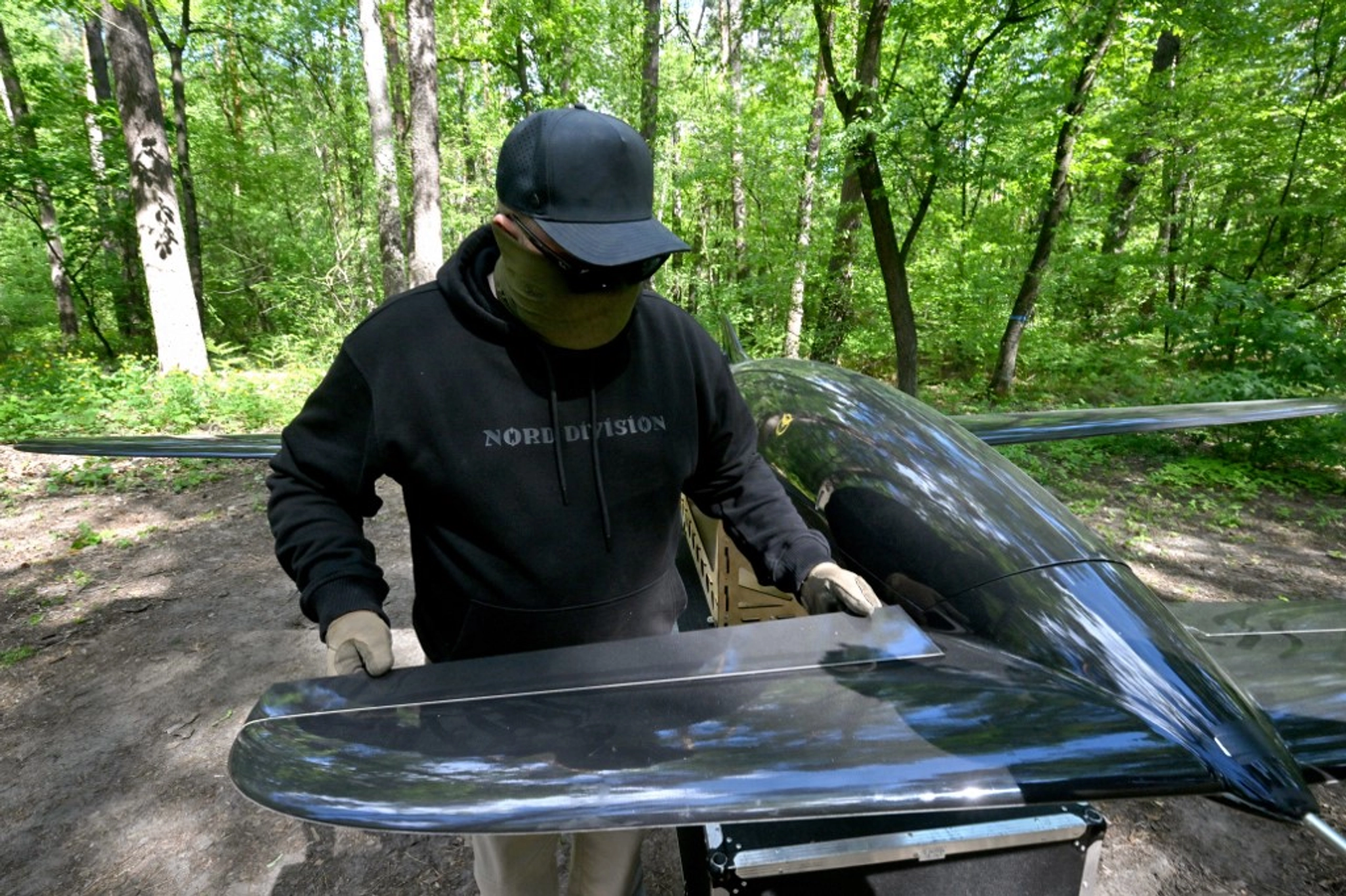
Ukraine’s elite Unmanned Systems Forces (USF) in early May kicked off an ambitious strike campaign to demolish the Kremlin’s deliveries of military materials to frontline troops by attacking Russian military trucks, trains, and logistics nodes with drone swarms.Ukraine’s punishing bombardment by explosives-toting kamikaze aircraft ranging deep behind Russian lines has employed both battle-tested and newly developed unmanned aircraft in what military specialists sometimes call “layered strike architecture.”For the layman, the main takeaways are that advanced Ukrainian drone tech, or sometimes known drones showing up in swarms bigger than expected, appears to have caught Russian truck drivers and air defenders by surprise repeatedly, Kyiv Post research into air operations during May and early June found.
The Behemot drone – precision-guided strikes, really cheap
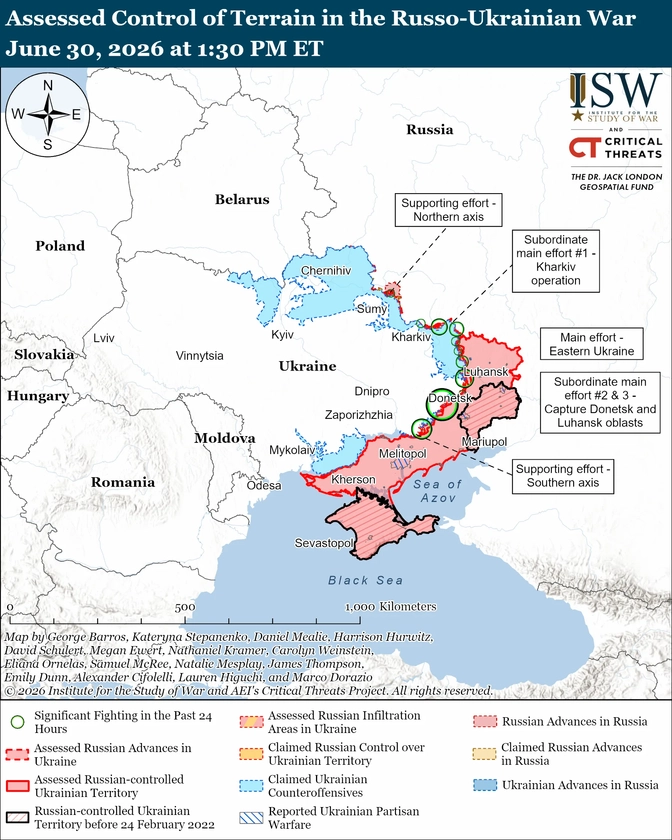
On Saturday, in the north of the Russia-occupied Ukrainian region Crimea, in one of the first battle uses of the weapon, a covey of Ukrainian Behemot drones, swooped down and blew holes into a road bridge crossing a multiple-kilometer-wide swamp in the north of the territory.
JOIN US ON TELEGRAM
Follow our coverage of the war on the @Kyivpost_official.
The drones’ 75-kilogram (165-pound) warheads blew at least meter-wide holes through the reinforced concrete road surface, in a moment shutting down one of only two major roads connecting the Black Sea peninsula and the Kremlin’s military bases there, and the Russian Federation mainland. Occupation authority officials said the route would not be repaired for around a month.
‘Die Together’: Ukraine’s LGBTQ Soldiers Fighting Russia – and for Their Rights
With a 2.3-meter (7.5-foot) wingspan, the Behemot, roughly the size of a rider mower or a small dining table, has a published range of up to 300 kilometers (186 miles). Prior to its employment, Ukrainian forces had not been easily able to attack and seriously damage hard targets needing down-to-the-meter accuracy that deep behind Russian lines, because the only weapons in the Ukrainian arsenal able to score a precise hit like that had been rare and infrequently-delivered French- or British-manufactured cruise missiles.
Images and audio published by the Ukrainian unit launching the attack, a picked strike unit called Code 9.2, said that the Behemot (Ukrainian: Бегемот = hippopotamus, or Behemoth) drone caused serious damage because, in part, it had been designed to carry a heavier warhead than the competing Iranian Shahed drone, and that the warhead had been designed specifically to penetrate hard targets like roadway or armored aircraft shelters. According to open sources, the Culver Aerospace-developed Behemot probably costs $35,000-50,000/launch, compared to a reported $1 million per unit cost for the much more powerful French-British cruise missile.
The report said that Ukrainian intelligence had identified the causeway, usually called Chonhar after a village nearby, as a high-priority target because of its heavy use by major Russian military units in the vicinity, among them Russia’s 37th Motor Rifle Brigade.
Kyiv Post researchers confirmed the fact of the strike and damage and the general presence of that unit in the vicinity. The Chonhar causeway is about 112-124 miles (180-200 kilometers) from probable Ukrainian launch sites. More precision attacks by relatively cheap Behemot drones on high-value targets are being planned, the report said.
https://www.youtube.com/watch?v=odhvaOmOh1U
The Hornet drone – long-range road domination
In late 2025, Russian military intelligence sources and milbloggers reported Ukrainian forces had started using an airplane-shaped drone roughly the size of a winged surfboard or small kayak called a Hornet that carried a small, 5-kilogram (11-pound) warhead out to ranges of 150 kilometers (93 miles).
Developed and produced by the California-headquartered Perennial Autonomy company, and sold at a reported $5,000/aircraft to Ukraine’s armed forces, the Hornet was reportedly first used in combat in small numbers in March.
Russian intelligence for months rated the drone a relatively small threat because of its small numbers and – perhaps ironically – gave it the tracking name “Martian,” in a possible reference to its rarity.
In early May, Ukraine’s USF forces shifted from low-intensity, rare use of the Hornet to massed Hornet drone patrols of major roads in southeast, Russia-occupied Ukraine, paying the most intense attention to major highways between the Ukrainian cities of Donetsk, Mariupol, and Melitopol. Selected video footage reviewed by Kyiv Post has shown two and even three Hornets operating around a single stretch of highway, and follow-up strikes taking place within seconds of an initial hit. Assisted by reconnaissance drones orbiting over roadway sections nearly 24/7, Hornet drone pilots from at least six USF strike units identified by Kyiv Post had, by late May, made those roadways almost impassable to military vehicle traffic, except in bad weather. The most frequent have been, and are, fuel trucks, military cargo trucks, and military vehicles. Typically, the truck is stopped with a hit to the engine or the windshield, and then follow-up drones seek to set the vehicle on fire. The pilot is assisted by an AI targeting system that seeks out truck-like objects and locks onto them, including ones moving, so that the pilot can decide whether or not to give the “go” order to strike.
By early June, OSINT research had identified at least 300 medium- or heavy-weight truck hulks along major highways used by Russian forces like the M03 (Mariupol-Donetsk) and the M14 (Mariupol-Melitopol), while occupation authorities banned civilian traffic from those roads because of the continuing drone threat.
The Darts-2 drone – Ukrainian version of the Hornet
According to Ukrainian military news platforms, the Ukrainian company Norda Dynamics is delivering a domestically manufactured mid-range attack drone called a Darts-2, a kamikaze unmanned air vehicle (UAV) with a slightly smaller range than the Hornet (31-62 miles/ 50-100 kilometers) but costing less, at a flyaway sticker value at around $1,000-$3,000. The Darts-2 is roughly the same size as a Hornet but has two small propeller engines rather than one big one, which allows a somewhat more powerful 8-10-kilogram warhead.
Like the Hornet, the Darts-2 has an AI system (called “Bulldog”). Details are secret, but based on drone video and comment by pilots of both systems speaking to Kyiv Post on background, the Darts-2 drone’s AI seems to be somewhat more capable of identifying a truck at a distance and then flying the drone into the truck, especially in more difficult conditions like smoke or poor weather.Partial battle report information reviewed by Kyiv Post points to more common use of Darts-2 aircraft by Ukrainian combat units with strong drone sub-elements, that are participating in the medium-range strike campaign but are not formally part of the Ukrainian army’s main drone force, the USF.
Combats formation recently reporting Darts-2 use in those operations include the Azov Brigade, drone units assigned to Ukraine’s border troops command, at least one special operations infantry regiment, and a volunteer drone battalion working with one of the USF flying brigades.
Because of its shorter range, Darts-2 is also widely used nearer to the front line, and often is the follow-up strike aircraft tasked to hit a Russian vehicle or infantry moving beyond the range of the Ukrainian military’s main frontline drone weapon, the First Person View (FPV) tactical drone, usually operated at ranges of 1-30 kilometers (.6-19 miles) from the front lines.
Reconnaissance: Shark and Leleka
Ukraine’s military has, since 2023, operated reconnaissance drones operating to various depths inside Russia-controlled territory for early warning, intelligence collection, and to find targets for follow-up strikes by conventional warplanes, artillery rockets, missiles or artillery.
In Russia-occupied southern Ukraine, that observation network, coordinated by data fusion software developed in Ukraine, is now collecting information about activity on road and rail routes used by Russian forces and directing strike drones (as possible) to make attacks. Typically, the sophisticated sensors and cameras aboard give an operator the ability to see a person at night from kilometers away at night, and in ideal daytime conditions to identify individual facial features.
At the close-in 20–50-kilometer (12-31-mile) range envelope, most Ukrainian combat brigades operate flights of a V-tailed, conventional winged observation drone called a Lelka-100, which is about the size of a bicycle. It is made mostly of foam and is thrown into the air by an operator. It can operate for two or three hours before needing to return for refueling. Most brigades operate four to six Lelkas, each costing $20,000-40,000. In past years, another Ukrainian-manufactured drone, called a Furia, was used in the role, but it is less popular because it costs three or four times more than a Lelka.
Ukraine’s premier mid-range observation drone is a highly successful aircraft called Shark, which is roughly the size of a low-CC motorcycle and can reach out to 80 kilometers (60 miles) and patrol for four or five hours at a time. Typically, a brigade operates about one Shark drone for every three Lelka drones it has in stick, and the main job of the Shark pilot is finding areas of interest and potential targets, whose precise locations the Lelka drones identify for a strike element to hit. In March-April 2026, Russian milbloggers reported abnormally high Shark overflights at distances from the front lines well beyond the range of Ukrainian artillery and artillery rockets.
Long-range flying medium-range strikes: Bober, Liutyi
Ukraine’s mid-range drone development has come relatively late in the Russo-Ukraine War, because small bomber and FPV drones were developed by troops fighting on front lines, and long-range drones by the Ukrainian government. Kyiv needed a way to counterattack Russia because Ukraine’s Western allies, for years, mostly banned the use of long-range NATO-standard weapons in Russian Federation territory. Three of those aircraft, still heavily in use in those long-range missions, have been used in the middle-range strike campaign to hit specific targets like rail hubs or fuel depots.
The Bober (UJ-26) (Ukrainian – бобер = Beaver) was developed by Ukraine’s Main Directorate of Intelligence (HUR) and local industry. It is a fixed-wing drone about the size of an ultralight aircraft, with a tail propeller carrying a 20-50 kilogram (44-110 pound) warhead to ranges up to 1,000 kilometers (620 miles). Some warheads are KZ-6 shaped charges designed to penetrate armor or reinforced concrete. Guidance is not by the operator but by GPS-based inertial navigation with waypoints, making the drone less accurate than pilot-guided drones but somewhat more resistant to jamming because there is no pilot-to-drone electronic tether to jam, and because, without the need to communicate with the pilot, it can fly at treetop level. In practice, Ukraine’s armed forces have used Bober for area targets like a fuel tank farm. Reportedly, a Bober costs around $50,000.
Ukraine’s premier long-range drone is the An-196 Liutyi (Ukrainian: Лютий – Fury), a tail-prop UAV manufactured by Ukraine’s biggest aerospace company, Antonov, and associated firms. The aircraft, roughly the size of a single-engine trainer, costs between $40,000-200,000 depending on the target selected and range needed, and can carry between 50-100 kilograms (110-220 pounds) of payload up to 1,000 kilometers (660 miles) reliably, and smaller warheads up to 2,000 kilometers (1,243 miles). Guidance is similar to Bober. Although not often used as part of the mid-range strike campaign, the An-196 has been used from time to time to hit targets beyond the range of lighter drones, or when a heavier warhead was needed.
You can also highlight the text and press Ctrl + Enter

Russia Hit by 660-Drone Overnight Barrage Targeting Moscow, Crimea and Key Military Sites