For decades, the only available option to North Korea in its relations with neighboring China was a junior partner status. Economically isolated, diplomatically constrained and heavily dependent on Chinese trade, Pyongyang had little choice but to accommodate Beijing’s interests and priorities. Today, that balance is shifting.
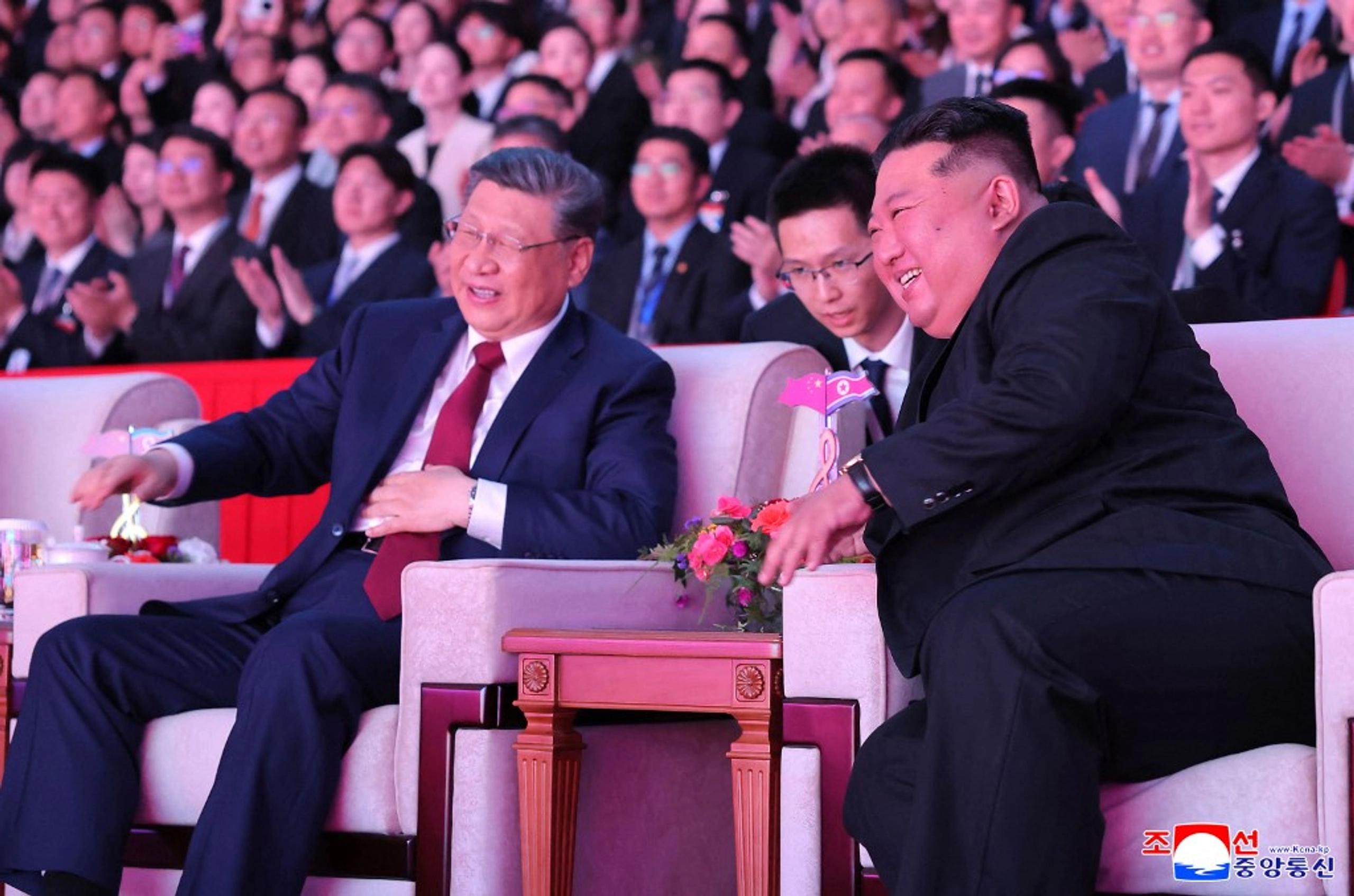
Xi Jinping’s visit to North Korea this week highlights a remarkable reversal in regional dynamics. Rather than arriving as the leader of an indispensable patron seeking to influence a dependent neighbor, Xi found himself engaging with a regime that had acquired strategic value through its deepening partnership with Putin’s Russia. North Korea managed to acquire new leverage over China at a time when a great-power struggle is reshaping the global geopolitical landscape.
JOIN US ON TELEGRAM
Follow our coverage of the war on the @Kyivpost_official.
Russia’s full-scale invasion of Ukraine has been a great catalyst in this process. By signing a mutual defense treaty in 2024, North Korea has emerged as a critical military partner for Moscow, supplying troops, ammunition and other forms of support to the Russian war effort. In return, Russia has provided economic assistance, diplomatic backing and enhanced military cooperation, helping to revive North Korea’s struggling economy while reducing its dependence on China.
The consequences extend far beyond the battlefield in Ukraine. For the first time in decades, Kim Jong Un has an alternative partner capable of providing economic support, political cover and strategic relevance. This has weakened Beijing’s historical ability to shape North Korea’s foreign policy through economic means.

Ukraine Hits Targets 1,300 km Inside Russia, Striking Ufa Oil Refinery and Penza Missile-Linked Plant
While China remains North Korea’s largest trading partner – accounting for over 90% of annual trade – such leverage is not determined solely by trade volumes. It depends on whether a country has viable alternatives. Russia’s increasing economic exhaustion from its ongoing military assault on Ukraine led to a search for alternative partners. And Pyongyang was eager to fill in the gap. The relationship has evolved from one of necessity into one of strategic choice, allowing Kim to resist Chinese pressure more confidently than at any point since he came to power in 2011.
This changing balance helps explain why Beijing’s approach to North Korea has evolved dramatically. In the past, China together with Russia and the United States supported international sanctions and publicly advocated denuclearization of the Korean peninsula, believing they possessed sufficient influence to steer Pyongyang’s behavior. Today, Chinese leaders appear to have accepted that such pressure is unlikely to succeed and could even backfire. Symbolically, days before Xi’s official visit to Pyongyang, Kim Yo Jong, the sister of the North Korean dictator, described the country’s nuclear program as “irreversible.”
From Beijing’s perspective, the danger is not merely that North Korea continues to expand its highly opaque nuclear arsenal, which currently has roughly 60 nuclear warheads. The greater risk is that excessive pressure could push Pyongyang further into Russia’s orbit. Xi’s visit can therefore be seen as an effort to prevent strategic drift and reassert China’s relevance in a relationship where its influence can no longer be taken for granted.
Beijing appears to have concluded that North Korea's nuclear status is a reality that must be managed rather than reversed.
North Korea has become an increasingly important player in the emerging China-Russia-North Korea triangle precisely because it now occupies a position between two competing patrons.
While Moscow and Beijing remain strategic partners, their interests on the Korean Peninsula are not necessarily aligned. Russia appears less concerned about North Korea’s growing military capabilities and nuclear program, viewing Pyongyang primarily through the lens of its confrontation with the West and the military assistance in its ongoing war efforts in Ukraine. China, by contrast, is deeply concerned with regional instability, the possibility of nuclear proliferation in Japan and South Korea resulting from North Korea’s nuclear program, and the economic consequences of a security crisis on its doorstep.
Kim has learned to exploit these differences. By strengthening ties with Moscow while maintaining his relationship with Beijing, he has increased North Korea’s diplomatic room for maneuver. Rather than being the object of great-power competition, Pyongyang is increasingly positioning itself as a beneficiary of it.
This new reality is evident in China’s gradual retreat from its longstanding emphasis on denuclearization. Chinese officials have become noticeably less vocal about North Korea’s nuclear program, while recent meetings between Xi and Kim have omitted references that once featured prominently in official statements. Beijing appears to have concluded that North Korea’s nuclear status is a reality that must be managed rather than reversed.
For Kim, this represents a significant strategic victory. North Korea’s nuclear arsenal, once the source of its international isolation, has become central to its geopolitical value. Combined with its growing importance to Russia, it has transformed the country from a dependent client into a more autonomous actor capable of balancing between larger powers.
Xi’s visit therefore reflects more than a routine display of socialist solidarity. It is an acknowledgment of a shifting regional order in which North Korea possesses greater agency than at any time in recent decades. The most striking development is that even though China still holds influence over North Korea, it now has to compete for it.
In the emerging triangular relationship between Beijing, Moscow and Pyongyang, North Korea is no longer merely the junior partner. Through the opportunities created by the Russian invasion of Ukraine and the intensifying confrontation between the major powers, Kim Jong Un has succeeded in turning strategic dependence into strategic leverage. The result is a Korean peninsula where China’s economic weight remains enormous, but its political influence is no longer unquestioned.
You can also highlight the text and press Ctrl + Enter

Russia Hit by 660-Drone Overnight Barrage Targeting Moscow, Crimea and Key Military Sites