This is the fourth and last of a Kyiv Post series on Ukraine’s air bombardment campaign targeting Russian military logistics at middle ranges from the front lines, with the declared objective of damaging Russian army unit capacity to fight effectively by using unmanned air vehicles (UAVs) to attack Russian supply routes and logistics.
The first article in the series, focusing on the aircraft used by the Armed Forces of Ukraine (AFU) in that ongoing strike campaign, is available here.
JOIN US ON TELEGRAM
Follow our coverage of the war on the @Kyivpost_official.
The second article in the series, focusing on the tactics and targeting strategies used by the AFU in that ongoing strike campaign, is available here.
The third article in the series, focusing on the conduct of the campaign and damage done to date, is available here.
Elite strike drone units manned by Ukraine’s most experienced combat pilots and war-seasoned flight operations planners are spearheading the country’s “middle strike” operation, a relentless air bombardment operation that in June alone destroyed hundreds of fuel trucks and shut down Russian military supply chains across a territory roughly the size of Belgium, Kyiv Post’s review of battle video, unit statements and open source reports found.
Ukraine’s Unmanned Systems Forces (USF) kicked off the strike campaign with the twin objectives of degrading Russian supplies to the front line and breaking logistics links between the Russia-occupied Crimea in mid-April. Since then, USF information outlets have documented hundreds of geolocated air strikes concentrated in Russia-occupied territory in southern Ukraine, and identified the drone units carrying out the sorties.
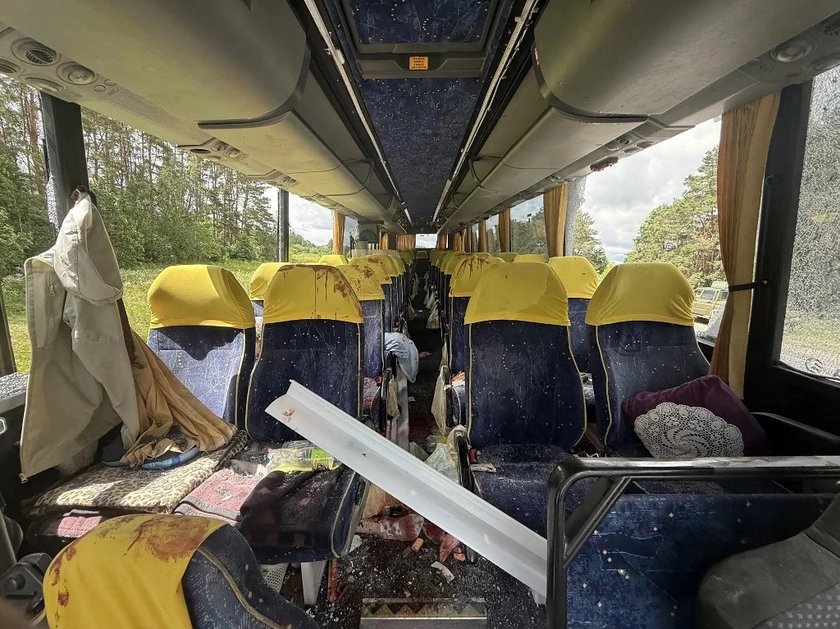
SBU Calls Bryansk Bus Strike Russian False Flag Operation
About 10 of Ukraine’s most combat-seasoned, veteran USF outfits, each typically a modestly-sized unit of 300-500 men capable of putting into the air at most 30-40 kamikaze attack aircraft and a smaller number of reconnaissance drones in a single strike package, are carrying out the air raids or flying scout missions over occupied southern Ukraine.
Along with smaller and specialist drone units assisting that air effort, the entire force mobilized by Ukraine for its “middle strike” campaign is probably about 5,000 – certainly less than 8,000 service personnel.
An estimated 250,000-300,000 Russian Federation ground forces (mostly under the command of Russia’s 5th and 8th Combined Arms Armies) occupying Ukraine’s Zaporizhzhia, Kherson, Donetsk and Crimea regions depend on supply lines now under direct, around-the-clock attack by that force of picked Ukrainian airmen.
The 1st Separate Center USF is a unit specializing in strikes on high-value targets like Russian air defenses, command posts, as well as fuel and logistics sites and rail infrastructure that are likely to be well-defended by Russian ground fire operating over Ukraine’s Donetsk, Zaporizhzhia, Luhansk and northern Crimea regions.
Founded in 2022 by a core of Ukrainian special operations veterans, the 1st Separate Center by 2023 had become one of Ukraine’s premier medium- and long-range strike units, hitting Russian airfields, oil depots, command posts, and training areas.
One of the better-known operations by the secretive unit, which hit Russia’s Morozovsk airfield and captured and damaged 3-5 Russian strike aircraft on the ground, was flown on June 13, 2024.
In the “middle strike” campaign, most sources credit the 1st USF for months of attacks demolishing Russian air defenses in territories now under attack by other drone units.
The 414th Brigade “Ptakhi Madyara” (Madyar’s Birds) became the world’s first military drone battalion in January 2024. Its commander, an Uzhgorod businessman aged 50 called Robert “Madyar” Brovdi, has led and usually pioneered the development of strike drone units in the AFU, and along with it the “vertical coordination” of supply, administration, personnel and recruiting, and manufacturing so that field drone operators can focus on attacking the enemy.
His original drone unit, predating the Ptakhi, was a half dozen men and a few Mavic drones purchased out of his own pocket in October 2022. Now, 414th Brigade, greatly expanded, is usually considered Ukraine’s most effective large-scale drone unit. President Volodymyr Zelensky appointed Brovdi, a non-military man, head of the USF in June 2025.
The 414th Brigade was one of the USF’s founding member units. In October 2025, Brovdi first stated in public that the USF planned to expand capacity to carry out a mid-strike campaign in the future. Two battalions Brovdi raised personally for the 414th Brigade – Kairos and Wormbusters – are at the forefront of those operations now.
The 9th Battalion “Kairos” is one of the 414th Brigade’s sub-units that is deeply involved in the “middle strike” campaign. Their video and unit statements show they are mostly flying mid-range logistics-interdiction and air-defense suppression missions in eastern Ukraine’s Donetsk region.
In June, Kairos aircraft have hit headquarters, locomotives, and freight vehicles. In the past six months, Kairos flew many missions against Russian air defense sites, missile launchers and oil depots in Crimea.
The 2nd Battalion “Wormbusters” is another 414th Brigade unit flying strike operations in the Donetsk region, particularly around the port city of Mariupol.
Video published by the unit or others has shown attacks against logistics hubs and freight vehicles, particularly along the H-20 Donetsk-Mariupol highway.
The 20th Brigade “K-2” is a drone unit predating Russia’s 2022 invasion of Ukraine. It was founded by an AFU officer named Kryrylo Veres, who joined the army as a volunteer in 2014, fighting Russia’s initial invasion.
Veres rose to command a reconnaissance unit in combat operations during the “ceasefire” period, and founded and commanded the K-2 battalion following Russia’s second invasion in April 2022.
Now K-2, one of Ukraine’s premier drone units and one of the first to experiment with ground robots, is another founding member of the USF. In the “middle strike” campaign, K-2 drones have flown anti-logistics missions over northern Crimea, as well as the territory Veres and his men operated over back in 2022, around the cities of Horlivka and Yenakiiev in the Donetsk region.
The 412th Brigade “Nemesis” was founded in the autumn of 2023 by civilian volunteers with past military experience, several of whom were in Ukraine’s General Staff.
The unit was a pioneer in bomber drone operations and, by 2024 – possibly thanks to personal relationships with the active-duty General Staff – had become a multi-domain unit specializing in counter-air, maritime, and ground strikes. The 412th Brigade, another founding member of the USF, reportedly pioneered Ukrainian use of first-person-view (FPV) drones from robot boats.
Currently, Nemesis drones have been most visible operating along the M-14/R-280 “Novorossiya” route, or the Mariupol-Crimea highway. In May 2025, a section of Nemesis operators was invited to NATO exercises in Estonia. In 29 simulated missions over three days, Nemesis pilots defeated and largely “destroyed” two NATO line combat brigades, which had never faced strike drones before.
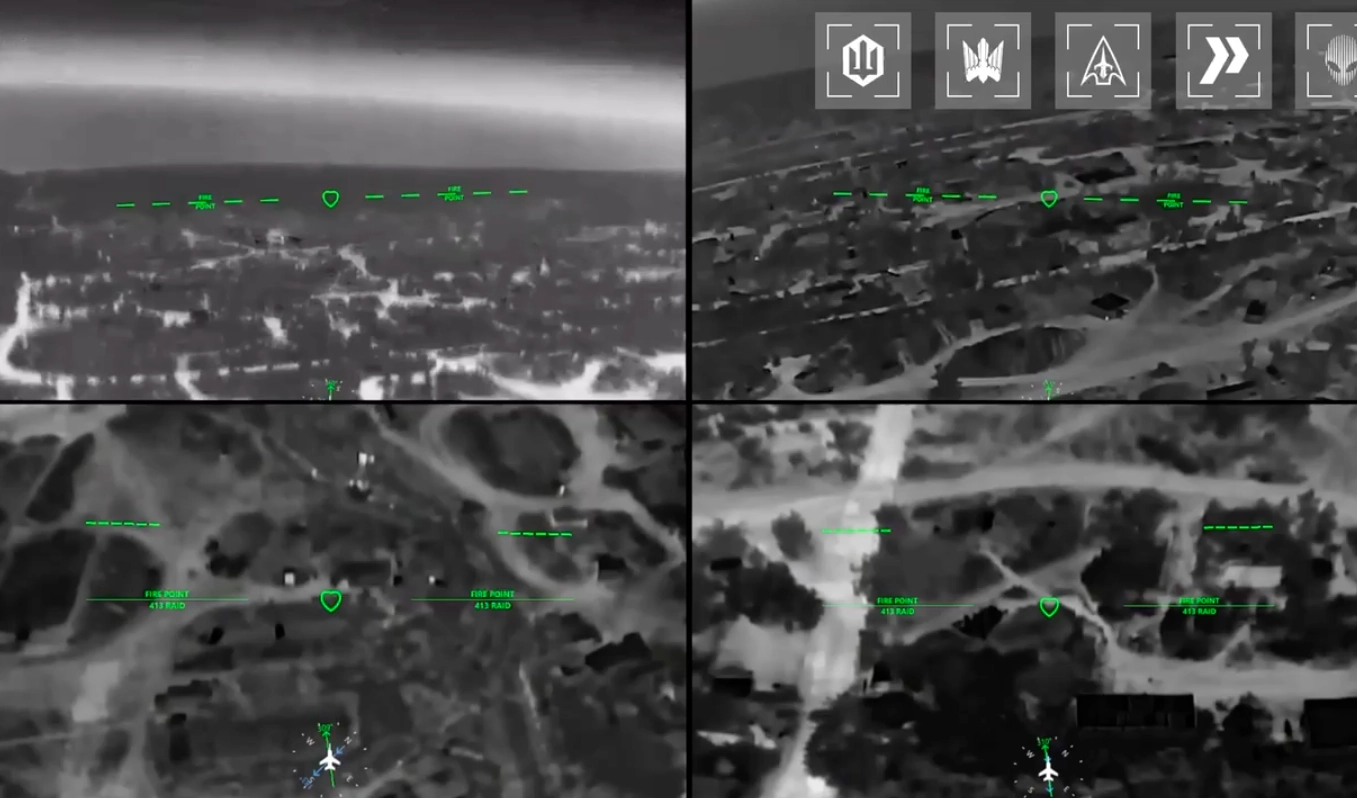
The 413th Brigade “Raid” was part of the 1st USF Center until 2024, when it was expanded and became its own unit. Its commander, Yevhen Karas, led a Ukrainian nationalist political group prior to Russia’s initial invasion of Ukraine; then, as a volunteer, he fought as an infantryman and scout with a militia unit raised in Kyiv. In 2023, he joined the 1st USF as a vice commander, and in 2024, became the commander of the 413th Brigade as a Major.
Another USF founding formation, Raid has since then specialized in long-range strikes in the Russian deep rear area, particularly energy infrastructure. In the current “middle strike” campaign, Raid has, per its reports, concentrated on Russian drone warehouses, air defenses near the cities Berdyansk and Mariupol, with additional missions flown in the Zaporizhzhia region.
The 422nd Regiment “Luftwaffe” evolved from a small scout unit assigned to a tank brigade raised from reservists at the start of the war. The unit performed all standard tactical drone missions but, over time, came to specialize in night bombing.
The 422nd’s commander, Mykola “Tyson” Kolesnyk, formed the unit largely from civilian volunteers. In recent years of the war, Kolesnyk became a proponent of unmanned ground vehicles (UGVs) and multi-domain drone operations.
Between March and June, based on posted video and combat reports, the 422nd Brigade was shifted from frontline flying to long-range strikes against Russian air defenses. In late May and June, the brigade has posted videos of strikes against fuel and freight trucks in southern Ukraine’s Zaporizhzhia region.
The 41st Regiment “Pilum” is the organic drone unit of the 1st Azov Corps, National Guard, a major ground combat organization known as one of Ukraine’s most experienced and hardest-fighting.
Azov, in its present form, was reconstituted after its forerunner unit, then a weak regiment, was destroyed by Russia during the 2022 Mariupol siege. Now the rebuilt Azov, one of the few Ukrainian units with a steady supply of volunteers, has expanded roughly fivefold its original size, as has its drone unit Pilum.
In April, during the opening phases of the “middle strike” campaign, Pilum was ordered to patrol over Mariupol and around it. In early June, Pilum announced that its aircraft had established “permanent fire control” on the main highways around the city. Pilum drones have also carried out attacks against bridges connecting the Crimea peninsula to the Zaporizhzhia region.
The 475th Separate Assault Regiment “Code 9.2” is a drone unit formed in 2022 as part of the 92nd Mechanized (later Assault) Brigade and, in that capacity, participated in heavy fighting across practically all key sectors of the front.
By August 2025, the drone element had grown almost to the size of its parent brigade and had become a specialist unit in combining ground operations with tactical drones. The commander, Major Oleksandr “Flint” Nastenko, is a career military man.
In early June, Ukraine opened a new wave of attacks targeting bridges and causeways between Crimea and the occupied territories in mainland Ukraine. Code 9.2 has been at the forefront of those attacks, launching mixed strike packages of FP-2 and Begemot drones. Freight and fuel trucks stopped because of road and bridge breaks.
You can also highlight the text and press Ctrl + Enter

Putin’s Worst Nightmare
Zelensky Reveals Intercepted Intel From Putin’s Desk