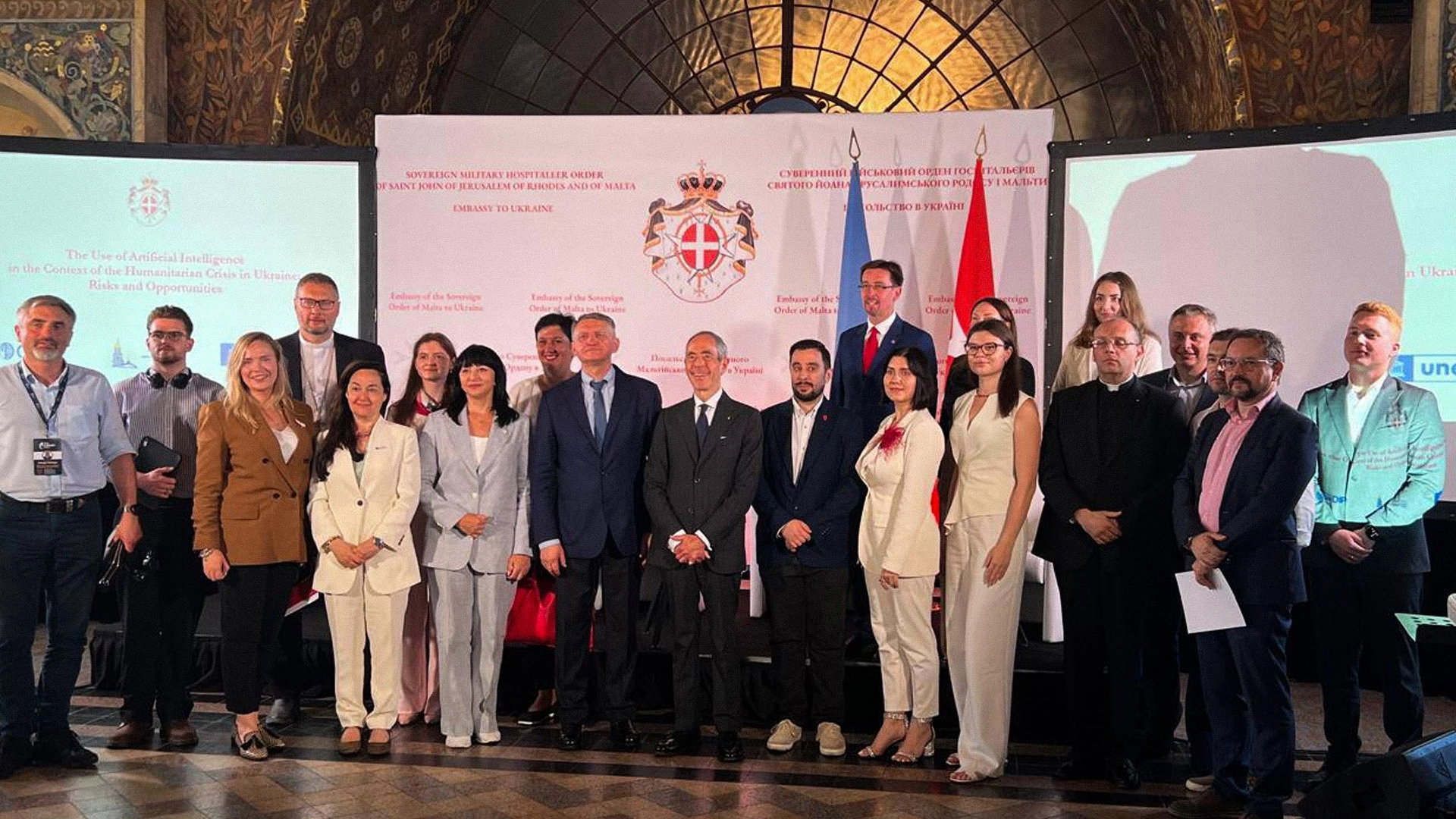
On July 2, the Embassy of the Sovereign Order of Malta to Ukraine, in cooperation with UNESCO Antenna in Ukraine and the Kyiv-Pechersk Lavra National Preserve, held the international conference “The Use of Artificial Intelligence in the Context of the Humanitarian Crisis in Ukraine: Risks and Opportunities.”
The conference explored how artificial intelligence (AI) can support humanitarian relief efforts while upholding ethical principles, human dignity, and human rights.
JOIN US ON TELEGRAM
Follow our coverage of the war on the @Kyivpost_official.
The participants included Ukrainian officials as well as representatives of UN agencies, UNESCO, the EU, and Catholic clergy.
AI is not a neutral tool
Opening the conference, Ambassador of the Sovereign Order of Malta to Ukraine Antonio Gazzanti Pugliese di Cotrone drew a parallel between the centuries-old humanitarian mission of the Sovereign Order of Malta and the historic Kyiv Pechersk Lavra, where the conference took place.
He noted that both institutions have devoted nearly a millennium to serving the vulnerable without discrimination.
“We find ourselves in a complex context where two major dynamics intersect: a humanitarian crisis demanding rapid, coordinated responses, and a technological transformation redefining the boundaries of what is possible,” he said.
“AI, understood not as an end in itself but as a tool in the hands of responsible people, can become the bridge between these two realities,” he added.

Monaco Issues Arrest Warrant for Ukrainian Woman Over Parcel Bombing
The ambassador highlighted AI’s growing importance in damage assessment, humanitarian demining, healthcare, mental health services, logistics, countering disinformation, and preserving Ukraine’s cultural heritage. Looking beyond the war, he said AI could also become an essential instrument for rebuilding infrastructure, restoring education, and supporting the country’s long-term recovery.
Meanwhile, he warned that technological progress cannot be separated from ethical responsibility.
“AI is never neutral,” he said. “It reflects the data, choices, values, and goals of those who design and use it. Innovation must therefore always be accompanied by responsibility, respect for privacy, human dignity, and fundamental rights.”
Ukraine should not become “experimental laboratory”
In one of the conference’s strongest appeals, the ambassador cautioned against treating Ukraine as an experimental laboratory for emerging technologies.
“My appeal is that the Ukrainian people should never become an uncontrolled laboratory for experimentation,” he said. “Respect for the suffering, dignity, and resilience of this great nation must always come first. AI should remain a tool to alleviate suffering and rebuild what violence has destroyed.”
The conference’s ethical dimension was further explored by Don Fulvio Berti, who presented the Catholic Church’s evolving reflection on AI through the teaching of Pope Leo XIV.
“The question is not technology itself,” Berti said, summarizing the Pope’s position. “The real question is how humanity chooses to use it.”
Drawing on recent papal messages and church documents, he argued that AI offers enormous opportunities for healthcare, education and humanitarian work while also creating profound ethical challenges involving human dignity, justice, children’s development and social responsibility.
Quoting Pope Leo XIV, Berti emphasized that technological capability should never be confused with wisdom.
“Access to information should never be mistaken for intelligence,” he said. “True wisdom lies not in possessing vast amounts of data, but in recognizing the deeper meaning of human life.”
He concluded that responsibility, cooperation, and education must guide the development of AI so that technology strengthens rather than replaces human relationships.
In other discussions, representatives of the EU delegation to Ukraine, alongside humanitarian institutions and officials, discussed legal regulation, psychological recovery, education, humanitarian demining, strategic communications, humanitarian coordination, and the practical deployment of AI technologies in wartime.
While participants acknowledged AI’s transformative potential, a common conclusion emerged throughout the conference: Innovation must always be guided by ethics, accountability, and the protection of human dignity.
Concerns over AI
Despite its utility, AI has long been a contentious field, raising ethical concerns over bias, privacy, and accountability. Because it learns from human data, it can repeat discrimination in areas such as hiring, policing, healthcare, and banking.
The concerns also pertain to battlefield usage.
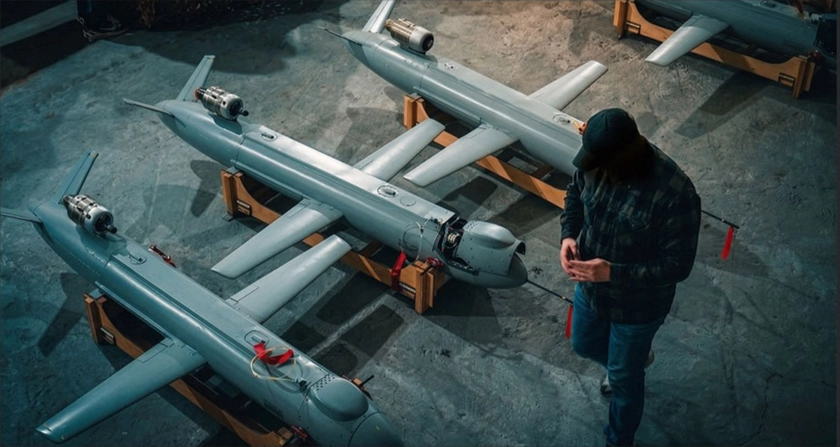
Ukraine has increasingly relied on AI in combat, using it to consolidate data and plot flight routes for long-range strikes inside Russian territory.
In January, Ukraine launched the “Brave1 Dataroom” alongside US tech firm Palantir to consolidate combat data to counter Russian drone strikes, an initiative hailed as a “game changer” by Defense Minister Mykhailo Fedorov at the time.
Frontline troops from Ukraine and Russia also use AI-based image recognition for “last-mile” targeting, allowing drones to identify and strike targets even when electronic warfare disrupts the pilot’s control link.
But as AI targeting gained traction in Ukraine and beyond, observers have also raised concerns over the lack of human oversight in lethal strikes and called for better safeguards.
AI usage in propaganda has also raised concerns over misinformation and disinformation.
In April, Ukrainian researchers identified more than 1,000 “deepfake” videos forming part of a structured “narrative kill chain” – a modular disinformation system built to target soldiers, civilians, and Western audiences with tailored messaging.
In May, the US-based Institute for the Study of War (ISW) noted a surge of AI-generated fake videos from Russia to portray false battlefield gains in Ukraine.
You can also highlight the text and press Ctrl + Enter