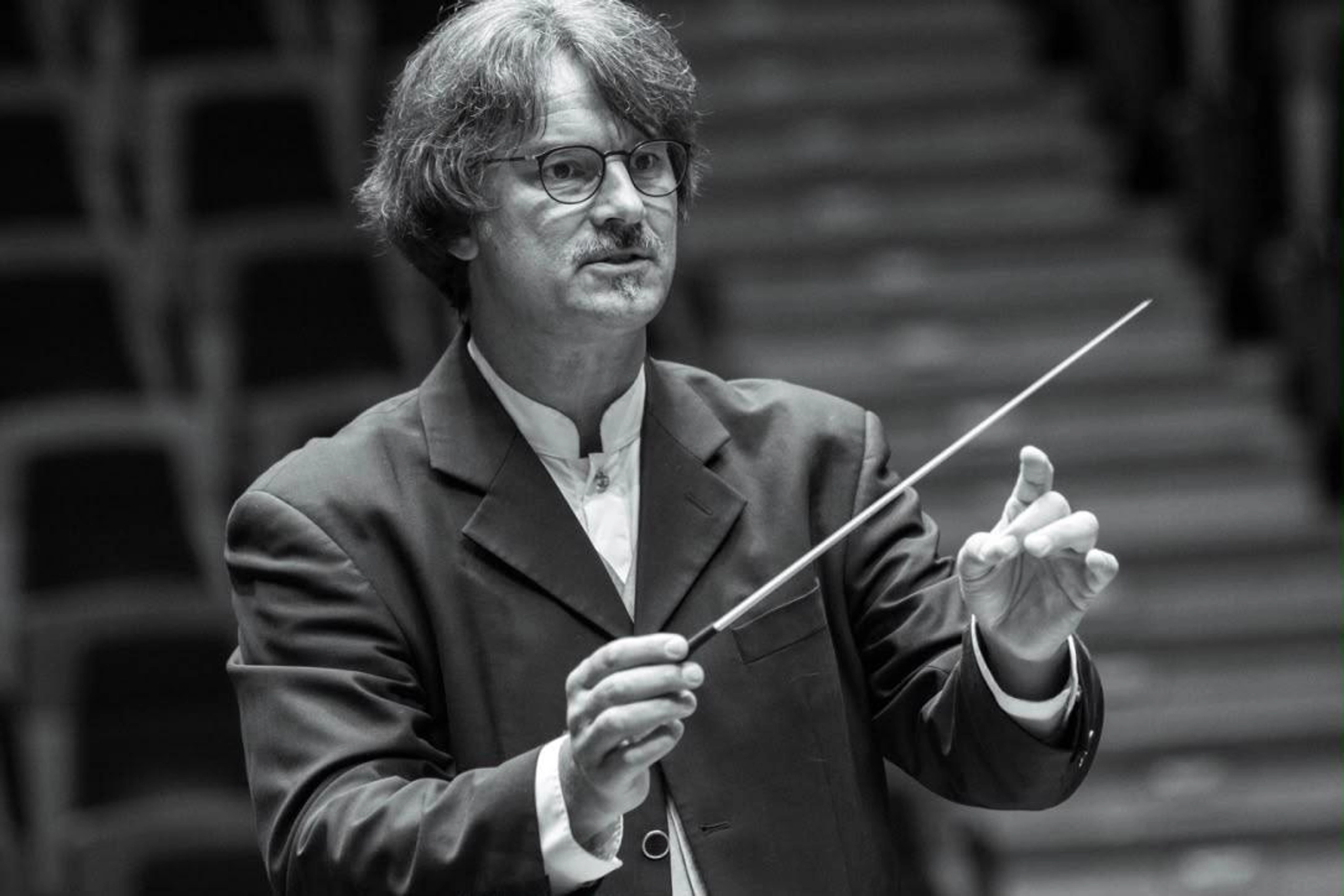
German conductor Milko Kersten arrived in Lviv this week with two objectives. One is to conduct a masterclass for young Ukrainian conductors. The other – and perhaps more significant – is to lay the foundation for a long-term partnership between the Carl Maria von Weber University of Music Dresden and the Mykola Lysenko Lviv National Music Academy.
The initiative, launched amid Russia’s full-scale invasion of Ukraine, aims to expand academic exchanges, strengthen institutional cooperation, and support the next generation of Ukrainian musicians through international collaboration.
JOIN US ON TELEGRAM
Follow our coverage of the war on the @Kyivpost_official.
Building a long-term partnership
On July 17, Kersten will lead a conducting masterclass for five students of Lviv National Music Academy, focusing on works by Ludwig van Beethoven and Johannes Brahms.
The class will be offered on a voluntary basis as a gesture of solidarity with Ukraine.
The visit follows Kersten’s first trip to Ukraine in February, when he accompanied a humanitarian convoy to Brody and Lviv. During the visit, he toured the Brody Music School and Lviv National Music Academy, where he met Professor Zinaida Ostafiichuk. Their discussions resulted in plans for the summer masterclass and a broader vision of institutional cooperation between the two conservatories.
As a member of the Academic Senate of the Dresden Music University, Kersten hopes the initiative will develop into a lasting partnership involving academic exchanges, joint educational projects, and closer ties between German and Ukrainian music institutions.
EU, Ukraine Officially Sign Drone Deal
Why Ukraine matters
Although raised in what was then East Germany, Kersten says he only began discovering the richness of Ukrainian culture after 2014.
“Only since 2014 have I become aware of the great intellectual richness that Ukrainian culture represents, and I am eager to learn more about it,” he told Kyiv Post.
He says his motivation extends beyond music.
“I want to share my experience with young musicians and encourage them to persevere in their commitment to a democratic, European-humanist Ukraine.”
“We musicians are one big family”
Kersten recalls that his first visit to Ukraine left a profound impression.
“We musicians are one big family. For centuries, we have known no borders and feel that cultural diversity is not a threat, but an enrichment.”
At the same time, he says, the reality of war was impossible to ignore.
“During my first visit, I felt the war in Ukraine at every moment and in every place. The many war graves in towns and villages deeply affected me.”
However, what impressed him even more was the resilience of Ukrainians.
“I met people who continue their daily lives with remarkable dignity and solidarity. The proverbial Ukrainian hospitality was overwhelming.”
Back in Dresden, Kersten shared these experiences with his students.
“I tried to teach them that peace and freedom are great privileges for which we in Germany should be grateful. That alone is enough motivation for me to continue supporting Ukraine.”
A lifetime dedicated to music
Kersten has been affiliated with the Carl Maria von Weber University of Music Dresden since 1996, where he serves as music director of the opera class and a member of the Academic Senate.
Over the past three decades, he has conducted leading orchestras across Saxony, led the Saxon Youth Orchestra on international tours, and taught orchestral conducting for more than 25 years.
Since 2019, he has chaired the Saxon Music Association and currently serves as Deputy Head of Dresden’s Office for Culture and Historic Preservation. He is also a member of several national expert commissions, including Germany’s National Youth Orchestra and the German National Classical Music Competition.
Music as cultural diplomacy
For Kersten, the masterclass in Lviv is only the beginning.
He hopes the cooperation will deepen ties not only between the music academies in Dresden and Lviv, but also between the music schools of Dresden and Brody, creating new opportunities for students and educators in both countries.
In a time when Russia continues to target Ukraine’s cultural institutions, initiatives like this demonstrate that international partnerships can become another form of resilience – strengthening education, preserving artistic traditions, and reinforcing Ukraine’s place within Europe’s shared cultural landscape.
You can also highlight the text and press Ctrl + Enter
OPINION: The Bill for Crimea Comes Due for Putin