President Emmanuel Macron and French officials over July 13-14 announced an arms assistance package for the transfer of advanced fighter jets, anti-aircraft systems, cruise missiles, precision-guided bombs and interceptor missiles to Ukraine in an agreement for long-term bilateral military cooperation almost unprecedented in modern French history.
Ukraine cooperates closely with several allied states in military procurement, most visibly in sea drones with Great Britain, in artillery systems with Denmark, in artillery shells and armored vehicles with Germany, and in fighter jets via a Norway-Netherlands-Denmark coalition. However, with a few minor exceptions, none of those countries has committed to helping Ukraine field cutting-edge, big ticket weaponry, even less to produce and upgrade it in Ukraine.
JOIN US ON TELEGRAM
Follow our coverage of the war on the @Kyivpost_official.
The F-16 fighters now operated by Ukraine’s air force, for example, are on average 30 years old and were considered obsolete by the states that donated them.
The French commitment to arm Ukraine with France’s very best weaponry, and to help Ukraine manufacture it as well, is for Kyiv the first-ever, full-on commitment by an allied state to arm the AFU with major, big-ticket weapons systems and to operate and upgrade them as an allied state over the long term.
For France the strategic ambition of the Ukrainian package is only roughly comparable to a 2016 $7-8 billion deal with India for the transfer of 36 Rafale fighter jets, but in that deal plans for long-term manufacturing in India fell through.
Russia Redeploys Air Defense From Arctic Circle to Fend Off Ukrainian Drones
For the most part the equipment will come from existing French military stocks and increased French production. A portion of the French assistance will be financed by EU mechanisms and revenues tied to frozen Russian assets.
Besides those transfers, the agreement cements for the joint development of a Ukraine-led anti-ballistic missile air defense project called FREYJA, along with Denmark, France, Germany, Italy, the Netherlands, Norway, Spain, Sweden and the United Kingdom.
Conspicuous by its absence is the United States which, if the French-led initiative succeeds, could find itself locked out from high-earning arms exports to NATO states Washington currently almost monopolizes: precision-guided bombs, ballistic missile interceptor systems, and long-range, surgically accurate cruise missiles.
The SAMP/T and SAMP/T NG air defense system (Transfer + follow-on version licensed production)
This is a heavy air defense system that uses advanced radars to detect flying targets like airplanes and then uses modern communications and a sophisticated interceptor missiles called Aster-30 to shoot the target down. An entire SAMP/T battery according to open sources costs about $500 million and a single Aster-30, depending on the variant, costs between $2-4 million.
Critically for Ukraine, whose homes and businesses Russia bombards with difficult-to-hit heavy ballistic missiles weekly, newer iterations of SAMP/T, particularly the latest SAMP/T NG with enhanced radars and improved guidance system, have a fair chance of intercepting a ballistic missile. To date, France and Italy each have sent Ukraine at least one system. Ukraine has said it needs about 25 systems like SAMP/T to protect the entire country from unimpeded Russian ballistic missile strikes.
Another advantage to SAMP/T, from the Ukrainian point of view, is that unlike the competing and by some measures more effective US Patriot system, SAMP/T and Aster-30 missile deliveries to Ukraine have been stable and mostly unaffected by French domestic politics. In February 2025 the US shut down arms deliveries to Ukraine repeatedly, at times leaving Ukrainian Patriot gunners to watch on their radars as unimpeded Russian ballistic missiles smashed into a Ukrainian town or city, because Washington had stopped shipping Patriot ammunition.
The deal announced Tuesday commits France to send two more SAMP/T systems to Ukraine by the end of 2026 and between four and eight upgraded “NG” systems in coming years. Deliveries of Aster-30 interceptor missiles, currently in catastrophically short supply, are slated to increase by October.
Aster-30 missile production capacity will be a limiting factor with only around 100 missiles currently manufactured annually and output reportedly only on track to increase to 300 missiles a year by 2028. Since Russia has been typically firing 50-70 ballistic missiles at Ukraine per month, even if all of France and Italy’s new Aster-30 missiles were sent to Ukraine, there still would not be enough interceptor missiles to stop the Russian attack missiles.
The cheaper, Ukraine-led FREYJA interceptor missile is being touted as a solution, but the weapon is still on the drawing board. Executives from the manufacturer Fire Point have said experimental FREYJA missiles might be launched by late 2026, provided a foreign partner can provide a guidance system for the weapon.
Rafale fighter jets (transfer)
Manufactured by Dassault, the Rafale fighter jet is a modern 4.5-gen combat aircraft superior to practically all planes operated by the Russian Air Force, and so advanced that even the best fighters operated by the Ukrainian Air Force are obsolete by comparison.
The aircraft is by design multi-role but, for the AFU, Rafale’s greatest advantages are state-of-the-art sensors, other electronics and engineering that would allow a Ukrainian pilot to take on his Russian counterpart on at least equal terms in a worst case, and usually on superior terms with the Russian flying at a serious disadvantage.
Exported to several countries, the Rafale typically costs $80-110 depending on customer and sales terms. There has been no announcement of planned transfer of the crown jewel of French military aviation, the world-class Meteor air-to-air missile, from France to Ukraine.
The deal commits France to send 16 Rafale fighter jets to Ukraine. Marcon said training for an initial four Ukrainian pilots would start “soon,” in 2026. French media has reported the first operational aircraft probably would reach air space over Ukraine in 2028, and that Kyiv and Paris are discussing longer-term supply that might build for Ukraine a 100-aircraft Rafale fleet in future.
Ukraine and Sweden recently announced plans for the Ukrainian air force to field a Swedish fighter jet comparable to the French Rafale, called Gripen, with Sweden donating 16 older Gripens and committing to building up to 150 more, with first jets operational in 2027. France’s Rafale deal with Ukraine, at least in part, is an attempt by Paris to prevent Stockholm from becoming Ukraine’s main future fighter jet provider.
Dassault usually manufactures about 30 Rafales a year and reportedly is planning a ramp-up to 35-36 a year. Currently the French air force and customers like India and the UAE will have priority to that production, so even if there is a 100-Rafale delivery to Ukraine under discussion, realistically it would be the mid-2030s before the Ukrainian Air force might actually receive the aircraft.
SCALP (Storm Shadow) cruise missiles (transfer and licensed production)
Ukraine first received small numbers of French-donated SCALP cruise missiles, as well as the British version called Storm Shadow, in May 2023 and used them most often against high value targets deep behind Russian lines that could only be hit by a highly precise weapon carrying an especially powerful warhead.
Probably the best-known Ukrainian use of those $1 million missiles, still considered the most accurate and effective long-range weapon in Kyiv’s arsenal, was a September 2023 SCALP strike hitting the Russian naval base in Sevastopol that demolished a missile submarine, an amphibious assault ship and the Russian Black Sea Fleet Headquarters as a senior admirals’ meeting was in progress. In November 2024 a SCALP/Storm Shadow salvo hit a Russian army headquarters in Kursk region Russia, reportedly wiping out most of that formation’s leadership, including a visiting North Korean general and many of his staff.
Production of SCALP had been stopped when Russia invaded Ukraine but was restarted in 2025, and by the end of 2025 France was reportedly producing 50-100 of the missiles a year. For Ukraine, whose drone forces using remote-controlled aircraft rather than missiles to hit targets deep inside Russia, that output is orders of magnitude smaller than the scale of war Kyiv is waging. In a typical night, 200 to 400 Ukrainians drones fly into Russian air space to attack targets that would be hit harder and far more destructively, if Ukraine had SCALP missiles to send instead.
According to Marcon Ukraine will receive all blueprints and full license to manufacture SCALP on its own. Assuming funding and quick Ukrainian implementation of production, over the short term a Ukrainian SCALP could fill a critical cap in AFU ability to strike and damage hard-to-hit targets like warships, aircraft shelters and bunkered headquarters, which Ukraine right now usually attacks with less-damaging drones.
Longer-term, and especially post-war, Ukrainian license-manufactured SCALP missiles – proved and enhanced by real war experience, and sold internationally by France – could be an export earner for both countries.
AASM Hammer precision-guided bombs (transfer and licensed production)
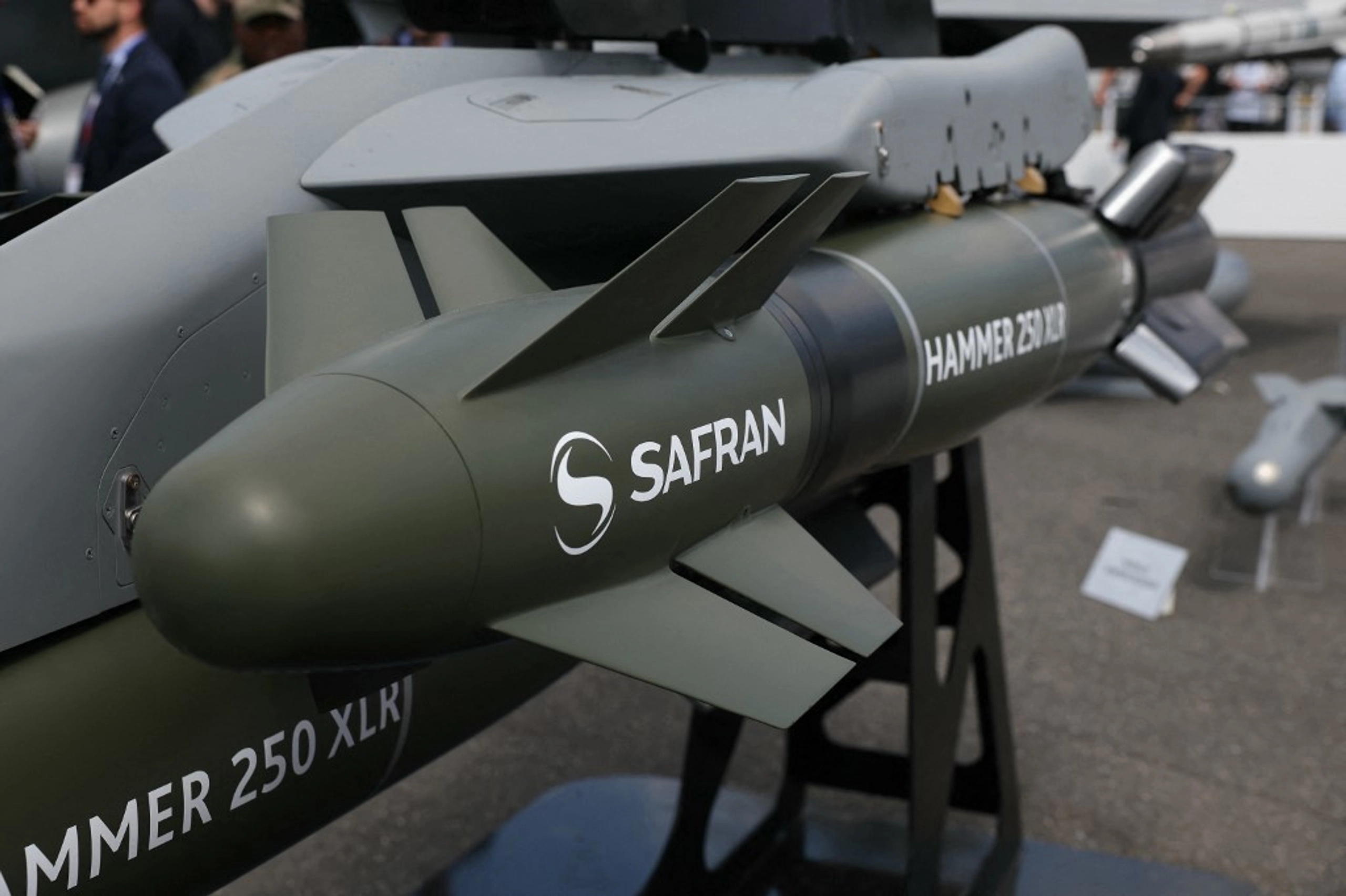
France’s AASM Hammer is a “bomb kit” with guidance ailerons and electronics fitted onto a conventional bomb, which converts it into a precision-guided munition. Stubby glider wings that fold out after the bomb is dropped extend range. The technology is not new, at $130-150,000/kit is much cheaper than a dedicated precision-guided munition like a SCALP missile, and is popular world-wide with armies with large stores of “dumb” bombs often dating back to the Cold War era.
Ukraine first used French-donated Hammer bomb kits in January 2024 and found it to be highly accurate, at least comparable to the US version of a bomb kit (called JDAM-ER), and an excellent means of hitting high value, hidden targets like Russian drone operator teams quickly. France committed to and kept to the promise of delivering 60 Hammers to Ukraine a month.
The license to produce Hammer kits in Ukraine likely will allow the Ukrainian military, which recently fielded a home-grown, less-accurate version of a bomb kit, called Vyrivniuvach (Equalizer) to upgrade all bomb kits produced in the country to Hammer-level accuracy. Like with SCALP, a functioning Ukrainian Hammer bomb kit production line, after the end of hostilities with Russia, would potentially be a solid export earner for Kyiv and the French company Safran, which manufactures Hammer and competes with US-, Chinese- and Russian-made bomb kits in international arms markets.
With the enormous advantage of being able to test upgrades and new designs in combat, Ukrainian engineers developing in country Hammer production would almost certainly learn to produce a Ukrainian version that is significantly cheaper than competitors’, and likely one that is more reliable in actual war.
You can also highlight the text and press Ctrl + Enter

OPINION: The Bill for Crimea Comes Due for Putin