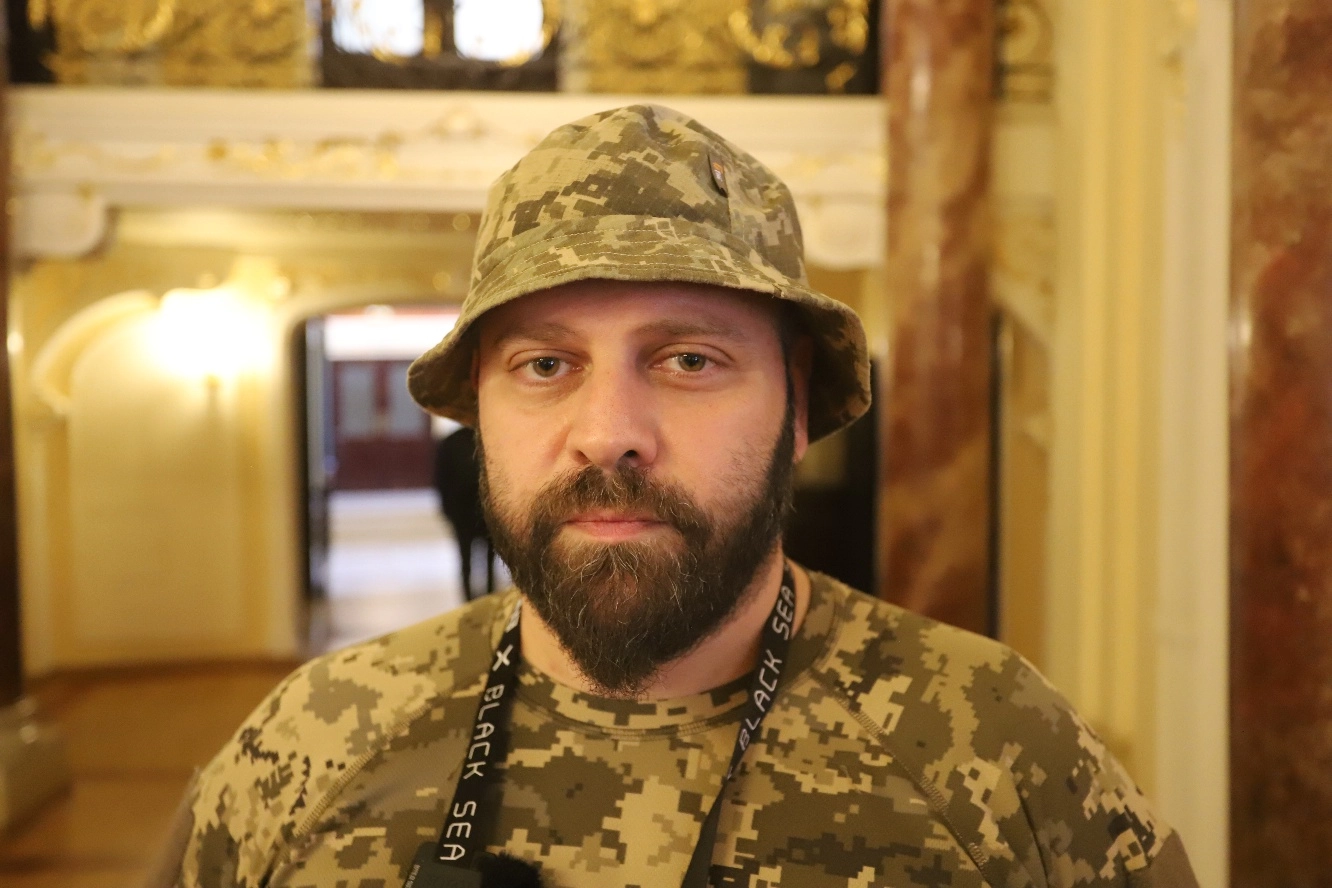
Mamuka Mamulashvili has been fighting Russian aggression since he was 14 years old, when he spent three months in captivity alongside his father during the War in Abkhazia.
For the past 10 years, he has commanded the Georgian Legion in Ukraine – the largest foreign unit in the Ukrainian Armed Forces after the Latin American formations. The legion numbers thousands of Georgian volunteers who have been fighting Russian forces long before the full-scale invasion in 2022.
JOIN US ON TELEGRAM
Follow our coverage of the war on the @Kyivpost_official.
Sergii Kostezh: Tell us a little bit about the Legion. Why have Georgians been fighting for Ukraine?
Mamuka Mamulashvili: We’ve been here for the last 12 years – some of us for the entire 12 years. Georgia and Ukraine are countries in the same region, and we have strong historical and cultural ties.
The Georgian Legion was founded by me in 2014, and Georgian fighters have been supporting Ukraine for the past 12 years. We were the first foreign volunteer unit, and in 2016 we became an official part of the Armed Forces of Ukrainian (AFU).
Today we operate in different areas, mostly in eastern Ukraine. We’re doing a good job. Most of our personnel are professional soldiers. After the full-scale invasion, we had many foreign volunteers in our unit, but today the majority are ethnic Georgians, and we recruit mainly from Georgia.
Of course, I understand this is confidential information, but approximately how many of your people are fighting for Ukraine?
Russian Strike on Kharkiv Suburbs Kills Three, Injures 20
Today, around 2,000 Georgians are fighting on the ground as part of the Georgian National Legion.
What exactly are you doing? Are you infantry, artillery, drone operators? What are your main combat roles?
We have different specializations, ranging from special operations to artillery.
Today, most of our soldiers have changed their roles and are working primarily with drones. They have become drone operators because this is currently the most promising direction for the Armed Forces. We’ve taken advantage of this opportunity, and about 90% of our personnel are now using FPV drones and other types of drones.
What’s their motivation? Some of them haven’t seen their families for months, even years. They’re living in another country, not in Georgia.
The point is that Ukrainians were the only volunteers who came to support Georgia in the 1990s.
I took part in the Russo-Georgian War of 1992-93 [the War in Abkhazia]. I was also held in Russian captivity when I was 14 years old, together with my father, who was a general. We saw only Ukrainian volunteers coming to support the Georgian Armed Forces and fighting for our independence.
So the fact that we are here today is very important to us. We have to honor those who gave their lives for Georgia’s independence. At the same time, Ukraine is our brother nation, and we will always support the Ukrainian people.
But in your homeland, today’s Georgian government is pro-Russian and isn’t really supporting Ukraine.
They are not supporting Ukraine, and they’re not supporting us either. Unfortunately, today’s Georgian government is absolutely pro-Russian. But Georgian society is pro-Ukrainian, the Georgian people are pro-Ukrainian, and we are the ambassadors of the Georgian nation here in Ukraine.
What are the relations between the Georgian Legion and the International Legion? There is information that the International Legion is going to be reorganized, but that’s not about you, is it?
We are a different unit with a different specialization. Right now we are working with different brigades.
Very soon, the Georgian Legion will become an ethnic battalion. I’m saying this publicly for the first time, but soon the Georgian Legion will become a regular unit of the AFU – not a volunteer battalion anymore, but an official military unit.
What are your relations with the other international units fighting for Ukraine, such as the Russian Volunteer Corps and others? They’re fighting for Ukraine, but they’re Russians. How do you communicate with them?
We mostly have good relations with the Caucasian battalions here, especially the Chechen battalion.
We don’t have much contact with the Russian or Belarusian units. However, if they are fighting for the right cause and supporting Ukraine, then of course that’s a good thing. I hope they are motivated by their beliefs, because in the end we’re all doing the same job.
What can Georgian officers, soldiers, and military personnel learn from this war and later apply in the Georgian Armed Forces?
From the very beginning, we were sharing our experience with the AFU. Back in 2014, the Ukrainian army had very little experience fighting the Russian Armed Forces. We already had that experience, and we shared it with them.
But we have evolved together throughout this war. Today, many of our soldiers who are moving into drone units are learning from Ukrainian drone operators and taking their courses.
All of the experience we’ve gained over these 12 years is extremely valuable. We are special forces and have participated mainly in special operations. Now we are also adapting to new roles as drone operators.
This experience will be very important for the future of the Georgian Armed Forces because these soldiers will be among the very few people in Georgia with real combat experience using these new systems.
You can also highlight the text and press Ctrl + Enter