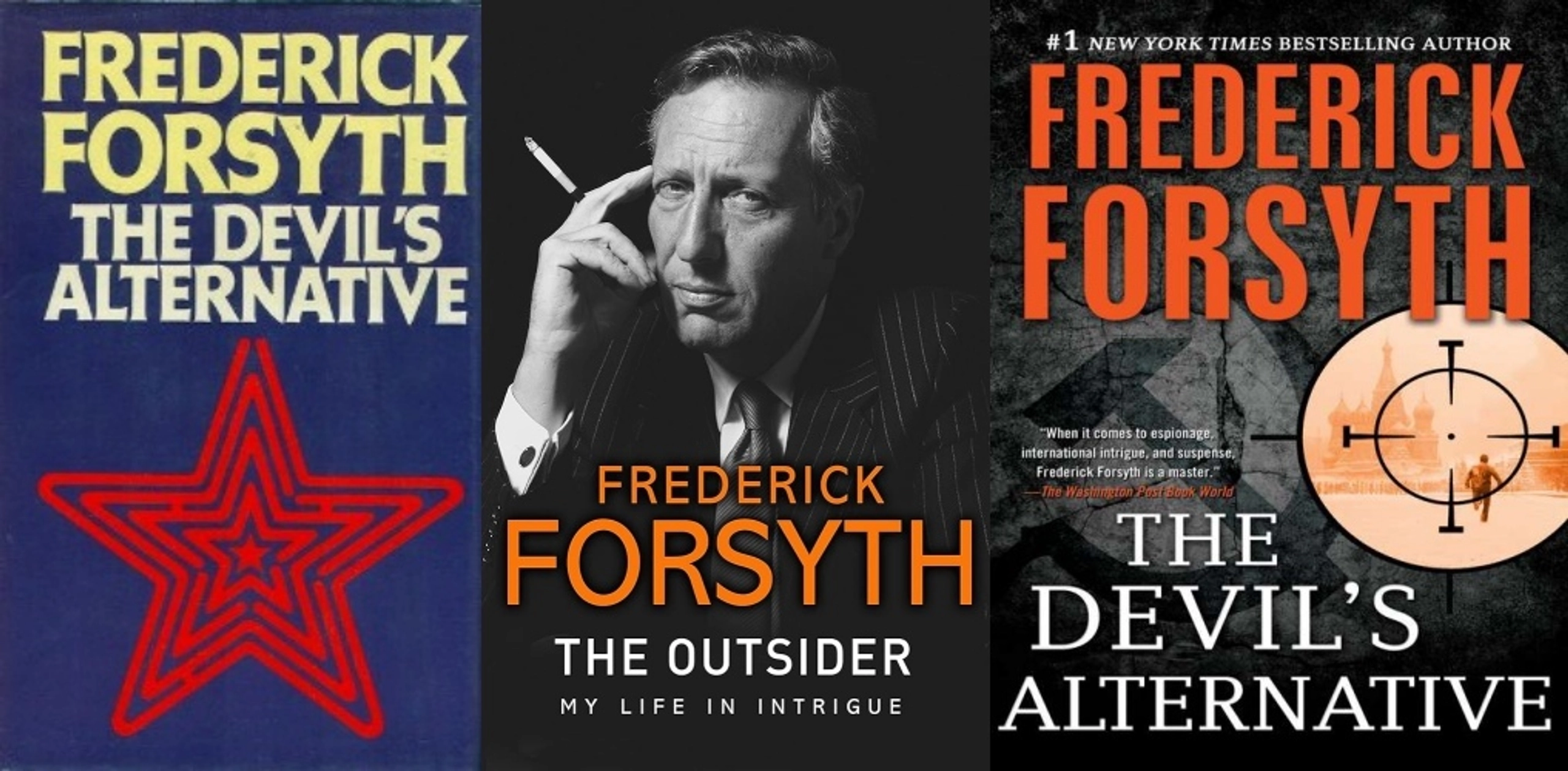
Frederick Forsyth, one of the preeminent British authors who specialized in espionage and the Cold War, died on June 9 at the age of 86. A former RAF pilot, investigative journalist and informant for British intelligence, he was best known for his novels “The Day of the Jackal” (1971), “The Odessa File” (1972) and “The Dogs of War” (1974).
Forsyth wrote 24 books, which sold a total of 75 million copies worldwide and spawned several classic films.
JOIN US ON TELEGRAM
Follow our coverage of the war on the @Kyivpost_official.
I was privileged to have known this master of the political thriller at the height of his fame in the late 1970s and to have assisted him in producing his fourth bestseller, but one with a very special difference.
“The Devil’s Alternative” was bold and prescient for its time – it appeared in 1979 but was set in 1982. The novel spotlighted suppressed Ukraine’s strive for independence when there was little interest in a country that was all too often dismissed as simply a region of Russia.
Forsyth was interested in Ukraine not just because he was an anti-communist and mild conservative. He abhorred imperialism and blurring issues with fake news and propaganda, even when London was at fault. In the late 1960s. he broke with the BBC over Biafra’s doomed struggle to break free from Nigeria, whom Britain was backing, and went back to the war-torn African region as an independent journalist to report the truth.
Ukraine Approves National Pantheon Law to Honor State Builders, Military Leaders and Cultural Icons
On his return to Britain, he quit journalism and tried his hand as a political thriller writer. His first two novels – “The Day of the Jackal” and “The Odessa File” were phenomenally successful and made into hit films.
The third – “The Dogs of War” – also did well and was turned into a film. After dealing with the civil war in Angola, which turned into a trial of strength between Moscow and its Cuban ally, on the one side, and the West relying on South African forces, on the other, he turned his attention to the Soviet Union itself.
The plot of “The Devil’s Alternative” revolved around a group of Ukrainian freedom fighters desperately seeking to draw the world’s attention to the plight of Ukraine under Soviet domination and the efforts of its heroic patriots – poets, writers, dissidents, oppositionists, political prisoners – to preserve their national identity and affirm their people’s desire for independence.
It also foresaw cooperation between Moscow and Washington to thwart the bold plan of the Ukrainian militants to further their cause through an international incident that was considered extremely dangerous and politically embarrassing at the time – the hijacking of a huge oil tanker in international waters.
In October 1978, the Evening Standard published a piece about the as-then unwritten story, which followed Forsyth’s return from Moscow and a prior declaration that he would not write another novel.

So, how did I get involved?
Well, Forsyth came up with the plot himself. As a former political journalist, he was a genius when it came to developing exciting topical stories that would not only rivet and entertain readers, but also inform and enlighten them. He researched carefully in advance and made his details as accurate and plausible as possible.
In 1978, as a young PhD student at the London School of Economics and Political Science, specializing in Soviet affairs, I was fortunate enough to be invited by Amnesty International to head the unit defending prisoners of conscience in the Soviet Union. And there were many of them, with Ukrainians being by far the most numerous among the political prisoners.
One day in July 1979, while working in my office in the organization’s International Secretariat in London’s Covent Garden, I was told by my secretary that a Mr. Forsyth was at reception and wanted to see me. I came downstairs not expecting to see Frederick Forsyth – the celebrated author.
In his gentlemanly manner, he told me he was working on a new novel and that I had been recommended to him as someone who, given its Ukrainian and Soviet themes, might be able to help him with the research and with insights. He invited me to have lunch with him, which we did at the nearby Africa Center on Russell Street.
I was flattered that Forsyth knew about me and wanted me to assist him. And, being of Ukrainian origin, I was very excited that he had chosen to shed light on the Ukrainian question.
Initially, he requested in-depth information about Ukraine, its history and the dissident movement there. But as we started to work together, he asked me to provide more specific information, including maps of Kyiv and expressions in Ukrainian that his characters might use.
Subsequently, after learning about my own background as a British Ukrainian born and raised in a patriotic Ukrainian family (in Wolverhampton, in the British West Midlands, no less), he wondered if he could use my example to base one of his characters on. I agreed, of course, and the figure appears in the book as Andrew Drake, an anglicized form of Andrii Drach.
Months later, I received a letter from Forsyth telling me that he had locked himself in a hotel room somewhere in Ireland and had finally finished the draft after five weeks of intensive work. He seemed pleased with the product.
He did not ask me to proofread the manuscript, and so unfortunately a few errors crept in that I could have corrected. The most glaring ones that were not spotted by the reviewers were that Ukrainians “write with Roman letters and not Cyrillic script” and that they are predominantly Uniate Catholics and not Orthodox Christians (he wrote, Russian Orthodox Christians). He also named the young cult poet of the early 1960s Vasyl Symonenko - Pavel.
Nevertheless, the novel was the first of its kind to deal with the still obscure Ukrainian question. As far as I know, it sold over two million copies, was on the New York Times bestseller list, and was translated into numerous languages. Unfortunately, the book was not made into a film, even though Forsyth had sold the rights to it.
When “The Devil’s Alternative” finally hit the bookshops, Forsyth delivered another pleasant surprise. I received a small parcel in the post containing an engraved silver plate and a hardback copy of his novel.
On the plate he engraved: “For Bogdan Nahaylo, With all my Thanks, Frederick Forsyth”, followed by the words of the Ukrainian national anthem, which at the time was still banned in the Soviet Union– “Shche ne Vmerla Ukraina” – Ukraine has not perished. And inside the book, Forsyth thanked me for my “enormous” help “so freely given.”
So, there you have it. An insider’s account of how, behind the scenes, I helped a famous writer draw attention to the case of Ukraine at a time when it was not in the headlines and seemed doomed to political oblivion as a supposed republic within the USSR, and treated as a province of Soviet Russia that was not only politically regimented but also intensely Russified.
Following the death of Frederick Forsyth – a passionate journalist, writer and champion of freedom and decency – this is my tribute to him and an expression of gratitude. Perhaps it will encourage others to read or re-read this novel, and a Ukrainian publisher to finally bring it out in Ukrainian.


You can also highlight the text and press Ctrl + Enter