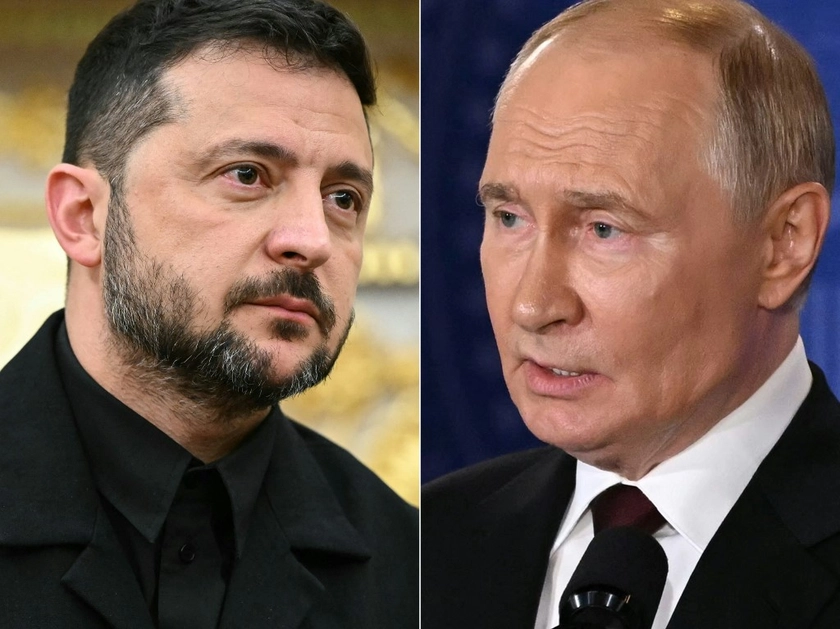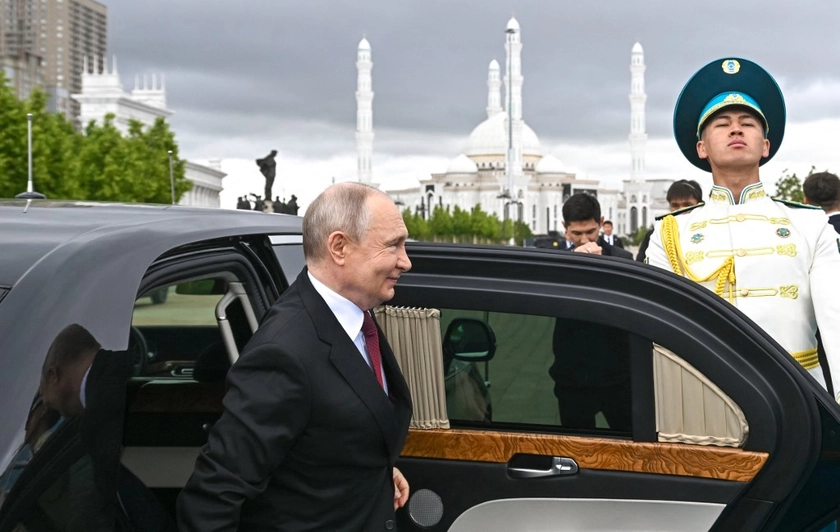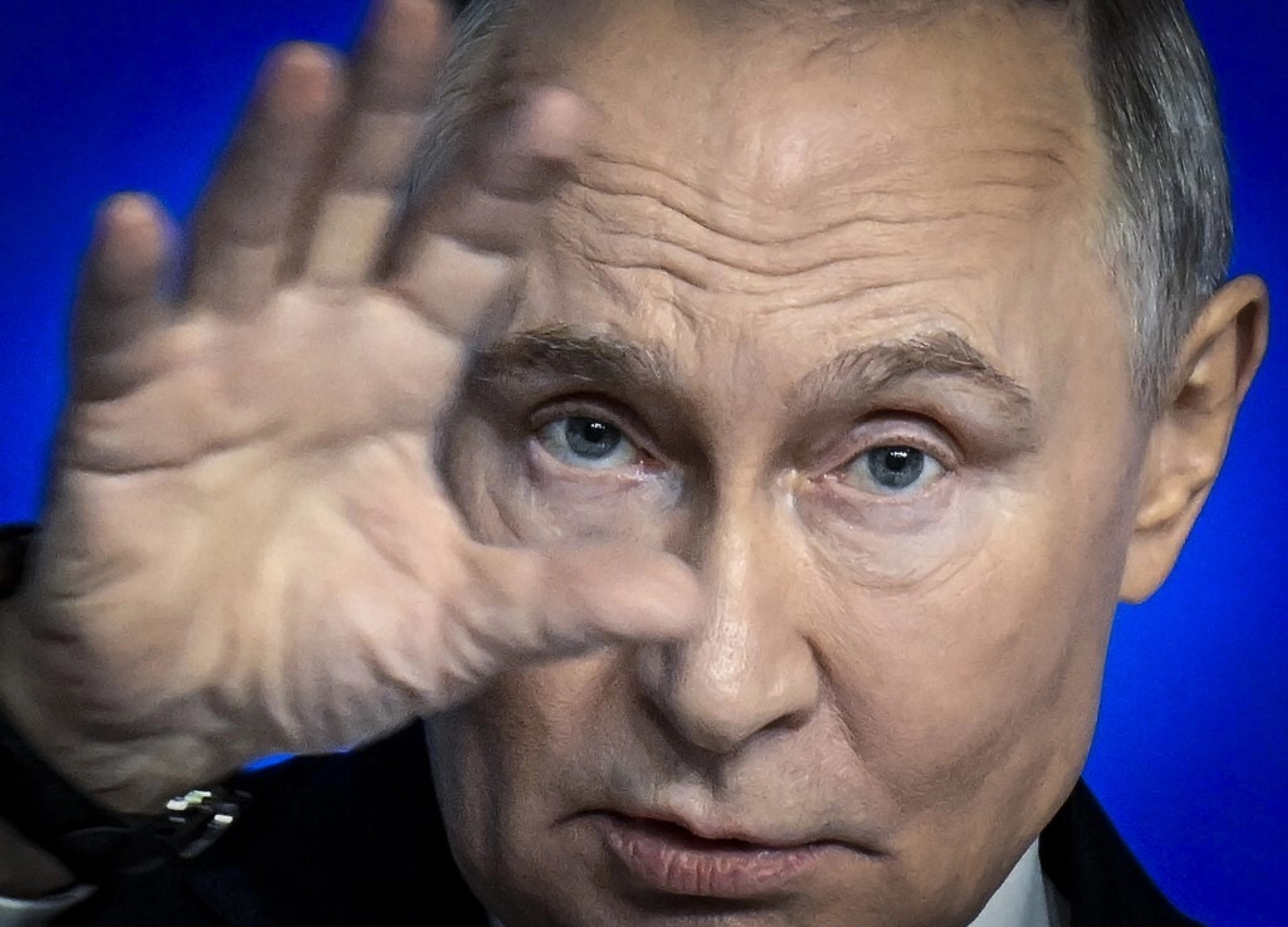
Three days before launching his full-scale invasion of Ukraine in February 2022, Vladimir Putin claimed that modern Ukraine “was wholly and fully created by Lenin’s Bolshevik, communist Russia.” Ukraine, he insisted, occupies “historically Russian lands” that belong to Moscow.
This month, he has been repeating this belligerent nonsense aimed at his own regimented population and the gullible or ignorant in the outside world.
JOIN US ON TELEGRAM
Follow our coverage of the war on the @Kyivpost_official.
These assertions have become the ideological foundation for a war that has killed hundreds of thousands.
But they raise a simple question: who actually defined Ukraine’s borders, and why won’t Putin accept them?
The answer reveals not a legitimate grievance, but imperial delusion and traditional Russian expansionist mania that threaten the post-World War II international order and peace and security not only in Europe but beyond.
So, it’s worth recalling some basic facts.
The Legal Foundation: Treaties Russia Signed
Ukraine’s current legally recognized borders weren’t invented by nationalists or imposed by the West. They emerged from the Soviet Union’s collapse in 1991. International law applied a principle holding that new states inherit existing administrative boundaries. Ukraine got the borders of the Ukrainian Soviet Socialist Republic as they existed in 1991, including Crimea, which the Soviet leadership transferred from Soviet Russia to Soviet Ukraine in 1954.
Germany Warns of Russian Orbital Nuclear Threat
Russia explicitly recognized these borders. Multiple times. In the 1994 Budapest Memorandum, Russia, along with US and UK, pledged to respect Ukraine’s territorial integrity in exchange for Ukraine surrendering the world’s third-largest nuclear arsenal. In 2003, Putin himself signed a treaty recognizing the border, including the Kerch Strait and Sea of Azov. Nobody forced Russia into these agreements.
International law is clear: territorial conquest is prohibited. This principle, enshrined in the UN Charter, emerged from World War II’s ashes. Russia, as a permanent member of the Security Council, is bound by it more than most. War crimes, ethnic cleansing and genocide are also prohibited.
Ukraine’s Perspective: Legal Boundaries, Democratic Choice
From Ukraine’s viewpoint, these borders represent legal boundaries confirmed by treaties that Russia voluntarily signed and that are internationally recognized.
Democratic choice confirmed these borders. In the Dec.1, 1991, referendum, 91% of Ukrainians voted overwhelmingly for independence within existing borders.
Even within Ukraine’s predominantly Russian-speaking regions, which had become such because of the engineered mass influx of Russians, enforced Russification, and repression. In Crimea, 54% voted yes. In Donetsk and Luhansk, 84% and 83% respectively.
Putin ignores these facts because they’re inconvenient. He prefers to refer to ancient Kyivan Rus (which existed centuries before the precursor of Russia, Muscovy, emerged) and tsarist conquests. As if democratic choices of millions of living Ukrainians matter less than the ambitions of dead monarchs and Russian tsarist imperialist historians who sought to justify imperial expansion by claiming Kyiv and its historical heritage as theirs.
Ukraine’s distinct identity long predates Lenin and the Soviet Union. For example, in 1648, French cartographer Guillaume Le Vasseur de Beauplan published detailed maps labeled “Ukraine” or “Land of the Cossacks,” reproduced across Europe for over a century.
That same year, the Ukrainian Cossack leader Bohdan Khmelnytsky launched a rebellion that became a war of liberation against Polish domination. He and his administration often used the name Ukraine for the state they established, and he accepted that it was a successor to Kyivan Rus, which had been destroyed by the Mongols in 1240.
Khmelnytsky signed a military alliance treaty with the Orthodox Russian tsar in 1654 at Pereyaslav, but died a few years later, bitterly regretting it and looking towards Sweden. However, in 1667, Muscovy and Poland partitioned Ukraine along the Dnipro River.
In 1709, another Ukrainian Cossack leader, Ivan Mazepa, sought to break Ukraine free from Muscovy by siding with Charles XII of Sweden against Peter the Great. They were defeated at the Battle of Poltava, after which Peter renamed Muscovy the Russian Empire, with himself as its emperor or tsar, and the Ukrainians were labelled “Little Russians.”
Summarizing these events, Voltaire wrote in 1731: “Ukraine has always aspired to be free.”
After the 1917 Revolution, Ukraine briefly achieved and fought for independence, gaining recognition in the 1918 Treaty of Brest-Litovsk from Germany, Austria, Turkey, Bulgaria, and even Bolshevik Russia.
The strength of the Ukrainian national movement forced Lenin to formally recognize a Soviet Ukrainian state as a constituent member of the Union of Soviet Socialist Republics, which, for Ukrainians and other non-Russians, meant the Russian empire reconstituted under new labels and a new social ideology.
In 1945, the Ukrainian SSR became a founding member of the United Nations alongside 50 other nations – a status Ukraine retained after independence.
Hardly the markings of an invented people.
Russia’s Imperial Pattern: Denying Ukrainian Existence
Putin’s border revisionism follows a centuries-long Russian pattern of denying Ukrainian identity. In July 2021, he published a 5,000-word essay arguing that Russians and Ukrainians are “one people” and that Ukrainian identity is artificial.
This isn’t historical analysis – it’s mendacious imperial ideology.
The pattern is familiar. The imperial power claims the colonized aren’t really separate but merely confused subsets of the imperial nation. Their language is a dialect, their culture provincial, their independence the result of foreign manipulation. Britain said this about the Irish. France about Algerians, Franco’s Spaniards about the Catalans. Russia has said it about Ukrainians for centuries.
In the 19th century, Russia banned the Ukrainian language in print and education. In the 1930s, Stalin engineered a genocidal famine killing millions of Ukrainians and liquidated their cultural elite.
In 2014, Russia annexed Crimea and started a war in the Donbas. Putin claims that he was forced to do this because of a Western-organized coup d’etat in Kyiv.
In fact, the Ukrainians themselves rose up against a kleptocratic president who was becoming a vassal of Russia by blocking Ukraine’s aspirations to integrate into Euro-Atlantic structures. What followed was a blatant denial by Moscow of sovereign Ukraine’s right to self-determination and its intervention into the affairs of an independent neighboring country.
In 2022, Putin’s Russia launched a full-scale invasion. Ostensibly to defend Russian-speakers in the Donbas. Yet Russian forces were not welcomed there as liberators.
What is striking is that Ukrainians who are Russian-speakers, or even ethnic Russians, but who are loyal to the democratic and inclusive values that pro-European Ukraine represents, have in fact formed the backbone of the resistance to Russia’s aggression, both as soldiers at the front and within such key cities as Kharkiv, Odesa, and Dnipro.
So, what we have is textbook imperial revisionism. Every empire claimed its conquests were reunifications, that subjugated peoples were being liberated from artificial divisions. Putin’s arguments aren’t unique – they’re standard imperial rhetoric, distinguished only by their brazenness in the 21st century.
The through-line is clear: Russia has never accepted Ukrainian independence because doing so means accepting the end of the empire. Though in this case there are clearly additional motives, such as seizing not only territory but also some of Ukraine’s considerable agricultural and mineral wealth, as well as the potential energy reserves in eastern Ukraine and the Black Sea.
The Deeper Issue: Democracy as Threat
Ultimately, though, Putin’s obsession with Ukraine’s borders isn’t really about borders and even economic resources. It’s about legitimacy.
Putin fears not NATO expansion but Ukraine as a successful, democratic, European state. An independent, prosperous Ukraine disproves the central narrative of his regime: that democracy is a Western imposition, that Russia’s imperial sphere, in which despotism is backed up the Russian Orthodox Church, is the natural order of things.
Ukraine’s 2004 Orange Revolution and 2014 Euromaidan demonstrated that Ukrainians wanted democracy and European integration, not Russian domination. These weren’t CIA plots but genuine popular movements. They threatened Putin’s model of atavistic oriental despotism by showing the alternative to Putinist neo-fascism isn’t chaos and moral decay but democracy.
Conclusion: The Choice Before the World
Ukraine’s borders were defined by international law and confirmed by treaties that Russia signed.
The Russo-Ukrainian war isn’t really about security concerns or NATO expansion or protecting Russian speakers. It’s about imperialism. It’s about refusing to accept that the age of empire is over, that Ukraine is sovereign, that Ukrainians determine their own future.
The map Putin cannot accept is the map of the 21st century. His war attempts to redraw it back to the 19th.
The question for the world is whether he’ll be allowed to succeed. The answer will determine not just Ukraine’s future, but the future of the international order itself.
The views expressed are the author’s and not necessarily of Kyiv Post.
You can also highlight the text and press Ctrl + Enter
Putin’s Worst Nightmare