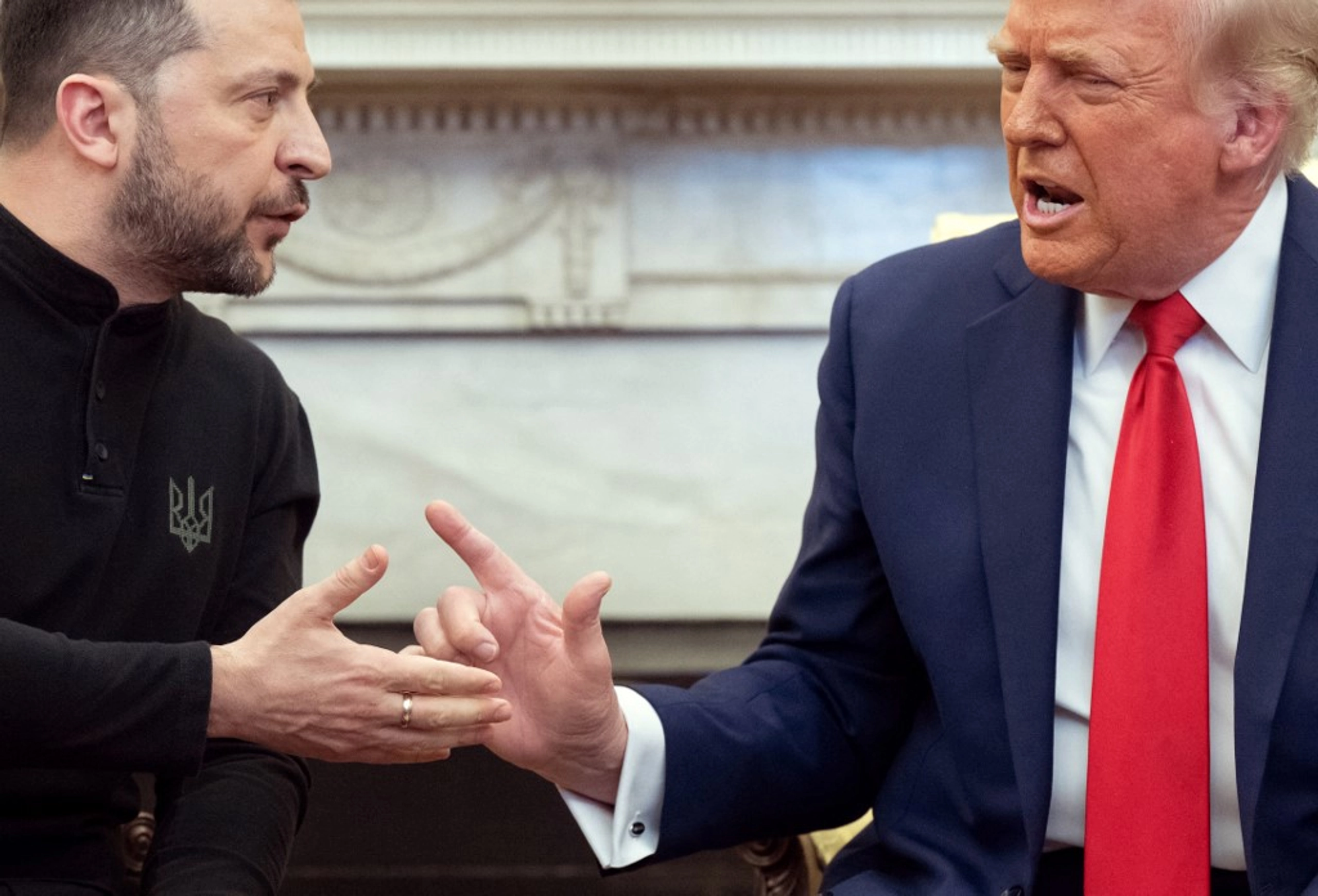
When President Volodymyr Zelensky offered President Donald Trump priority access to Ukraine’s mineral resources, he hoped to get security guarantees in return. Instead, the two signed off on a “Bilateral Agreement Establishing the Terms and Conditions for a Reconstruction Investment Fund.” Its full two-page text has recently been published in the media. However, it merely establishes the general framework and the intent to negotiate a “Fund Agreement.” It is that agreement that is to contain all the relevant financial and operational details of what is commonly known as the “mineral deal.”
Faced with the difficult choice between immediate termination of US military support and agreeing to enter a yet-to-be-negotiated future agreement, Zelensky made the right decision by opting for the agreement. Immediately afterward, Trump’s rhetoric regarding Zelensky shifted, and military supplies and intelligence support were resumed. The conditions Zelensky faced in making such a decision were as dire for Ukraine as the economic pressure it faced when it agreed to exchange its nuclear deterrence for US and UK “assurances.” The legal term for such agreements is “made under duress.”
JOIN US ON TELEGRAM
Follow our coverage of the war on the @Kyivpost_official.
Work is currently underway to draft the Fund Agreement, which, if ratified by Ukraine’s parliament, the Verkhovna Rada, will be binding on both parties. It will contain all the details about how the “mineral deal” is to be implemented, as well as the rights, responsibilities, and recourse of the two parties. Each of the two sides has appointed their working groups to hammer out the details and differences.
Ukrainian Forces Sever Occupied Kherson Railway and Strike Russian Pontoon Bridges
Trump rejected Zelensky’s early offer to trade priority access to Ukraine’s natural resource assets for US security guarantees. He did recognize the extraordinary opportunity this opened up for the United States. Access to Ukraine’s assets would put the US at the forefront of the global competition for natural resources – especially those essential for the US to maintain and leverage its technological advantage. Ukraine ranks fourth in the world in terms of the value of its natural resources, especially scarce minerals.
Unfortunately, Ukraine’s circumstances are such that it cannot afford a “time out” from the battlefield to assess, develop, and implement the most profitable strategy for monetizing these resources. Consider, for example, the security commitments a country like China could have offered in exchange for near-global control of scarce but essential assets. Instead, Ukraine’s president had to endure his host’s offensive “hospitality” and accept a counteroffer that may prove beneficial to both parties, but only if the terms are fair and balanced.
I have had the opportunity to review an early draft of the 55-page “Fund Agreement” and propose (below) several modifications that may make it more palatable – both in tone and substance – to Ukrainians, especially its Parliament.
- There is no legal, moral, or ethical justification for Ukraine to “refund” the money that President Biden had requested and Congress had authorized in support of Ukraine. It was neither a loan nor a charitable contribution. Russia remains an “existential threat,” and Putin made no secret, before his invasion, of his ultimate goal to defeat NATO and erode America’s economic and military power and leadership. Ukraine’s fight was America’s and the Free World’s fight – the one with blood, the other with weapons and money. Fifty other countries supported Ukraine, and none have requested “refunds.”
If such a precedent for a phantom claim were to be set, then perhaps Mr. Trump would agree to credit Ukraine’s account with the additional $808 billion in phantom savings that the American Enterprise Institute estimated would have cost the US taxpayer over the next five years to defend Europe and NATO against a victorious Russia. The offending language should be removed and replaced with a more appropriate and viable allocation of initial contributions to the Partnership.
- The agreement should reflect, both in tone and substance, that Ukraine owns the assets and that Ukraine is providing its US partner in this joint venture with priority access, in a prescribed manner, for the development and monetization of its resources, specifically those to be listed. Ukraine is not a third-world country, and both parties have a strong interest in the success of this venture. Inevitably, differences will arise and should be resolved amicably, rather than being imposed without consideration. Understandably, if the US were to undertake this task, it would require significant concessions and accommodations from Ukraine, as well as a long-term commitment. However, at the same time, Ukraine must retain ultimate control and have the freedom to terminate the agreement or seek appointment of another “General Partner” if its US-appointed General Partner is not up to the task.
- The agreement requires numerous waivers, restrictions, and representations from Ukraine that may be excessive. There should be a process by which operational concerns or disagreements could be resolved through arbitration without the concurrence of the General Partner or the US-dominated Board.
- In his review of the draft agreement, Pres. Zelensky should enlist the expertise of a foreign law firm (preferably from the UK) that specializes in “mineral deals.” The terms are complex and spread out over 55 pages. Lawyers without subject-matter specialty experience would be at a great disadvantage in ferreting out the “devil in the details.”
It is a great benefit to have the US International Development Finance Corporation (successor to OPIC) as the US government’s sponsoring agency and overseer. With the threat of war always looming in the background, substantial investments and years may be required to bring Ukraine’s natural resource assets to market. Additionally, it will take time and a significant political commitment for Ukraine to overcome corruption and distrust in its judicial system, both of which are prerequisites for attracting foreign investment. Without US government sponsorship and the application of US law, finding investors would be a significant challenge.
President Trump correctly recognizes that America’s interest in the peaceful co-exploitation of Ukraine’s assets, along with the presence of US personnel and equipment, would serve as a deterrent to Putin. His “mineral deal,” as modified, is precisely what Ukraine may need in the interim to escape the grasp of oligarchs like Dmytro Firtash, Rinat Akhmetov, and Ihor Kolomoisky while its younger generation watches, learns, and improves.
Notwithstanding the distrust many Ukrainians may have towards the US president, they should avoid throwing the baby out with the bathwater. On the other hand, without significantly greater Ukrainian control – at all stages of the operation – no agreement is better than simply handing over the nation’s most valuable assets to a foreign power for an indeterminate period.
The views expressed in this opinion article are the author’s and not necessarily those of Kyiv Post.
You can also highlight the text and press Ctrl + Enter