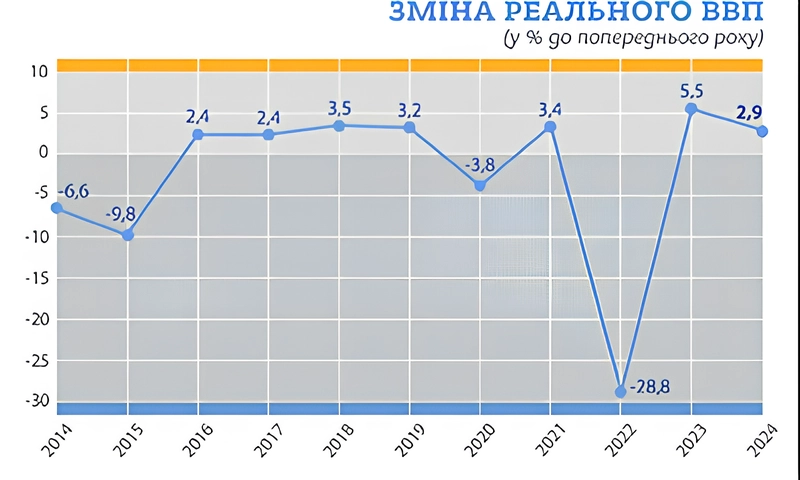
Ukraine’s State Statistics Service estimated that Ukraine’s real GDP grew by 2.9% in 2024, as opposed to the 3.4% previously reported by Ukraine’s central bank.
The estimations turned out to be even lower, despite the central bank having already accounted for Russia’s strikes on Ukraine’s energy infrastructure when it reported decreased GDP growth in the second half of 2024.
JOIN US ON TELEGRAM
Follow our coverage of the war on the @Kyivpost_official.
Ukraine’s central bank, the National Bank of Ukraine (NBU), said its January Inflation Report included “reassessment of potential GDP due to further losses of production factors and the continued impact of strikes” in its macroeconomic forecast table.
According to Ukraine’s updated official statistics in 2025, the real GDP fell by 28.8% in 2022 after Moscow launched its full-scale invasion of Ukraine in February of that year.
While the GDP recovered and grew by 5.5% in 2023, the growth has slowed down to 2.9% by 2024.
Reasons for updating the figures
After Ukraine’s State Statistics Service announced the new figures, the central bank said the growth decrease was “predictable” due to lower harvests, continued energy deficit, and worsening security.
However, the central bank said Ukraine is still recovering despite its ongoing fight against Moscow’s invasion, including the attacks on Ukrainian energy infrastructure.
The central bank attributed weaker harvests in the second half of 2024 as the key cause for the lowered GDP forecast.

‘Die Together’: Ukraine’s LGBTQ Soldiers Fighting Russia – and for Their Rights
“The actual growth rate of real GDP turned out to be lower than the National Bank’s estimate published in the January 2025 Inflation Report (3.4%). This was partly due to a renewed decline in GDP in Q4 2024 (by 0.1 percentage point), driven by a significant contraction in agricultural output (down 30.3% year-on-year),” the central bank wrote in its press release.
Kyiv Post previously reported that drought in 2024 caused grain harvests to plummet by 4.6 million tons and vegetable harvests to decrease by 0.7 million tons compared to 2023.
The drop caused a chain reaction: prices increased for raw food products, then processed food products, and eventually meal costs for Ukrainians dining outside.
Prices of raw food products also led to the rising costs of livestock feed, fueling prices of livestock products.
The central bank expected that drought would cause additional price pressure but underestimated the extent of its impact on prices – drought, on top of war-caused factors, led to a 13.4% inflation spike in February 2025.
“These factors turned out to be stronger than we had expected,” NBU Deputy Governor Sergiy Nikolaychuk previously told Kyiv Post in an exclusive interview, explaining the impacts of war and poorer harvests on Ukraine’s economy.
“The intensity of military activity in the fourth quarter of 2024 was higher than we had anticipated, and this factor intensified inflationary pressures,” Nikolaychuk said. “These increased costs, combined with other factors, have been passed on to prices to a greater extent.”
The central bank also tied the real GDP decrease to a comparison base effect. The State Statistics Service raised the real GDP for the fourth quarter of 2023 upon revision, meaning real GDP for the end of 2024 was compared to higher figures in 2023.
“A contributing factor was also the upward revision of the comparison base following the State Statistics Service of Ukraine’s adjustment of the Q4 2023 economic growth figure as part of its regular GDP data updates,” the central bank wrote.
You can also highlight the text and press Ctrl + Enter