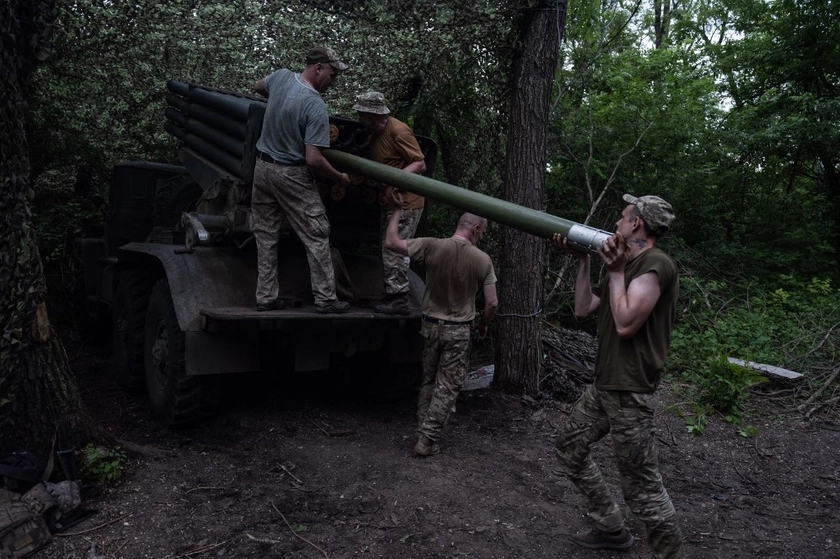
After relying on light-infantry assaults to advance in late 2024 and early 2025, thanks to the efficiency of Ukraine’s drones to neutralize incoming tanks and armored personnel carriers, leadership in Moscow appears to be returning to the original game plan of sending tanks, motorcycles and even civilian cars to carry invading forces toward the front lines, the Institute for the Study of War (ISW) reports.
Luhansk Group of Forces spokesperson Lt. Col. Dmytro Zaporozhets said over the weekend that Ukraine’s Armed Forces (AFU) repelled a “reinforced company-sized Russian mechanized assault” toward Stupochky (south of Chasiv Yar) and Klishchiivka (southeast of Chasiv Yar) with 13 armored vehicles, several civilian vehicles, and an unspecified number of motorcycles on Sunday in the occupied Donetsk region.
JOIN US ON TELEGRAM
Follow our coverage of the war on the @Kyivpost_official.
A Ukrainian brigade operating in the Novopavlivka area also published footage on Monday showing Russian forces conducting a reinforced company-sized mechanized assault with more than 20 armored vehicles, including more than 10 infantry fighting vehicles and several tanks.
ISW reported that the same brigade noticed Russian forces attempting to advance in a wave of motorcycles ahead of the attacking armored vehicles to “swiftly reach Ukrainian positions.”
Another Ukrainian brigade operating nearby stated that a Russian assault near Vilne Pole (northwest of Velyka Novosilka) were met with Ukrainian forces who destroyed two tanks and 12 infantry fighting vehicles.
Despite strikes on Ukraine, Russian advances slow, analysts say
Meanwhile, the Ukrainian National Guard published footage on Monday of Russian forces conducting a reinforced company-sized mechanized assault with three tanks, 18 infantry fighting vehicles, an unspecified number of MT-LB armored fighting vehicles, and 41 motorcycles in an unspecified area around Zaporizhzhia.


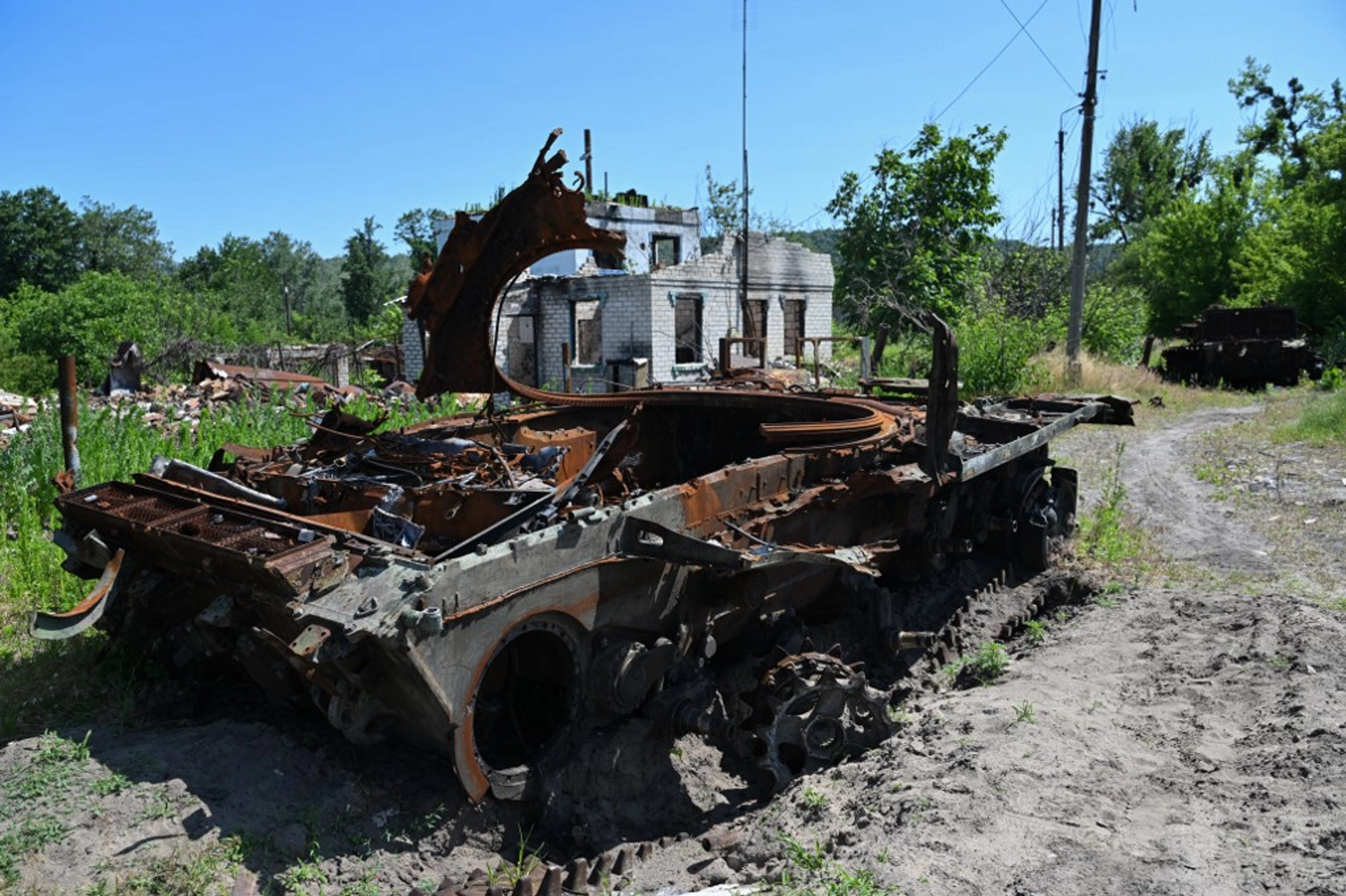
ISW noted: “Russian forces have been augmenting mechanized assaults with civilian vehicles, motorcycles, and all-terrain vehicles (ATVs) since late Fall 2024 after limiting their use of armored vehicles across the entire frontline, likely due to concerns about unsustainable armored vehicle losses in Summer and early Fall 2024. Russian forces largely relied on small infantry groups to advance in Ukraine and used armored vehicles to transport infantry to the frontline and as fire support for infantry assaults in late Fall 2024 through Winter 2024-2025.
“Russian forces continue to attack in small infantry groups along the frontline but may be recommitting armor to frontline assault operations as part of a general intensification along the entire frontline,” the think tank analysts wrote.
ISW had previously assessed that Russia’s defense manufacturers cannot produce new armored vehicles and artillery systems at rates that could offset Russia’s current rate of losses in the long term, and Russian forces “are likely using these alternative civilian vehicles in assault operations to bolster such assaults amid concerns about dwindling supplies of Soviet-era armored vehicles.”
You can also highlight the text and press Ctrl + Enter