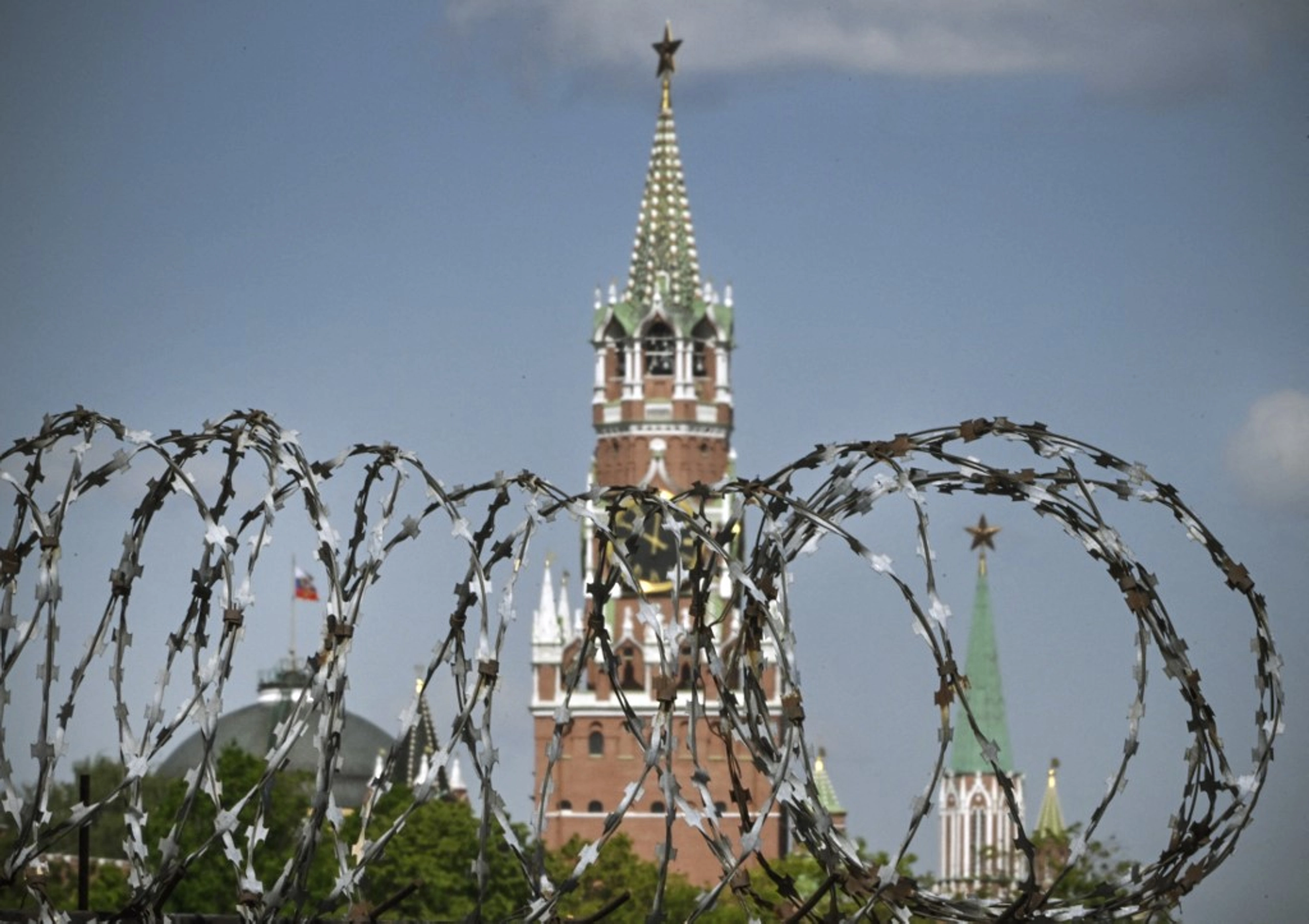
Two Russia scholars at London’s prestigious Chatham House – Dr. Ben Noble and Nikolai Petrov – discuss the alarming trajectory of Russia under Putin.
Dr. Ben Noble: On May 14, a Moscow court sentenced Grigory Melkonyants – co-chairman of the Golos election monitoring group – to five years in jail for working with an “undesirable organization,” given the past affiliation of Golos with the European Network of Election Monitoring Organizations. What explains this harsh sentence? What challenge, if any, did Melkonyants present to the regime?
JOIN US ON TELEGRAM
Follow our coverage of the war on the @Kyivpost_official.
Nikolai Petrov: The essence of political repression lies less in neutralizing real threats than in cultivating and sustaining an atmosphere of fear. This fear is achieved by sending deliberate signals and enforcing sweeping obedience through frequently harsh and public punishment of dissenting voices.
The danger Melkonyants posed was not so much a result of his election-monitoring activities. It was the mere fact of doing something seen as defying the regime. In the eyes of the authorities, acts of defiance must not go unpunished, as they could set a precedent and snowball out of control.
‘‘As the regime becomes more entrenched, even the slightest expression of doubt about its absolute legitimacy or infallibility is treated as subversive.’’
This does not mean that the regime always escalates immediately in response to dissent. Often, the regime operates on the principle of “calibrated sufficiency”: the state’s initial strategy is to try to squeeze dissenters out of the public political arena – or, ideally, out of the country altogether.
Kasparov: Ukrainian Flag in Sevastopol Is the Shock Russia Needs to Accept Empire Is Dead
Only if individuals remain defiant does the state escalate to harsher punitive measures.
The sentence for Melkonyants comes at the same time as high-profile searches and detentions across Russia that appear to be the latest wave of domestic repression. What’s going on?
The FSB, in coordination with the Ministry of Internal Affairs, the Investigative Committee, and the National Guard, conducted “preventive and prophylactic operations” across 81 Russian regions. The stated aim was to pre-empt the spread of “violent ideology, mass killings, and suicide” among young people. In the process, law enforcement detained 57 administrators of Telegram channels and chats, accusing them of disseminating “neo-Nazi and terrorist” content.
Meanwhile, a case against the publishing house Eksmo was revived two-and-a-half years after it began, with multiple arrests of current and former employees. The case was initiated in January 2023 with the publication of a book deemed to promote “gay propaganda.”
These are recent, high-profile examples of sprawling, drawn-out, and often blatantly fabricated criminal cases. They are less the result of direct political orders from the Kremlin and more a reflection of law enforcement bodies demonstrating their eagerness and utility to the regime.
These cases are bureaucratic reflexes – responses by security officials to an overall tightening of the political climate. They are also expressions of personal motivation: an attempt by these functionaries to earn plaudits and promotions from the safety of the rear, rather than risking deployment to the frontlines in the continuing war against Ukraine.
‘The state is now shifting its focus to the ‘insufficiently loyal’.’’
This descent into punitive paranoia echoes a well-worn Soviet trajectory. Putin himself has paraphrased Stalin’s infamous doctrine of escalating class struggle as socialism advanced. During a state award ceremony on November 27, 2018, the Russian president remarked: “My colleague just said he believes the challenges we are facing are temporary. I would like to disagree. The further we go, the higher we climb, the more difficult it will become.”
In the Stalinist playbook, “progress” justified growing repression. In the Putinist version, the same logic holds – but now applied to “internal enemies” considered broadly, rather than “hostile classes.”
It is no coincidence that, in this context, the state is cultivating Stalinist nostalgia. This includes renaming Volgograd’s airport in Stalin’s honor and the restoration of his bas-relief in the Moscow metro. These are not isolated acts of commemoration, but, rather, ideological cues, reinforcing a climate where repression is not only possible but normalized – and, at times, celebrated.
Up to this point, we’ve referred to the authorities, the regime, the state, and the Kremlin interchangeably and as a unitary actor, albeit with some bottom-up initiative. But does that reflect reality?
There are competing interests at various levels of the power hierarchy – within different institutions, security agencies, and political clans, and down to individual actors. These interests do not always align with, and may even directly contradict, the goals of the Kremlin.
This fragmentation has been exacerbated by Russia’s hardened confrontation with the West. As the constraints once imposed by international scrutiny and the desire to maintain appearances have eroded, internal power struggles have become less restrained.
This fragmentation is also a natural outcome of the “fortress under siege” mentality: when the state defines itself as encircled by enemies, the lines between regime survival, institutional opportunism, and personal ambition, blur – with increasingly chaotic consequences.
You can also highlight the text and press Ctrl + Enter
Russia Hit by 660-Drone Overnight Barrage Targeting Moscow, Crimea and Key Military Sites