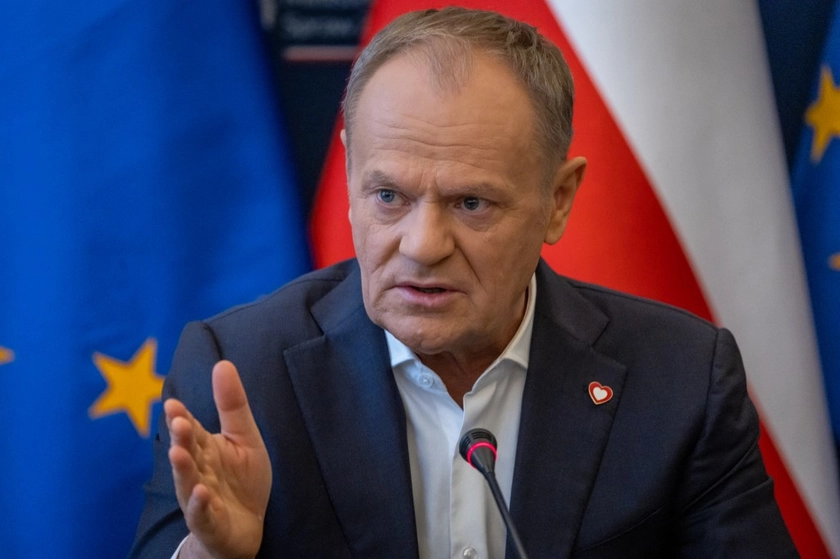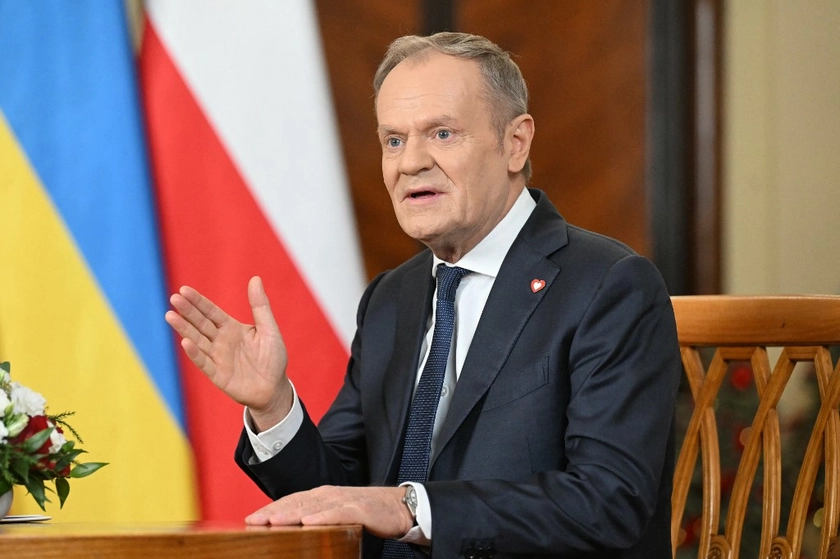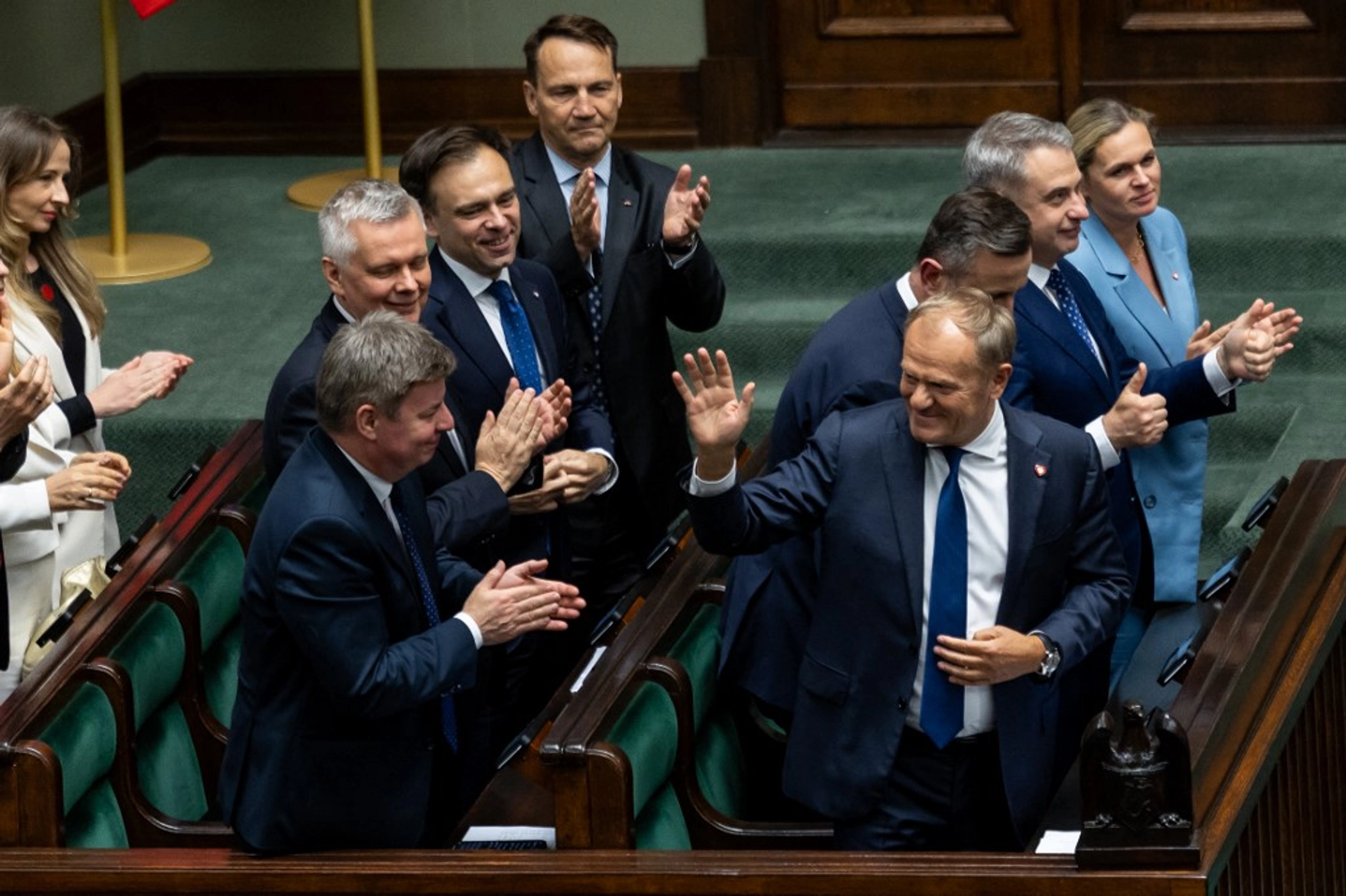
Poland’s prime minister, Donald Tusk, won a vote of confidence in the lower house on Wednesday afternoon, guiding his fragile coalition through its most public test since the presidential election defeat of the government’s candidate, Rafał Trzaskowski.
The victory, by 243 votes to 210, gives Tusk’s government a short-term reprieve after over a week of internal feuding, external attacks, and mounting pressure from the opposition since Law and Justice-aligned Karol Nawrocki’s victory in the presidential runoff on June 1.
JOIN US ON TELEGRAM
Follow our coverage of the war on the @Kyivpost_official.
But with Nawrocki set to take office in August and coalition partners angling for concessions, the result is likely only a pause in the turmoil, not its end.
Winning the vote gives Tusk breathing room, but the real test will be whether he can impose order on his coalition, regain momentum and push through a government reshuffle before the political climate becomes even less forgiving.
The immediate stakes
Tusk’s goal in calling the vote was to reassert control. Trzaskowski’s loss exposed tensions long bubbling beneath the surface and triggered calls from within the coalition for a strategic reset, a streamlined cabinet and clearer leadership from the prime minister.As Tusk told party members, the vote was meant to “give himself and the Civic Coalition a breather” after the electoral defeat while forcing coalition partners to show whether they were still committed to the project.
Bus Traffic at Medyka Checkpoint Continues Despite Repairs, Minister Says
If the government failed to win the vote, the constitution would hand President Andrzej Duda the right to nominate a new prime minister.
Inside the coalitionAfter a year and a half in power, the ruling coalition, made up of Tusk’s Civic Coalition (KO), The Left and centrist grouping Third Way, has struggled to deliver on its core campaign promises, from judicial reform to women’s rights, fueling growing unease among its own partners.
Donald Tusk’s personal approval rating has dropped steadily, reaching just 36% in the latest IBRiS poll for news site Onet; 59% of respondents say the country is heading in the wrong direction.“[KO] thinks it deserves to win,” wrote Joanna Mucha of centrist coalition partner Polska 2050, a former KO MP now serving as deputy education minister, in a scathing Facebook post. “They gave voters an unelectable candidate and were surprised he lost.”The agrarian Polish People’s Party (PSL) took a more tactical approach. PSL circulated an internal survey asking members whether they would support forming a government with PiS and the far-right Confederation, which was almost certainly a pressure tool rather than a real option.
Senior PSL figure Marek Sawicki warned that the government’s Achilles’ heel remains its stalled efforts to hold the previous administration accountable and added that if it were up to him, he would replace Tusk as prime minister.
Yet the message was that their loyalty had limits. Polska 2050, for its part, issued a five-point list of demands to Tusk ahead of the vote, including new legislation on depoliticizing public media, reforming state-owned companies and banning smartphones from schools.
Leader Szymon Hołownia, who drew fire for allegedly sabotaging Trzaskowski’s campaign with his ill-judged appearance at the debate in Końskie, is now battling for his own political survival as his support in the election dropped below 5%.The Left stayed loyal, but not uncritical. They backed Tusk in the vote but insisted that social housing and labor protections be prioritized.
The confidence vote
For Wednesday morning’s vote, MPs were recalled from abroad, including Civic Coalition’s Aleksandra Uznańska-Wiśniewska, who cut short a trip to Florida, where her husband is preparing for a NASA mission that will see him become only the second Pole to go into space.
Addressing the lower house before the vote, Donald Tusk reasserted authority and outlined a political reset. He insisted the vote was not about defending the past but “renewing the mandate” for governing in difficult conditions.
Almost all PiS MPs were absent from the chamber during his speech in a pointed gesture of contempt.
“We have 2.5 years of hard work ahead, under pressure from a hostile presidency and a still-powerful opposition,” Tusk said. “But ten million Poles just told us: keep doing your job.”
Tusk highlighted government achievements, citing social spending levels “well above the EU average” and pointing to the 62 billion złoty spent on the 800+ child benefit program in its first year, nearly four times more than under PiS’s first year of 500+.
He said nearly one million people had already registered for the new widow’s pension and repeated that only Polish firms would be prioritized in the construction of CPK, Poland’s new central airport.
He promised structural changes in July’s cabinet reshuffle, including a new government spokesperson. But he also drew red lines: no anti-Ukrainian rhetoric, no return to “witch hunts” and no amnesty for PiS-era abuses. “No fraud, no theft, no abuse will be swept under the rug,” he said.
Tusk reaffirmed his commitment to holding the previous government accountable, referring to ongoing investigations into PiS-era abuses. “We will not back down by even a millimeter,” he said.
“Few expected we’d see a country where the president hides suspects in his palace, people pursued by the state,” Tusk added, in an apparent reference to former ministers who have avoided detention by staying within the presidential chancellery.
In response, PiS MP Przemysław Czarnek accused Tusk of “serving German interests” and demanded he resign “instead of making a foolish request.” Confederation and the Left also lined up to attack.
Adrian Zandberg of left-wing Razem scoffed at claims of professionalized governance, asking if hiring party loyalists and internet trolls counted as reform.
A record 267 MPs signed up to speak during the debate, Sejm Speaker Szymon Hołownia confirmed.
While the final tally is 243 to 210, the legal consequences of failure would have been immediate. Under Article 160 of Poland’s Constitution, a lost vote of confidence requires the prime minister’s resignation and gives the president the first right to nominate a successor.
In late 2023, President Andrzej Duda used that same mechanism to install a two-week PiS government under Mateusz Morawiecki, despite its lack of majority support.
Opposition attacks
The lead-up to the vote gave the opposition a stage to go on the offensive. Party leaders called for Tusk’s resignation and proposed the formation of a “technical government” that could replace the current coalition without fresh elections.
Confederation, buoyed by strong post-election polling at over 20%, was listening. Its co-leader, Sławomir Mentzen, openly expressed interest in discussing such an arrangement, only for PiS leader Jarosław Kaczyński to dismiss the idea of talks, citing Mentzen’s youth and low number of MPs as disqualifying factors.
The exchange underlined that, for now, both parties remain unified only in their attacks on the government.
Government reset
With the vote secured, attention now turns to the much-talked-about cabinet reshuffle. Donald Tusk has signaled that the cabinet overhaul will take place in July, just before Karol Nawrocki assumes the presidency.
The timing is deliberate, as a reset then allows Tusk to reassert control on his own terms, rather than wait for a hostile president to start shaping the political agenda from the palace.
Among the expected changes are “deeper cuts” to the number of ministries, replacement of underperforming ministers, and the long-postponed naming of a government spokesperson, an issue raised repeatedly by coalition partners, particularly Poland 2050 and the Polish People’s Party.
Talks are ongoing about the merger of ministries, such as digital affairs and infrastructure, which would signal a reversal of the earlier expansion in government posts, especially junior ministers, that Tusk authorized to satisfy the demands of multiple coalition partners.
Tusk also faces pressure to bring in new political faces, especially from younger or less visible wings of the coalition.
While no names have been confirmed, the logic is to show renewal and unity, delivering visible change before Nawrocki can use the presidency to undermine the government from above.
You can also highlight the text and press Ctrl + Enter