Millions of locusts are swarming villages and chewing their way through crops in Ukraine’s southern Dnipro and Zaporizhzhia regions, and in Russia-controlled territory in Crimea, officials and news reports on both sides of the fighting line said this week.
Thick concentrations of the grasshopper-similar insects also were reported in Ukraine’s southern Kryvyi Rih, Kherson, and Odesa regions, as well as the central Vinnytsia region. Local media on Thursday and Friday reported the densest swarms in the Zaporizhzhia region, where isolated locust sightings were first reported last week.
JOIN US ON TELEGRAM
Follow our coverage of the war on the @Kyivpost_official.
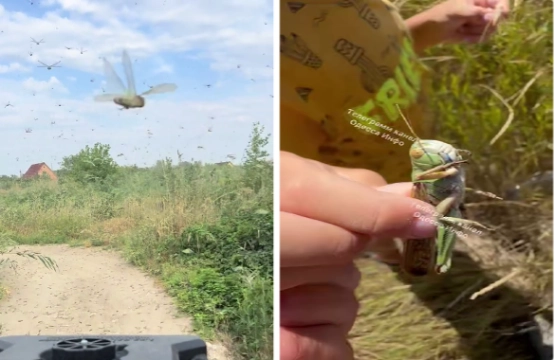
Video images recorded in the southeastern Dnipro region showed thousands of insects infesting a village with a reported 50 locusts a square meter of wall or road, and masses of flying locusts clouding a town center. Radio Liberty, in a Wednesday report, showed near-Biblical bug concentrations in the air and on trees:
Two species – the Migratory Locust (Locusta Migratoria) and the Egyptian Locust (Anacridium Aegyptium) – have been reported present on the ground and in the air. Based on news reports over the past seven days, the locusts’ main body appeared possibly to be moving east.
Andriy Piatnitsky, vice head of Ukraine’s Zaporizhzhia region, in Wednesday comments to local media said: “There is no (direct) threat to people. Yes, it (the locust swarms) looks horrible. Yes, there are huge numbers of bugs, the sky is full of them, but once again, I say that this is not a threat for the life and health of citizens.”
UK Signals Readiness to Support Kyiv-Pechersk Lavra Restoration
A Ukrainian government agency linked the locusts’ mass appearance with an abnormally dry Spring along the Black and Azov Sea north shores, and damage done to local ecosystems by more than three years of conventional war.
The Ukrainian state consumer protection service, Dzerzhprodpoziv Sluzhba, in a press release, said that the Russian military’s demolition of the giant Kakhovka hydroelectric dam on the Dnipro River likely helped increase the density of the swarms.
The June 6, 2023 breach of the dam by Russian army-set demolition charges ruined power generation capacity and emptied a 150-kilometer (93-mile) reservoir upstream. Flooding killed 50-100 people and forced thousands from their homes.
The swampy lowlands that had once been underwater, left behind after the dam breach, are an ideal locust breeding ground, a public service announcement entitled “What Is Important to Know About Locusts?” published on Thursday by the agency said.
Aside from the now-dry Kakhovka reservoir, no-man’s land and un-worked farmland near the fighting front are potential additional productive locust breeding grounds in the region, because combat activity prevents farming and tilling of fields, increasing the size of potential locust habitat. The front line between Russian and Ukrainian troops in Ukraine’s Zaporizhzhia and adjacent Donetsk region is some 150 kilometers (93 miles) long and in most places 30-40 kilometers (19-25 miles) wide.
Land on both sides of the lower Dnipro River is mostly flat steppe. Often consisting of deep black earth loam, it is some of the world’s most productive farmland. Crops most often raised in the region include wheat, corn, soy, and sunflowers – reportedly the locusts’ preferred food.
The independent Ukrainska Pravda news magazine, in a Thursday article, reported extermination work had succeeded in limiting swarm growth in the Zaporizhzhia region, but that in the Kherson region, the bugs destroyed 27 square kilometers (10.4 square miles) of sunflowers before they were contained.
A Saturday statement by the Russian state agency Rozzelkhotsentr said that locusts had already destroyed 200 hectares of corn in (Kremlin-controlled sections of) the Zaporizhzhia region, particularly in the Vasylivsky district. A statement by that Kremlin-controlled agency likewise linked the appearance of locusts to dry weather and extensive disuse of farmlands, creating excellent conditions for massed locust breeding.
“The insects are in the stage of active development, which will significantly complicate taking steps to deal with them,” the statement said in part.
Andrei Siguta, a Kremlin-appointed official in the occupied Crimea region, said authorities have the situation under control and that “steps are being taken” to prevent mass assaults by the insects on crops.
“We are already working on steps, that will help in the future to limit the damage and prevent the expansion of this menace,” Siguta said in Wednesday comments reported by the pro-Moscow KP Zaporozhia news platform. “We are doing everything we can.”
You can also highlight the text and press Ctrl + Enter

Putin’s Worst Nightmare
Zelensky Reveals Intercepted Intel From Putin’s Desk