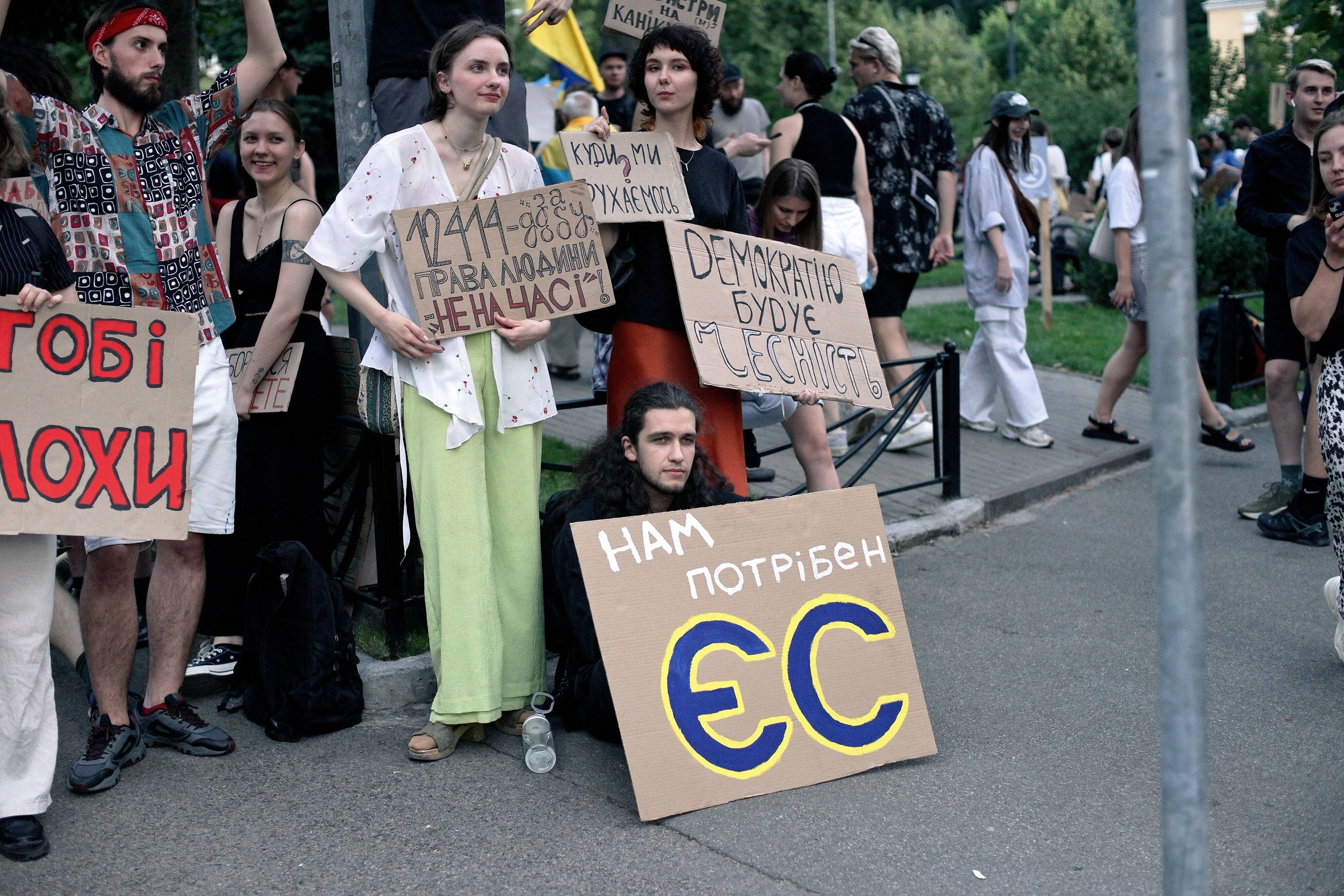
The protests in central Kyiv have yielded results. President Volodymyr Zelensky responded to the mass rallies by announcing and submitting to parliament draft law No. 13533 on Thursday, July 24 meant to restore the dismantled independent status of the National Anti-Corruption Bureau (NABU) and the Specialized Anti-Corruption Prosecutor’s Office (SAPO).
However, the protests are ongoing, as demonstrators do not trust the authorities following the controversial vote in the Rada two days earlier, during which many procedural rules were violated. They await a vote.
JOIN US ON TELEGRAM
Follow our coverage of the war on the @Kyivpost_official.
Young men – Why are they here and not at the front?
Among the critics of the protests, the question of why young men are at the rallies instead of at the front has come up repeatedly. The question “Why aren’t they at the front?” has been asked not only by foreign readers and viewers but also by Ukrainian soldiers, who are irritated by the seemingly carefree gatherings of men in the city center.
“Can we expect that the next rally you all attend will be for replenishing the blood-drained brigades with personnel, allowing those who have been serving nonstop for over three years to rotate?” military serviceman Dmytro Larin remarked sarcastically.
However, among the military, there’s also an opposing viewpoint – that dismantling anti-corruption bodies is a rollback of reforms, and corruption demotivates soldiers at the front. Therefore, protests against reactionary moves are justified and logical.
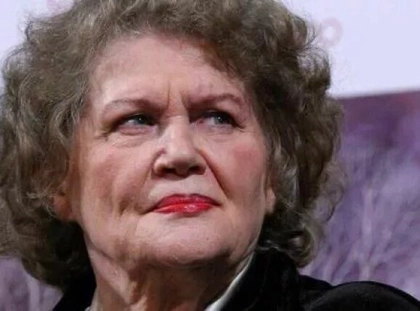
Lina Kostenko – Ukraine’s Poetic Sphinx, Turns 96
“In all my time in service, I’ve understood one thing: if there’s one demand common to all military personnel, it’s justice. We want to finally live in a world of objectivity, legality, and order. Nothing demotivates more than seeing someone looting the country while you sit in a trench and your comrades die. Are we dying so they can rob?” wrote Sergeant Yehor Firsov of the 110th Brigade of the Armed Forces of Ukraine, a former lawmaker who has been fighting at the front for three years
The presence of men at rallies rather than at the front can be explained by several factors.
First. The majority of protesters – even on the most crowded protest day, Wednesday, when about 10,000 people gathered – are young people, especially women.
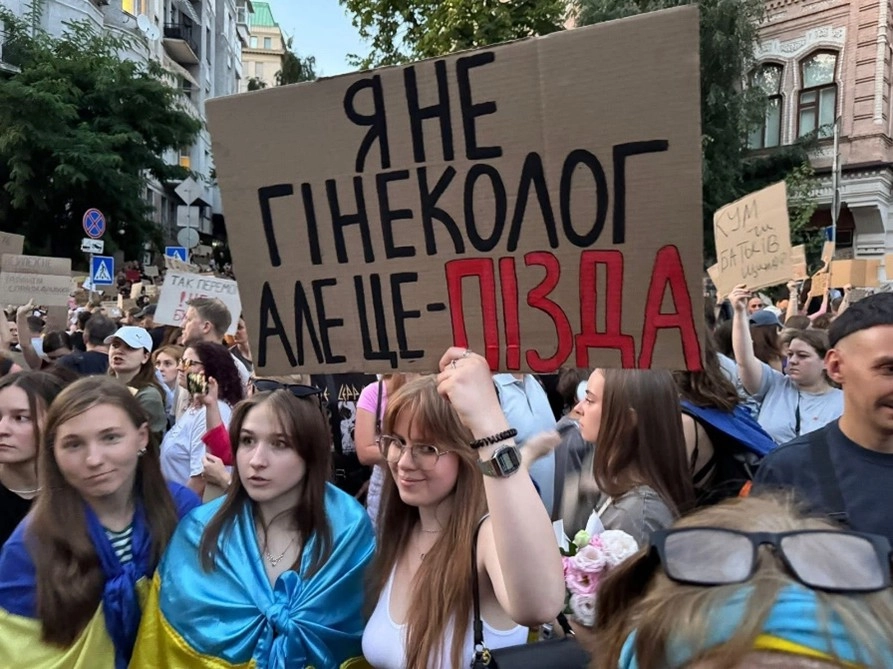
Regarding women, the mobilization law clearly states that women are mobilized voluntarily – even those required to register for military duty (such as medics and pharmacists). Meanwhile, thousands of women have voluntarily joined the armed forces, with some serving for over ten years, dating back to the anti-terrorist operation (ATO) period.
Okay, but what about the men?
Young men in Ukraine under the age of 25 are not subject to mandatory mobilization under current law. The only exception is reserve officers. Previously, the age limit was 27, but it was lowered.
Why is that? After all, historically, young people have been the backbone of armies.
The problem lies in Ukraine’s demographic situation. Ukrainians are a classic “aging” European nation, and the age-gender pyramid of the population resembles a mushroom – there are significantly more older people than young.
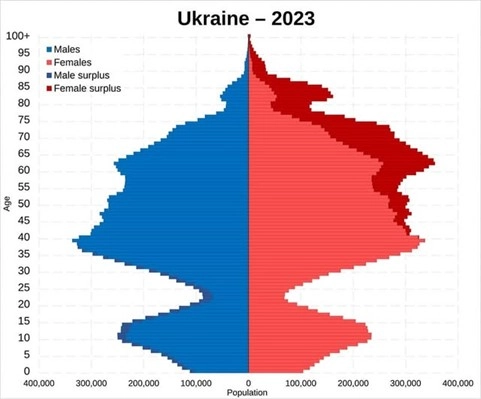
If young people die en masse, in 20 years there will be even fewer young Ukrainians. And in 40 years – fewer Ukrainians in general.
Another aggravating factor is population loss due to migration. About 1-1.5 million people remain in the occupied territories. Another million ended up in Russia. Up to six million are in Europe. Often these are young families, as older people are typically less mobile. Many of those who left are women with children.
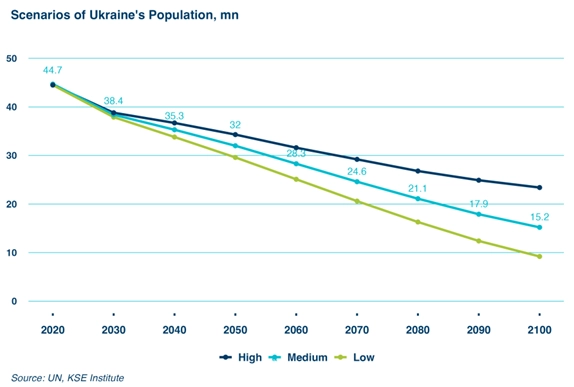
As a result, in 2024, Ukraine recorded a record population decline – mortality exceeded birth rates threefold. According to UN forecasts, if this trend continues, Ukraine’s population – about 45 million in the year 2000 – may shrink to just 15 million by the year 2100.
Men aged 18 to 25 can be mobilized only voluntarily, by signing a military service contract.
Many do exactly that – Ukraine launched the “18–24 program” with large bonuses for contract enlistment. Tens of thousands of young people have taken advantage of this opportunity. Tens of thousands more joined the military voluntarily at the beginning of the war.
Overall, young people under 25 make up the majority of current protesters in Kyiv’s center.
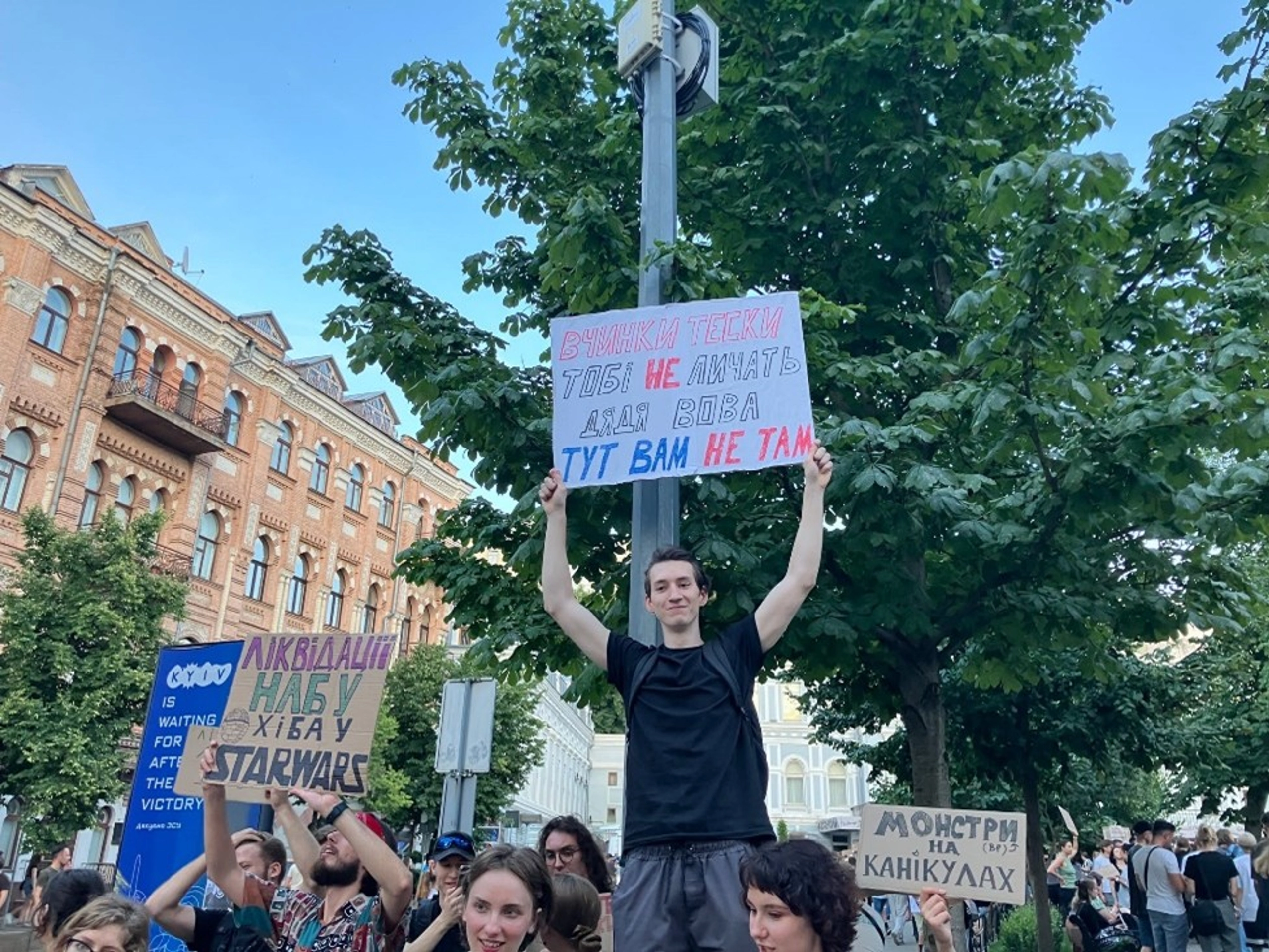
Alright, but what about older men? They’re also at the protests.
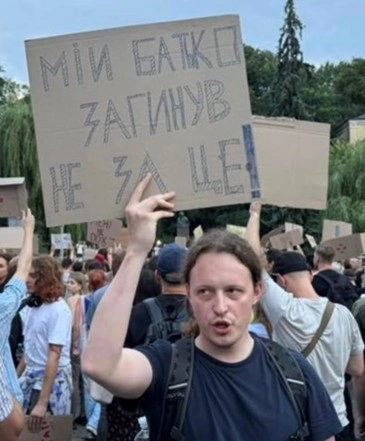
Mobilization of men over 25 is more complicated. First, many men are exempt from mobilization – for example, immediate family members of those killed in the war (father, son, spouse), fathers of three or more children, persons with disabilities, etc. And such people were at the rallies. One young man held a sign reading, “My father didn’t die for this.”
Yes, there have been abuses, particularly with disability claims – i.e., obtaining fake disability certificates to get an exemption (“white card”). However, many such schemes have now been shut down. It should also be noted that these schemes exist in every country waging a full-scale war – British publicists wrote about similar issues during WWII in England.
Another large category includes those exempted (“reserved”) – people who have temporary exemptions due to working in critically important sectors.These include police officers (many of whom serve in police brigades of the defense forces, such as “Lut”), government officials, defense industry workers, utility workers, infrastructure sector employees (e.g., in energy), teachers, etc. Of course, abuses happen – if a company convinces authorities it is “critical,” it may secure exemptions for staff. As a result, even supermarkets or non-defense companies sometimes manage to retain employees under exemption status.
However, there’s another side to this – Ukraine’s entire budget is spent on defense, and for it to be filled, the economy must function. The government must balance mobilizing more men with keeping them in the real economy to prevent collapse. Maintaining this balance is very difficult. But so far, it’s working.
According to the Cabinet of Ministers of Ukraine, as of 2025, there are about five million men of conscription age fit for mobilization, and about 1 million of them are reserved or deferred.
Another significant group at the rallies were veterans who returned to civilian life after injury – many are amputees, as seen in protest photos. They also seek justice and feel solidarity with the youth and activists.
There were also many active-duty soldiers undergoing treatment for wounds in Kyiv hospitals who view the authorities’ actions as unjust. They typically attended in civilian clothing.
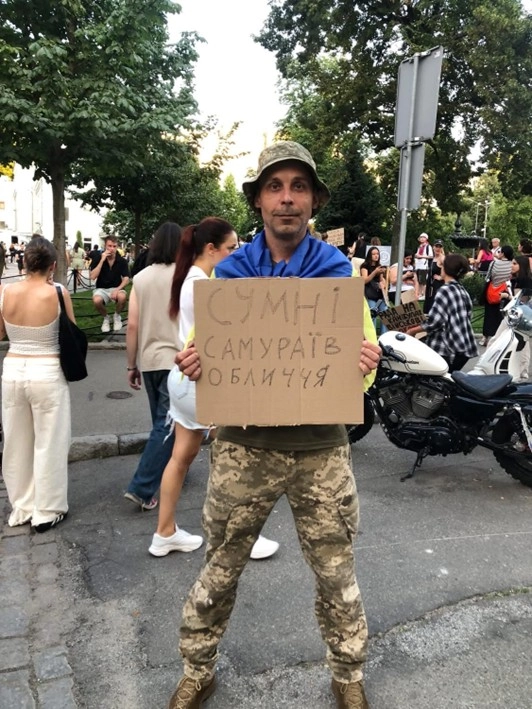
Here on the photo – Yevhen Shibalov, infantryman, who demobilized after the heavy injury. He is holding a slogan “Samurai’s faces are sad.”
Finally, there is a large group of men aged 25+ who are eligible for mobilization, not exempt, but simply awaiting their turn. Some are hiding or trying to flee illegally to the EU, but most, according to Territorial Recruitment Centers, accept summonses and go through medical commission and mobilization. For example, two acquaintances of the article’s author, without exemptions, lived civilian lives but were preparing – training in the gym, studying tactical medicine – until they were mobilized.
Of course, such men are the least likely to be seen at rallies – but some of them were there too.
You can also highlight the text and press Ctrl + Enter

EU Moves to Ban Entry for Russian Troops
EXPLAINED: What’s the Deal With Russia’s Frozen Assets in Europe? All You Need to Know
EXPLAINED: More and Better Western Assistance to Ukraine Announced This Week