As Ukraine enters a fourth winter of full-scale war, a crucial question looms in Brussels: Can Kyiv continue to finance its defense and basic state functions without being forced into painful spending cuts that would undermine morale and resilience?
That question may be decided this week. EU leaders are set to meet on Thursday, Dec. 18, at a European Commission summit aimed at breaking a political deadlock over the use of frozen Russian state assets to support Ukraine, including through a proposed “reparations loan.”
JOIN US ON TELEGRAM
Follow our coverage of the war on the @Kyivpost_official.
The stakes are high. Ukraine faces a projected budget shortfall of €71.7 billion ($84 billion) next year. If external funding does not begin flowing by April, Kyiv would be forced to slash public spending, potentially weakening its ability to sustain the war effort nearly four years after Russia launched its full-scale invasion.
Ukraine’s finance ministry has said the country will need $74.8 billion to cover 2026-27 if the war continues into 2026, with financing needs for 2026 alone expected to reach almost $45 billion, on top of debt servicing obligations.
What is the reparations loan, and how would it work?
The European Commission (EC) proposed a “reparations credit” in fall 2025 under which Ukraine would only repay the loan once Russia compensates for war damages after the war ends. The concept is designed to avoid burdening Ukraine with new debt in the absence of reparations.

What the US-Iranian Ceasefire Agreement May Mean for Ukraine
The proposed reparations loan would tap into frozen Russian assets in Europe to finance Ukraine now, with repayment linked to future Russian compensation.
Under the proposal, up to €165 billion ($194 billion) of Russia’s frozen assets would be mobilized to support Ukraine over 2026-27. The size of the proposed package has been scaled back over time, as the plan faced sustained political resistance and legal caution from several member states – most notably Belgium, where the bulk of the frozen assets are held.
EC President Ursula von der Leyen said on Dec. 5 that the EU aims to cover €90 billion ($108 billion) of Ukraine’s estimated €135 billion ($160 billion) financing needs for that period through new borrowing and the loan mechanism.
The remaining frozen assets would stay immobilized, with the possibility of drawing on a larger share from 2028 onward if political and legal hurdles are overcome.
How much Russian money is frozen in Europe?
Around €210 billion ($247 billion) of frozen Russian assets are currently located within the European Union, making Brussels the central arena for decisions on how – or whether – those funds can be used to support Ukraine.
Of that, the overwhelming majority – over €193 billion ($227 billion) – is held by a single Belgian financial institution, Euroclear. The figure is slightly below pre-invasion estimates of Russia’s reserves in major currencies, as Moscow’s gold and yuan holdings were never subject to immobilization.
In total, roughly €260 billion ($305 billion) in Russian central bank reserves have been immobilized worldwide.
What happens to the profits and taxes from frozen assets?
Interest income is already being redirected to Ukraine – but the tax levied on that income remains contentious.
EU regulations now require central securities depositories to separate accounting for interest on immobilized assets. In 2024, Euroclear generated more than €6 billion ($7 billion) in interest income on Russian assets, with close to €5 billion ($5.9 billion) transferred to Ukraine. That flow dropped by about 25% in the first three quarters of 2025, partly due to European Central Bank rate cuts.
But Belgium also levies a 25% corporate tax on Euroclear’s profits from holding the reserves. In 2024 alone, that tax reportedly brought in €1.7 billion ($2 billion), while Belgium’s total declared support to Ukraine between the start of the war and August 2025 stood at €3.44 billion ($4 billion).
Belgian officials said all such tax revenue is earmarked for Ukraine.
“The Belgian government has committed to allocating all corporate tax revenue from the interest income on Russia’s immobilized assets at Euroclear to support Ukraine,” a Belgian official said, estimating 2025 revenue at around €1 billion ($1.2 billion).
That said, some European officials have reportedly raised concerns about transparency in how Belgium manages the tax revenue.
Why is Belgium opposing the reparations loan?
Belgium has pledged to block the plan unless other EU member states provide binding legal guarantees and share liability risks.
Belgian Prime Minister Bart De Wever said the EU has yet to receive full legal wording from the commission and warned Belgium could face massive legal and financial consequences if Russia retaliates.
The European Commission says it has proposed a “three-tier defense” to protect Belgium and Euroclear, but that has so far failed to break resistance.
On Dec. 11, the EU decided to freeze Russian assets indefinitely, removing the requirement for renewal every six months – a move adopted despite opposition from Hungary and Slovakia. A day later, Russia’s central bank announced it is suing Euroclear.
Who else is pushing back?
Opposition stretches from Washington to several EU capitals.
The United States has reportedly urged some European governments to resist the reparations loan, arguing frozen assets should be preserved for a future peace settlement.
The original US peace plan associated with US envoy Steve Witkoff would reportedly divide roughly $300 billion in assets into three parts, with only one-third allocated to Ukraine reconstruction under US supervision and the remainder placed into a joint US-Russia investment mechanism.
Within the EU, Italy, Bulgaria, Malta and Slovakia have joined Belgium in opposing the use of frozen assets for military support. Slovakia’s Prime Minister Robert Fico said his country would not participate in any scheme using Russian assets for Ukraine’s defense, arguing it would prolong the war.
What are the alternatives if the loan fails?
None of them is easy – or politically likely.
One fallback option would be direct EU borrowing not backed by immobilized Russian assets, with repayment shouldered by EU member states or covered through new EU revenue streams.
While this route would avoid the legal risks tied to Russian reserves, it would still require unanimity among member states. Several governments – including Germany, the Netherlands and Sweden – have opposed taking on new collective EU debt, making approval uncertain even before the veto risk comes into play.
A second option would be ad-hoc national contributions or a coalition-based financing mechanism outside the EU framework.
While this could bypass vetoes by individual governments, diplomats say it would likely fall far short of Ukraine’s financing needs and lack the predictability required to sustain the war effort and public services.
EU officials have also discussed short-term stopgap measures, such as rolling over existing assistance or expanding limited credit lines. But these are widely seen as temporary fixes that would delay – rather than resolve – Ukraine’s looming budget crisis.
Why does this decision matter now?
For Kyiv, it is about survival – and justice.
Ukraine’s Foreign Minister Andriy Sybiha called the reparations loan “urgent and critical,” saying it would provide sustained support, strengthen morale and reinforce self-reliance. He described the proposal as a matter of justice, arguing that compensation by aggressors is a core principle of international law.
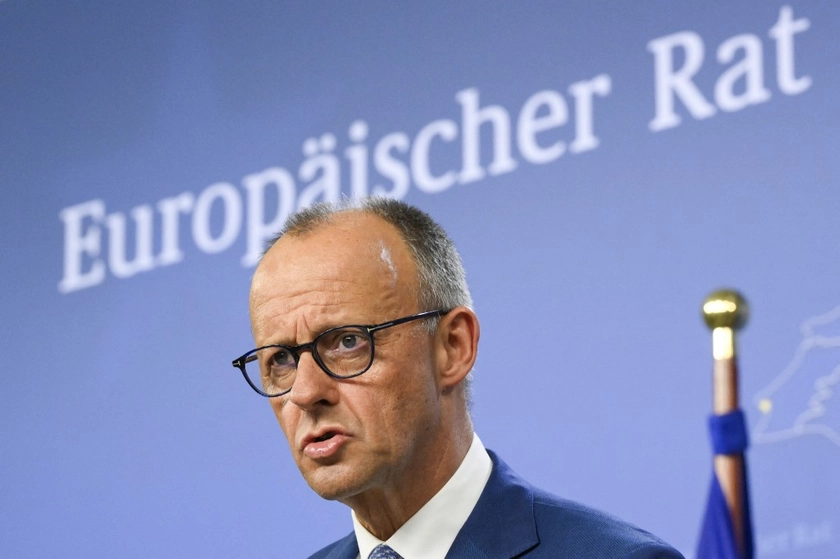
German Chancellor Friedrich Merz warned this week that failure to move forward would leave Europe’s credibility “severely damaged,” signaling an inability to act at a decisive moment. Merz has insisted the assets must remain under European control and directly benefit Ukraine, rejecting proposals that would divert economic gains elsewhere.
As EU leaders gather in Brussels, the outcome will signal not only how Europe plans to fund Ukraine’s defense – but whether it can act decisively when its own security order is at stake.
You can also highlight the text and press Ctrl + Enter

Zelensky Reveals Intercepted Intel From Putin’s Desk