The 18th package of sanctions against Russia comes into force, lowering the price cap for crude oil from $60 to $47.6 per barrel, and further increasing the list of bans against Nord Stream, Russian banks and petroleum products.
The EU approved the 18th package of sanctions against Russia on July 18 in response to the Kremlin’s full-scale invasion of Ukraine in 2022. The majority of the sanctions list became active after the European Commission (EC) announced it.
JOIN US ON TELEGRAM
Follow our coverage of the war on the @Kyivpost_official.
The reduced oil price cap will come into force in September, Arianna Podesta, Deputy Chief Spokesperson of the European Commission told European Pradva.
Another part of the sanctions, ban on transactions with 22 additional Russian banks took effect over the last weekend, on August 8, 2025, according to Podesta.
“The EU just approved one of its strongest [set of] sanctions against Russia to date,” EU foreign policy chief Kaja Kallas wrote on X on July 18.
The 18th package of sanctions is tough, but again, not enough. The reduced oil price cap of $47.6 per barrel, set dynamically at 15% below the Urals average price, cuts Russia’s budget revenues, but lacks enforcement due to the role of intermediaries.
Adding 105 shadow fleet ships to the blacklist still does not include all shadow fleet tankers. Expanding transaction bans to a wider circle of Russian banks and punishing third-country financial institutions assisting evasion will increase costs for Russia, but the companies will still run the business, and the banks on the list do not seem to be major market players.

Armenia Threatens 25-Day Military Camp for Russia-Based Election Voters
It seems that the EU is trying its best, but it still doesn’t help. Why?
What’s in the 18th Russia sanctions package?
The new sanctions target Russia’s energy revenues, banking sector, and military-industrial complex, while also tightening loopholes, addressing individuals responsible for propaganda, crimes against Ukrainian children and cultural heritage, the EC reported in a press release.
The key change – the EU lowered the price cap on Russian crude oil from $60 to $47.6 per barrel. The cap will now be reviewed automatically and kept 15% below the average market price of Urals crude over the previous six months.
The EU also banned all transactions related to Nord Stream 1 and 2 pipelines, natural gas pipelines that run under the Baltic Sea, directly connecting Russia to Germany, and restricted imports of refined oil products made from Russian crude processed outside the country.
Another measure is import ban on refined oil products derived from Russian crude. The EU imposed restrictions on imports of refined products made from Russian crude that are processed outside the country and shipped to the EU.
The EU enlarged the list of Russia’s sanctioned shadow fleet with 105 additional ships and watercraft, bringing the total list of blacklisted water-borne vessels to 444. Russian and international companies managing shadow fleet vessels got full-fledged sanctions: asset freezes, travel bans, and bans on providing resources.
“These target both Russian and international companies managing shadow fleet vessels, traders of Russian crude oil, as well as a major customer of the shadow fleet, a refinery in India with Rosneft as its main shareholder,” the EC wrote in its press release.
Financial measures include a full transaction ban with “certain” Russian banks.
“This means EU firms are banned from doing any business, including providing specialised messaging services subject to this measure so far, with the 23 listed entities,” the EC wrote.
The sanctioned bank list is enlarged with 22 banks, with now the list totalling 45 banks. “No EU operator will be able to engage with any of the listed banks directly or indirectly, including providing specialised messaging services,” the EC wrote.
The sanctions also ban all transactions with third-country financial operators – including crypto firms – that help Russia circumvent restrictions. The new rules ban EU firms from supplying “certain” banking software to Russian institutions or the Russian government.
The EU’s new measures prohibit engaging with any legal person, entity or body in which the Russian Direct Investment Fund (RDIF) holds any ownership or investments.
The EU blacklisted 26 more entities aiding Russia’s military industry – 15 of them based in Russia, and 11 in third countries, including Turkey, China, and Hong Kong. The transit ban is expanded by adding 8 Combined Nomenclature (CN) codes from the list of Economically Critical Goods.
To limit Russia’s military capabilities, the EU imposed 55 new listings targeting its defense supply chain, including Chinese firms supplying goods used on the battlefield. Eight Belarusian arms companies were also listed.
The EU sanctioned another individual involved in Russia’s abduction of Ukrainian children. The bloc has now blacklisted over 90 people connected to child deportations and ideological re-education.
Finally, the EU added export restrictions on sensitive goods and sanctioned nine more Belarusian entities – one under trade restrictions and eight under asset freezes.
“In parallel, the package includes additional measures on Belarus, namely prohibiting arms procurement from Belarus, adding a catch-all provision for advanced technology items, transforming the ban on specialised financial messaging services into a full transaction ban, and adding measures to protect Member States from arbitration,” the EC wrote.
Will it work?
Oil price cap is necessary, but won’t hurt Russia
Let’s start with the oil price cap. Russia is struggling with oil revenues, since lower prices cause less budget inflows.
In 2024, oil & gas earnings accounted for about 30% of total federal revenues and 16% of consolidated government revenues, according to the estimates by the Bank of Finland’s economist Heli Simola. Russia’s budget for 2025 previously assumed that the average export price of Russian crude oil is $70 a barrel, while the 2026 budget assumes an average export price of $66 a barrel.
Russia then changed the budget as Russian crude oil price decreased to $50-60 per barrel on average, Russia adapted its oil price forecast to $56 per barrel, submitting new budget estimates in May this year, Russian Interfax wrote.
The lower oil price has already caused the decline in Russia’s oil and gas revenues by 18.5%, according to Russia’s Vedomosti. Russia’s seven-month budget deficit exceeded the target for the entire year by a quarter [slated to incur a deficit for the year of 1.7% GDP, it has already reached 2.2%, overshooting the target by 29%], according to Reuters. One cannot say there are no losses for the Kremlin’s war machine.
“This package of sanction is going to weaken further the Russian economy which is already struggling: oil-and-gas revenues have been dropping, the federal deficit hit the full-year target of 1.7% of GDP by mid-year, and interest rates are still very high at 18% with official inflation around 9-10% (although the real inflation may be way higher),” Economics Professor at Kozminski University Olha Zadorozhna wrote Kyiv Post via email, replying for a comment.
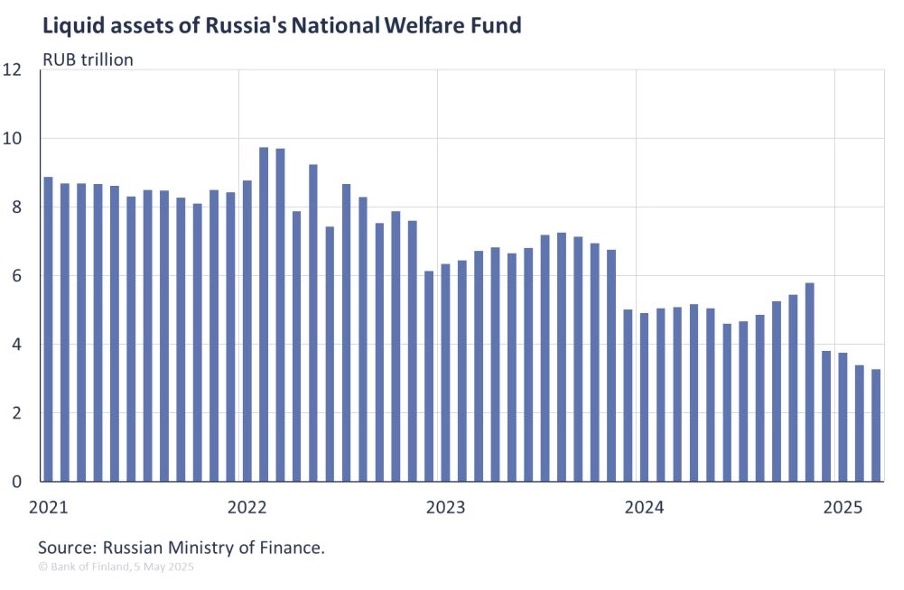
Lower oil revenues will also decrease the levels of the National Wealth Fund, Russia’s key source to fund its war against Ukraine. “Given Russia’s limited liquid buffers (the National Wealth Fund’s liquid assets are about $48 billion, or 1.8% of GDP), it is not much to smooth the impact of the sanctions,” Zadorozhna told Kyiv Post.
But will a lower oil price cap from the EU cause a sudden sharp decline for revenues? No, since the EU has been reducing purchases of Russian oil and gas due to sanctions and in response to Russia’s invasion against Ukraine.
The European Union says that Russia’s share of EU imports of pipeline gas dropped from over 40% in 2021 to about 11% in 2024. For pipeline gas and LNG combined, Russia accounted for less than 19% of total EU gas imports in 2024, according to European data.
Russia changed its buyers in response. Over the past two years, the geography of Russian oil exports has changed completely. Instead of EU countries, the largest purchasers are now China, India and Turkey, the Bank of Finland’s Senior Adviser Laura Solanko wrote.
Even with banning fuels made from Russian crude even if they’re refined in third countries (after a transition period), the Kremlin’s losses from the EU 18th sanctions package don’t exceed several billion euros monthly.
“The EU’s ban on petroleum products refined from Russian crude oil will reduce Russian export earnings by a couple of billion per year – in 2024, EU member states are estimated to have imported a little more than €5 billion ($5.8 billion) of such products from third countries,” Benjamin Hilgenstock, Senior Economist at KSE Institute (Kyiv School of Economics), wrote Kyiv Post, replying to a request for comment.
Slovakia and Hungary remained the only EU countries importing Russian oil and gas, Mykhailo Svyshcho, natural gas market observer at ExPro Consulting, told Kyiv Post.
“Russia has learned to sell and transport oil using a “shadow fleet,” and the buying countries are willing to cooperate with Moscow on these terms. As a result, the issue of a price cap on Russian oil has indeed become largely irrelevant,” he said.
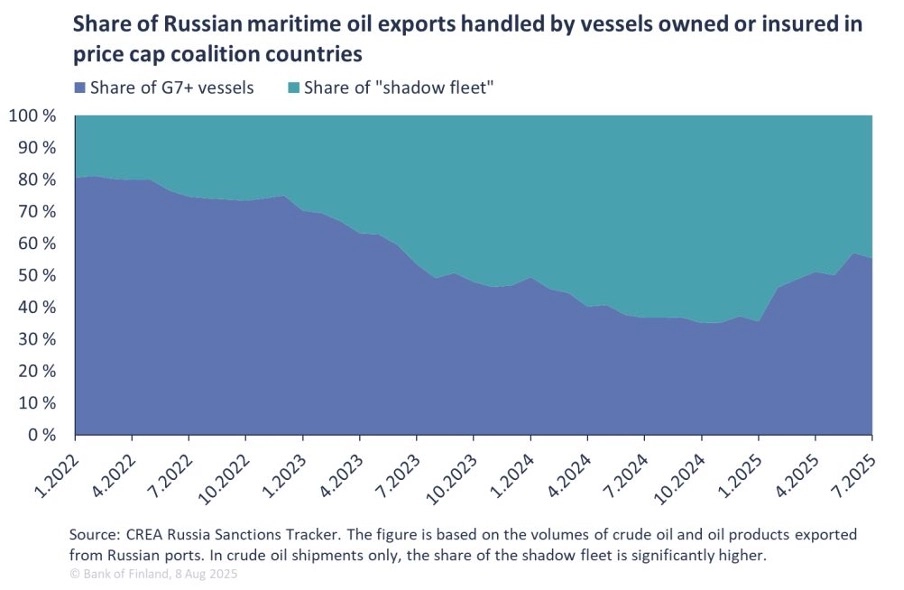
Hilgenstock calls the oil price cap “ineffective” since it’s difficult to enforce – Russia’s shadow fleet found its way to avoid selling the energy to the EU directly.
“The key issue here is the ineffectiveness of the oil price cap, which has been evaded – via the shadow fleet – and violated– via lying about oil prices – for almost its entire existence,” he told Kyiv Post.
Make oil price cap work by enforcing it
Enforcement remains the key weakness of the EU’s sanctions package, according to economists Kyiv Post spoke with.
Zadorozhna names voyage-by-voyage price attestations and audits, denying insurance and port access to violators, and quickly adding ships and facilitators to the sanctions list. “If used consistently, these tools will cut Russia’s oil take, if used lightly, the effect will fade over time,” she added.
Hilgenstock suggested targeting Russian exports to countries outside of the sanctions coalition. But targeting exports to the third countries requires the active involvement of the US.
“To change Russia’s calculus, either the volume or the price of Russian oil and gas exports to third countries has to be targeted (more) decisively. However, this is not something that the EU can do without other allies such as the US,” Hilgenstock said.
US secondary sanctions can come in handy here, when the US threatens to cut off someone from the US financial system/US Dollar (e.g., an Indian refinery) to influence the behavior of Russian oil buyers. The example here is tariff threat regarding India’s purchases of Russian oil, Hilgenstock wrote.
“It’s a bit of a blunt instrument but fundamentally does the same thing: someone will face certain consequences if they choose to continue a certain behavior (here: buying Russian oil),” he added, replying to Kyiv Post’s comment.
Svyshcho agrees that India’s case can be a role model, targeting tariffs against the countries that purchase Russian energy. “If the US and EU jointly developed a mechanism for such tariffs on other buyers of Russian oil, it could have a real impact. However, such a scenario seems unlikely,” he said.
Additional financial sanctions will raise costs, but not substantially change the situation
Financial sanctions against Russia in the 18th sanctions package will raise the costs for the business, but economists Kyiv Post spoke to remain unanimous as to whether they will scare the buyers.
Zadorozhna told Kyiv Post they will raise the cost and friction of settling trade with the EU (and EU-exposed firms), reduce access to euro liquidity, and push more invoicing via non-EU channels (e.g. yuan), which is slower and pricier.
“Full transaction ban for 22 additional Russian banks matters at the margin – mainly for cross-border payments and trade finance rather than for day-to-day domestic banking,” she said.
The EU also expanded the circle of no-go counterparts to 45 banks, utilizing tools to penalize third-country financial institutions that facilitate circumvention will make more banks in places like Turkey, the UAE, and China. It may help to motivate them to stay away from Russian clients to avoid trouble, Zadorozhna wrote Kyiv Post.
“If that enforcement follows through, Russian importers and exporters will see fewer willing correspondent partners, longer settlement times, higher prepayment requirements, and wider spreads on letters of credit. In other words, this won’t crash the Russian banking system, but it raises Russia’s cost of doing business abroad,” she wrote.
But the money will always find the way to the end transaction even if the costs become higher, according to Hilgenstock from KSE.
“The cost of doing business will probably go up but, unless banks in third countries are threatened with secondary sanctions, there is no reason for them to stop dealing with Russian banks,” he told Kyiv Post.
Neither will it trigger any systemic financial issues within the country. The list of the banks, published by the European Union, includes smaller banks for the economy. There is the ones serving retail customers: a popular retail bank T-bank (previously known as Tinkoff-Bank), or Yandex Bank the financial arm of Russia’s key search engine and IT company Yandex.
But there also banks serving for Russia’s energy sector, according to vc.ru: Zenit Bank (part of the Tatneft group), Surgutneftegazbank (the bank of the oil group Surgutneftegaz), Metcombank (serves the metallurgical sector), Severgazbank (controlled by Gazprom Neft).
Russian banks, however, have been able to circumvent them by operating through third-country intermediaries in financial centers outside of the sanctions coalition, Hilgenstock told Kyiv Post.
The EU’s 18th sanctions package includes several meaningful steps to increase pressure on Russia, Hilgenstock told Kyiv Post. “However, it is unlikely to fundamentally change Russia’s calculus and desire/ability to continue its brutal war of aggression on Ukraine,” he added.
You can also highlight the text and press Ctrl + Enter

Kremlin Warned: War Spending Is Breaking the Budget