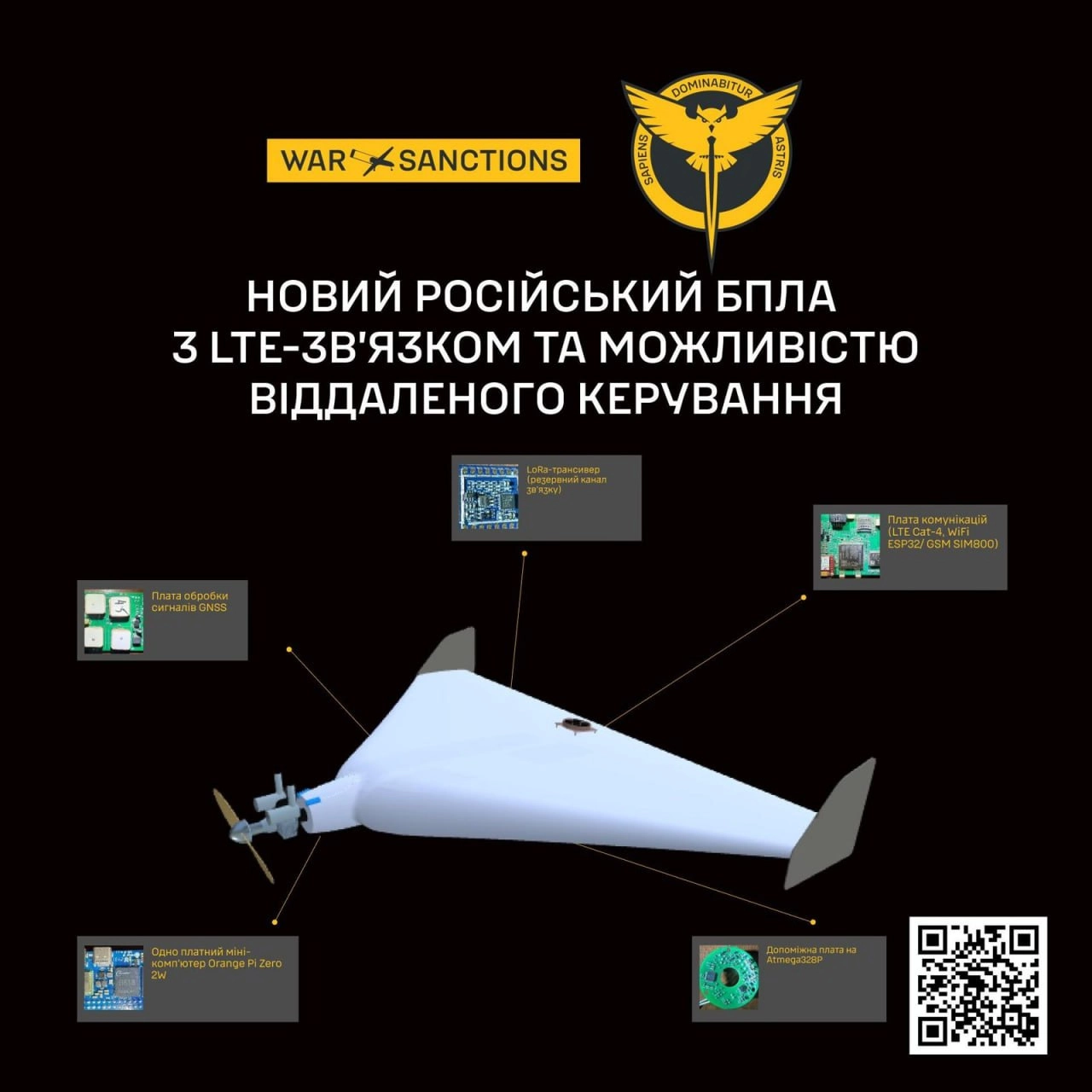
Ukraine’s Main Intelligence Directorate (HUR) has released data on a new model of Russian drone already fielded that uses phone system modems and a camera to transmit video in real time or recorded by a mobile base station.
Information on Russia’s new UAV, along with a graphic image of the drone, with onscreen rotatability to show it in 3D, were published on the War&Sanctions portal in the section “Components in Weapons.”
JOIN US ON TELEGRAM
Follow our coverage of the war on the @Kyivpost_official.
According to intelligence, the drone can perform several tasks at once — serving as a reconnaissance or strike UAV, as well as being used as a decoy to overload Ukraine’s air defense system.
Design features
Russia’s new drone is equipped with a camera and two LTE modems, which allow the transmission of video in real time or recorded through mobile base stations. The modems also provide the ability to receive commands for remote flight correction.
In the strike version, the camera with remote control can be used in FPV mode, allowing the operator to guide the drone directly to the target.
“Structurally, the drone has a delta-wing fuselage similar to the Shahed-131 (Geran-1), but somewhat smaller. Navigation is carried out by a jam-resistant satellite positioning system with four patch antennas and Chinese Allystar modules,” the intelligence service reported.
LTE control is a technology that allows a drone to operate not through traditional radio channels, but via the 4G LTE mobile network. This enables the operator to receive live video from the UAV and remotely adjust its course even over long distances.
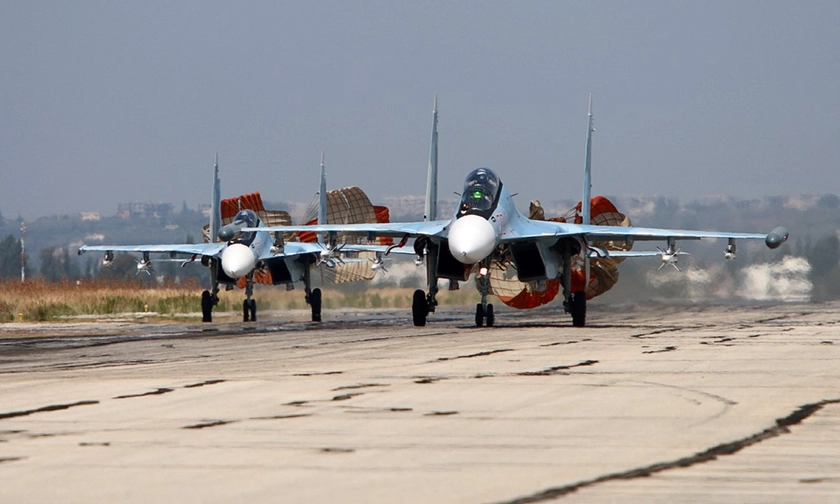
Ukraine Hits Russian Warplanes in Hangars at Crimea’s Saky Air Base
Unlike standard control channels, which Ukrainian defenders can jam with electronic warfare, LTE modems rely on civilian mobile infrastructure. This makes signal interception more difficult and demonstrates how Russia is adapting civilian technologies for military purposes.
Foreign components
Almost half of the drone’s parts are of Chinese origin — communication modules, a mini-computer, a power regulator, and a quartz generator.
The DLE engine, located in the nose of the fuselage, makes the UAV most similar to the “Italmas” loitering munition produced by the Russian company Zala Group.
Ukrainian intelligence regularly publishes analyses of captured or downed Russian equipment to demonstrate the extent of Russia’s dependence on imported components, despite the effect of international sanctions. The new drone with LTE modules is further evidence of Russia’s use of civilian market technologies to modernize its military hardware.
Last month HUR published the technical specifications and components of a new Russian drone that is currently actively used by the Russian military.
According to intelligence officials, this UAV performs reconnaissance tasks and is used as a decoy to be detected and overload the Ukrainian air defense system. In addition, according to some reports, the drone is capable of carrying a warhead weighing up to 15 kg (33 lbs).
The aircraft has a delta-wing fuselage similar to the Shahed-136 but is significantly smaller. All components and modules on the UAV are of Chinese origin.
“Almost half of them, the flight controller with autopilot, navigation modules and antennas, airspeed sensor, and Pitot tube, come from a single Chinese company, CUAV Technology,” the HUR press service reported.
You can also highlight the text and press Ctrl + Enter

Russia Hit by 660-Drone Overnight Barrage Targeting Moscow, Crimea and Key Military Sites