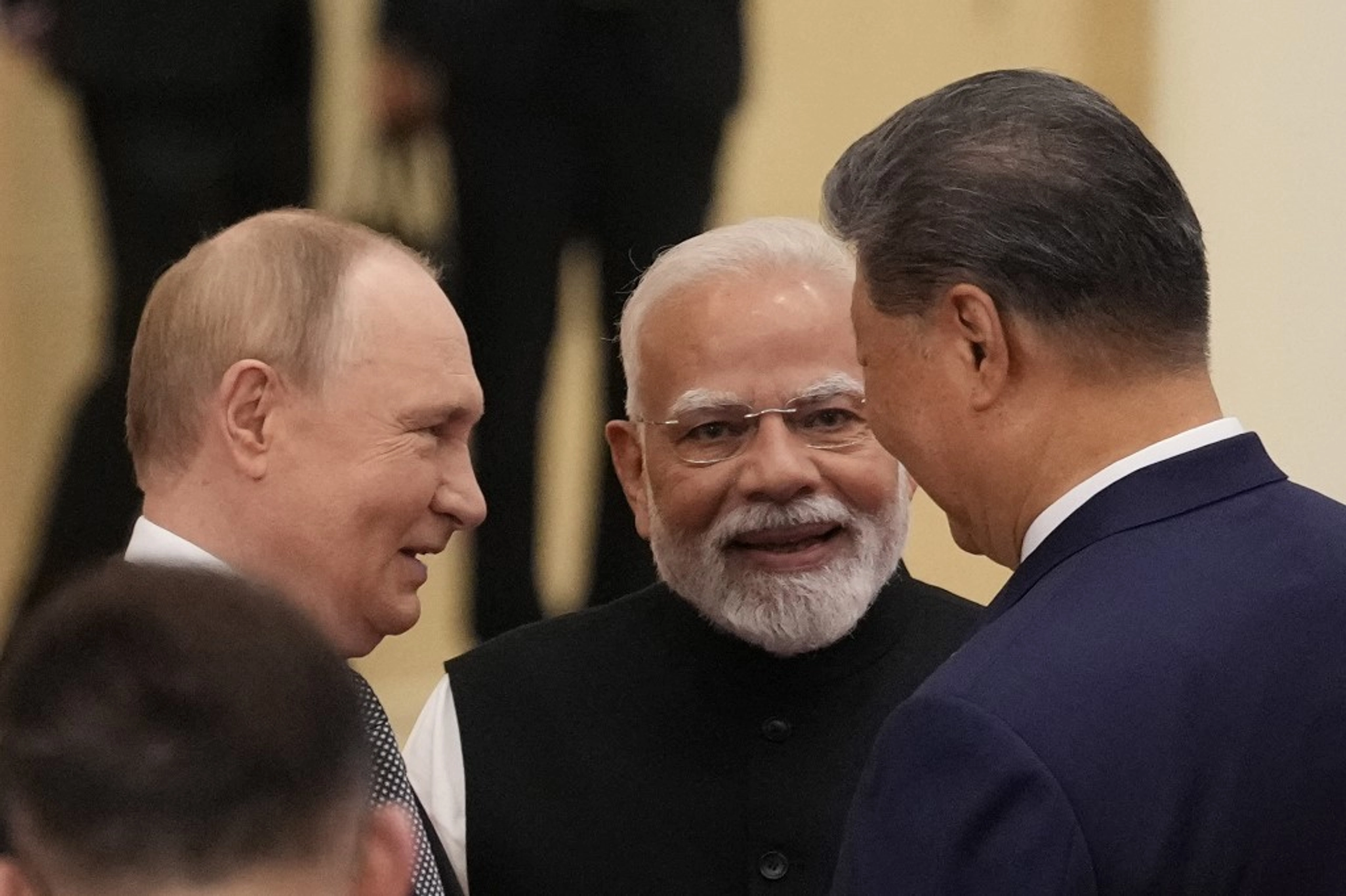
The evolving global power dynamics were on full display as Chinese President Xi Jinping welcomed leaders from more than 20 non-Western nations for the Victory Day parade, following the Shanghai Cooperation Organisation (SCO) summit. Key partners such as Russia and India were in attendance, underscoring China’s effort to consolidate a multipolar alliance.
While much of the messaging appeared directed at US President Donald Trump, what stood out was the emerging bloc’s unmistakably anti-Ukrainian posture – and the underlying tensions between its central powers. Despite their shared strategic interests and the optics of the new global order, China, India, and Russia continue to face significant obstacles in forging a truly unified front.
Russia’s enablers at the parade
Held in Tiananmen Square, China’s Victory Day parade was as much a show of its rising military and technological strength as it was a symbolic reassertion of historical narratives. By spotlighting Japan’s invasion of Manchuria in 1931 – eight years before Nazi Germany invaded Poland – China sought to remind the world of its early and significant sacrifices in the war, challenging the traditionally Western-centric narrative of victory.
The military display included cutting-edge drones, hypersonic missiles, and fighter jets – underscoring Beijing’s message of “peace through strength.” Among the more than 25 foreign dignitaries in attendance were leaders from North Korea, Pakistan, Belarus, and Iran, some of the most ardent enablers of Russia’s aggression against Ukraine that have been providing critical technology and manpower to the battlefield.
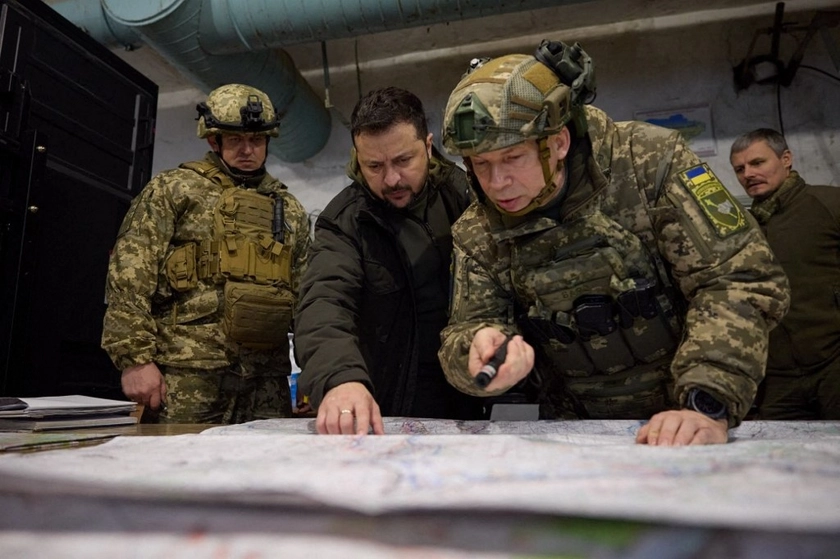
Syrsky: Russian Maps Show False Advances to Please Top Command
Despite the declared neutrality, the role of China and India in enabling Russia’s sustained military aggression against Ukraine is well known. These two nations are not only the largest buyers of the discounted Russian crude – with China leading the way – but also the suppliers of critical tech to the Moscow’s military-industrial complex.
A closer alignment among China, Russia, and India remains fraught with challenges.
According to a recent investigation by the British daily The Telegraph, China is largely responding for propping up Russia’s domestic drone production industry. In 2023 and 2024, Chinese companies have sent close to $55 million worth of components to Russian firms sanctioned for making drones. After the agreement with Tehran in early 2023 to make the Iranian Shahed drones at home, China emerged as Russia’s main external suppliers, having sent aircraft engines, aircraft engine parts, metals, microchips and other parts needed to make drones that continually inflict death and destruction on Ukraine.
India has become the second largest supplier of restricted critical technology to Russia’s military-industrial complex. Microchips, circuits and machine tools (the so-called CNCs) are among its exports to Moscow. Almost one fifth of the critical tech needed by the Russian military that Moscow is unable to produce domestically comes via India, which has emerged as a critical transshipment point.
The Shanghai Cooperation Organisation (SCO) Summit that occurred a few days prior to the military parade was a display of visual unity among the hosting nation of China and its two junior partners, India and Russia. Although India’s Prime Minister Narendra Modi participated in the SCO summit days earlier to advance India’s economic interests, his decision to skip the Victory Day parade suggests a calculated diplomatic distance. It reflects India’s continued wariness of a deeper alignment with China, despite the potential economic gains, underscoring the unresolved tensions between the two Asian giants.
The China-India-Russia Triangle: a troublesome threesome
Recent high-level developments in China underscore Beijing’s ambition to position itself as a global counterweight to the United States by deepening ties with regional partners. However, a closer alignment among the SCO’s key members – China, Russia, and India – remains fraught with challenges.
The China-Russia relationship, in particular, reveals a stark imbalance. As Western sanctions isolate Moscow, Russia has grown increasingly dependent on China – both economically and technologically. China has become Russia’s largest crude oil customer, often purchasing at discounted rates, while also serving as a conduit for critical technologies that support Russia’s military-industrial complex.
At the latest SCO summit, Russia’s Gazprom signed a memorandum with Chinese partners to advance the Power of Siberia-2 pipeline, a project intended to deliver 50 billion cubic meters of natural gas annually to China via Mongolia. While this would offset only about a third of Russia’s lost European gas revenue, the project’s viability hinges on China’s full commitment and favorable pricing terms – which are likely to tilt in Beijing’s favor.
With the EU set to phase out Russian gas by 2027 or even earlier according to recent reports, Moscow is pushing hard to cement its energy alliance with China, hoping it will provide the financial lifeline needed to sustain its ongoing war against Ukraine. Yet in this partnership, it is clear who holds the upper hand – and it’s not Moscow.
The China-India relationship, briefly eased by the Trump-era tariff war targeting both nations, remains fraught and complex. At its core lies the unresolved border dispute across three Himalayan provinces, a legacy of the 1962 war. This contested region is also vital to China’s Belt and Road Initiative (BRI), a sprawling infrastructure project launched by Xi Jinping in 2013 that includes Pakistan – India’s longstanding adversary. China’s robust support for Pakistan in economic development, infrastructure, and military cooperation deepens mistrust and hampers prospects for closer ties between the two Asian giants.
Complicating matters further, India relies heavily on Chinese imports of raw materials essential to such export sectors as pharmaceuticals and textiles. Between 2024 and 2025, India’s trade deficit with China ballooned to a staggering $100 billion. And the trade between the two nations is still settled in the US dollar instead of rupees or yuan. This deep economic imbalance exposes India to strategic vulnerabilities, raising fears that China could leverage economic dependence as a tool of coercion to advance its broader political and economic objectives.
Finally, the India-Russia link is by far the most durable relation in the constellation of three Asian powers. Official New Delhi keeps referring to this relationship as “reliable, predictable and truly strategic in nature,” which allows India to practice its proclaimed “strategic autonomy” in foreign relations.
The durability of the Moscow-New Delhi link dates back to the Soviet era and a short-lived war that broke out between India and Pakistan in 1971, also known as the Bangladesh Liberation War. The Indo-Soviet Treaty of Peace, Friendship and Cooperation enabled Indira Gandhi to call on the deployment of a Soviet nuclear-armed flotilla in the Indian ocean, deterring Americans and the British from intervening on behalf of Pakistan. The war came to its end in 13 days, allowing for the creation of an independent state of Bangladesh supported by New Delhi and Moscow.
The memory of this event lingers in the minds of Indian decision makers who perceive Putin’s Russia as a natural extension of the Soviet Union. Amid an increasingly unpredictable partnership with the US, Moscow’s consistency continues to hold strategic value for India.
On the economic front, India has emerged as Russia’s second largest buyer of crude oil after China, having purchased $133 billion worth of discounted fossil fuel since the full-scale invasion up until Sept. 11, 2025. This figure is commensurable with Russia’s military budget of $145 billion allocated for 2025.
As a result, India came to be known as one of the “laundromat” countries that define Russian crude and sell those refined oil products such as gasoline abroad, namely to the United States and Europe. The imposition of a 50% tariff rate on Indian goods by the Trump Administration aims to dismantle India’s dependence on discounted Russia crude and its indirect financing of Russia’s illegal war on Ukraine. So far, however, such a move has only backfired.
What emerges is not a cohesive bloc, but a potentially fragile, uneasy arrangement of interests.
Despite its lengthy Cold-war era partnership with Moscow, India has expanded its defense partnerships with countries like the US, France, and Israel, buying fighter jets, helicopters, and drones to reduce reliance on a single supplier. Nevertheless, Russia remains India’s key strategic partner, supplying major systems like S-400 missiles, nuclear submarines, and Su-30MKI jets. Joint projects like the BrahMos missile and regular military exercises show that defense ties with Moscow continue to play a central role in India’s security strategy, also acting as a key transshipment point for critical tech needed by the Russian military-industrial complex.
While China, India, and Russia project the image of a united front against Western hegemony, their strategic triangle is marked more by competition and mistrust than true alignment. Russia is firmly in China’s shadow, trailing far behind economically and technologically with no path to equality. India, for its part, remains wary of China’s regional ambitions and deep ties with Pakistan and Russia, even as it maintains robust economic and defense ties with both Beijing and Moscow.
Meanwhile, Russia leverages its historic partnership with India to hedge against overdependence on China – all as it wages a war in Ukraine that requires resources that China and India are willingly providing, at least for now. What emerges is not a cohesive bloc, but a potentially fragile, uneasy arrangement of interests – one that may prove unsustainable in the face of rising geopolitical pressures and internal contradictions.
The views expressed in this opinion article are the author’s and not necessarily those of Kyiv Post.
You can also highlight the text and press Ctrl + Enter

Russia Hit by 660-Drone Overnight Barrage Targeting Moscow, Crimea and Key Military Sites