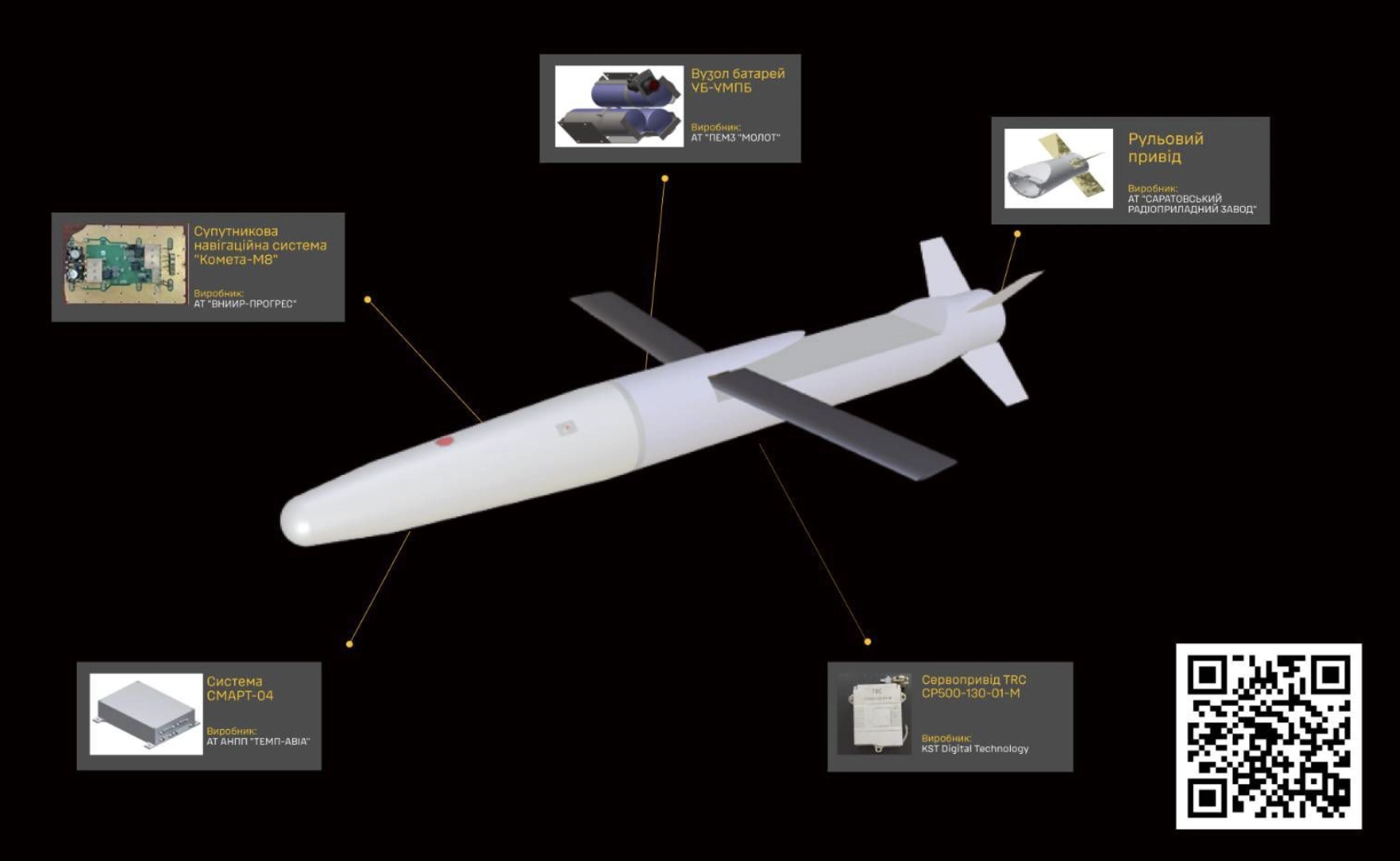
Russia’s D-30SN aerial guided bombs contain foreign components from Ireland, Taiwan and Japan – among other countries – according to Ukraine’s Defense Intelligence Directorate (HUR).
HUR, which maintains a database of components found in Russian weapons, released the latest findings on the aerial bomb on Monday.
JOIN US ON TELEGRAM
Follow our coverage of the war on the @Kyivpost_official.
What is the UMPB D-30SN?
Russia’s Universal Interspecific Glide Munition (UMPB) D-30SN is an aerial guided bomb fitted with wings that deploy mid-air once the munition is dropped allowing it to glide towards the target.
Defense Mirror wrote in May 2024 that Russia had begun using the bomb in Ukraine at the time, citing footage depicting its use having been posted online.
HUR said the bomb can be launched from planes or ground-based launchers, with a range up to 100 kilometers (62 miles).
“The D-30SN aerial bomb can be carried by Su-34, Su-30SM, Su-35, Su-24 aircraft, and the S-70 Okhotnik unmanned aerial vehicle (UAV). The range of use is up to 100 kilometers (provided that it is released from a height of 12-15 kilometers [39,370-49,213 feet]),” HUR’s Monday press release says.
“According to preliminary data, the UMPB can also be launched from ground platforms such as the ‘Tornado-S’ 300 mm multiple launch rocket systems using a starter engine,” it adds.
HUR said the D-30SN is equipped with the same 250-kilogram (550-pound) warhead found in the FAB-250 aerial bomb integrated into the guided bomb itself.

Ukraine Hits Targets 1,300 km Inside Russia, Striking Ufa Oil Refinery and Penza Missile-Linked Plant
The bomb uses an autopilot module known as “SMART,” HUR wrote.
According to the agency, the bomb also utilizes the “Kometa-M8” satellite navigation module found on other weapons to help negate Ukrainian electronic warfare (EW) countermeasures.
Foreign components found on UMPB D-30SN
HUR wrote that while the weapons and key components are made in Russia, production was made possible with foreign components; some of those found in the SMART navigation module are summarized below:
- IM06 low-level signal relay made by TE Connectivity in Ireland
- RS232 transceiver made by Sipex Corporation in the US
- RS-485/RS-422 transceiver made by Analog Devices in the US
- MAX-M10S GNSS module made by U-blox in Switzerland
A full list of components found in the bomb’s SMART-04 system can be seen here.
The servo drive found on the bomb is made by China’s KST Digital Technology, according to HUR, which itself utilizes foreign components such as the N-channel MOSFET made by Din-Tek in Japan.
Sanction concerns
HUR has identified the Russian companies making the weapons but argued that sanctions were not imposed on some of its suppliers.
“The patent holder and main organizer of the production of the UMPB is the Russian corporation ‘Tactical Missile Armaments’ (Корпорация ‘Тактическое ракетное ворожение’, KTRV), the main contractor is an enterprise within the corporation Concern ‘Granit-Electron’ JSC (АО “концерн ‘гранит-электрон’),” HUR wrote.
“Dozens of companies involved in the production of the D-30SN UMPB have long been known for their ties to the military-industrial complex of the aggressor state of Russia and are already under sanctions by most countries of the sanctions coalition,” it added.
HUR has called for more sanctions on other companies identified, highlighting concerns over the components making their way into Russia, presumably due to their “dual use” nature.
“However, individual manufacturers and suppliers of components for the Russian air bomb have so far remained outside the scope of the sanctions policy, and therefore continue to have access to foreign components, equipment and technologies,” it added.
You can also highlight the text and press Ctrl + Enter