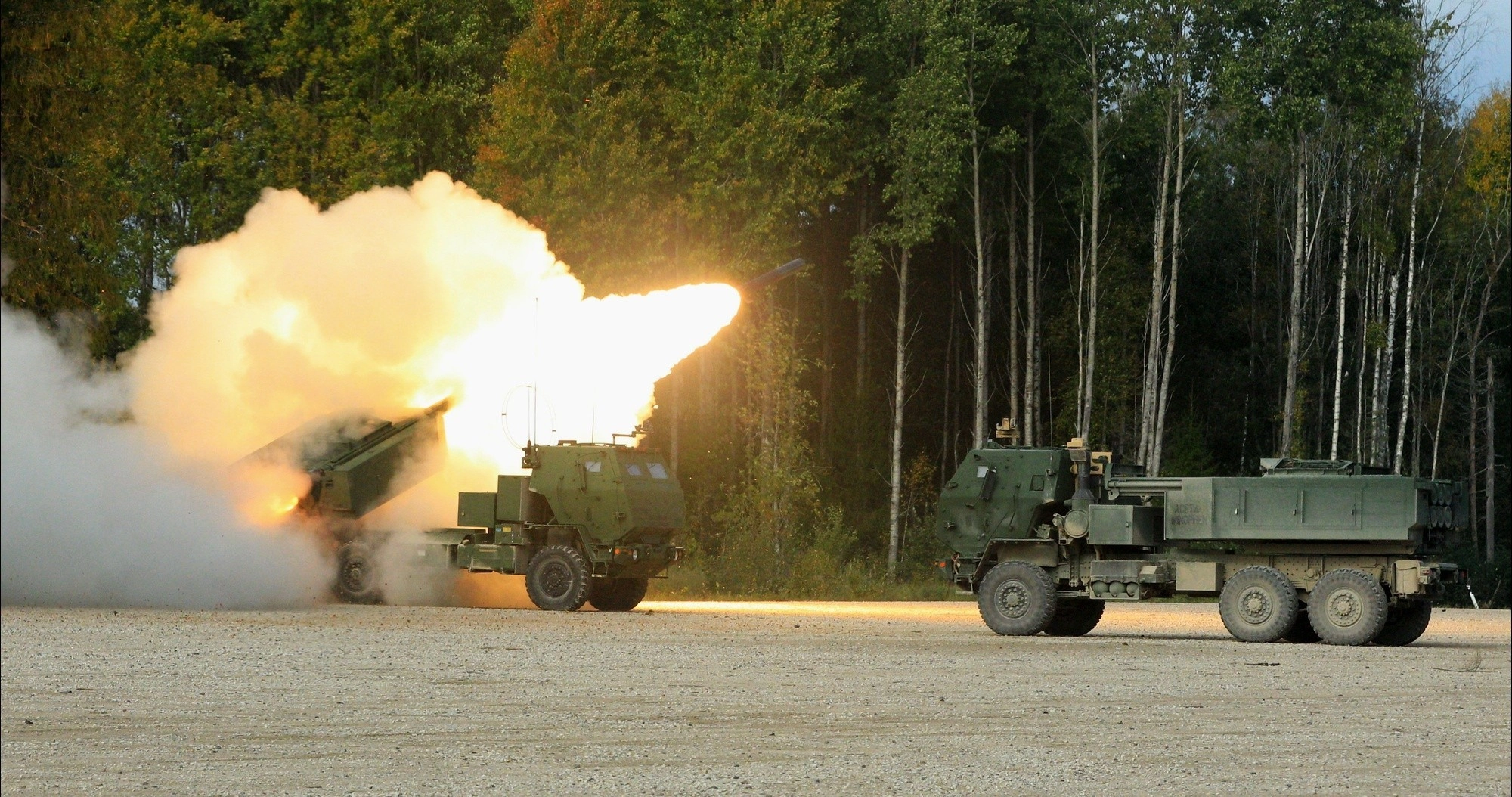
WASHINGTON DC – The Trump Administration has notified the Congressional leadership of a sweeping, multi-billion-dollar expansion to a critical arms sale for Estonia, dramatically escalating the long-range firepower intended for NATO’s eastern flank, Kyiv Post has learned from diplomatic sources.
This enhanced agreement, now valued at a staggering $4.73 billion, focuses on delivering hundreds of precision missiles for the M142 High Mobility Artillery Rocket System (HIMARS), a weapon that has proven instrumental in Ukraine’s defense.
JOIN US ON TELEGRAM
Follow our coverage of the war on the @Kyivpost_official.
This notification, formally submitted to Congress late last week under the Arms Export Control Act, represents an unprecedented investment in the Baltic nation’s defense capabilities and clearly underscores Washington’s commitment to deterring regional aggression, a commitment made all the more critical by recent events.
Unprecedented escalation in firepower
The new certification significantly upgrades an initial $500 million sale originally approved in 2022.
The most crucial change lies in the sheer volume of advanced munitions being made available, which will see the number of HIMARS launchers doubled from 6 to 12, alongside a massive increase in missile stocks.
The centerpiece of the upgrade is the M57 Army Tactical Missile System (ATACMS), the quantity of which has been increased from an initial 18 pods to a total of 200 pods of the long-range, 300km-class missile.
State Department Veteran Warns Against US Troop Pullback From Europe Amid Russian Threat
Furthermore, the procurement of Guided Multiple Launch Rocket System (GMLRS) pods – battlefield-proven, precision-guided rockets – has surged from 144 to a total of 1,000 pods, covering multiple variants including the new Extended Range (ER) models.
The revised total case value of $4.73 billion signals a robust, long-term commitment by Estonia to fortify its borders.
Strategic timing amidst Russian provocation
The scale and timing of this massive Foreign Military Sale (FMS) package are highly significant, emerging amidst escalating Russian aggression and recent reports of shifting US security assistance policy toward the Baltics.
The approval of deep-strike capabilities like the ATACMS missiles comes directly on the heels of a period of extreme tension along the NATO-Russia border, including Russia’s “unprecedentedly brazen” violation of Estonian airspace by three armed MiG-31 fighters on September 19th.
This incursion prompted Estonia to invoke Article 4 of the NATO treaty, calling for consultations among allies on its security.
The influx of HIMARS and the long-range ATACMS gives Estonia a credible deep-strike capability to hold Russian military infrastructure, logistical hubs, and staging areas at risk well behind the front lines, acting as a direct and tangible deterrent signal against the escalating pattern of Russian incursions and hybrid warfare tactics.
Addressing the land threat
Dr. Michael Cecire, a defense and security researcher at the RAND Corporation, a Washington think tank, told Kyiv Post on Tuesday that while Russian air incursions receive significant attention, the primary long-term threat is Russia’s capacity for conventional land warfare.
Dr. Cecire noted that the recent violations of Estonian airspace by armed jets are clearly “intended to increase pressure on the Atlantic alliance and expose weaknesses that can be exploited, while distracting from Russia’s failures to make appreciable gains against Ukraine.”
He added that in the aerial domain, “NATO Baltic air policing, theater allied assets from nearby Scandinavian air forces, and advanced, layered air defense can easily respond to Russian threats.”
However, the land-based threat requires a different solution.Retired US Army Lieutenant Colonel Amos Fox, a fellow at Arizona State University’s Future Security Initiative, told Kyiv Post that the sale also sends a clear message beyond land power.
“It strikes me as a response to the drone and airpower ‘tests’ that Russia has been making across central and north Europe as of late. Likely a signal, as well as imposition of capability, to deter Russia from further incursions into the airspace of their European neighbors,” he said.
He added: “Perhaps also a bit of a ‘call’ on some of Russia’s bellicose language as of late, especially regarding the potential of NATO attacking Russian aircraft.”
Shifting focus to long-range land power
Dr. Cecire stressed that efforts to acquire HIMARS is a rational response to a historically challenging strategic problem.
“However, the Russia-Ukraine conflict has underscored how Russian land power could threaten Europe, as well as its remarkable capacity for regeneration and endurance,” he told the Kyiv Post, adding, “In this context, it makes sense to boost Estonia’s ranged precision fires.”
He clarified that while “Russian air threats are expected and would likely be overpowered” in a conflict scenario, “the Kremlin’s capacity to generate and deploy significant military mass in Europe has challenged operational planners for generations and would likely do so again.”
The new HIMARS purchase would significantly bolster Allied combat power in a region seen as particularly vulnerable to Russian land power.
“Equipping NATO Eastern flank states with more robust capabilities would result in an elevated deterrence posture against Russia, and for Washington, greater European strategic self-reliance,” he said.
Rebalancing US security commitment
This multi-billion-dollar FMS package serves as a powerful strategic counterpoint to the Trump Administration’s reported policy to discontinue grant-based security programs like the Baltic Security Initiative (BSI) and certain Section 333 funding.
While the Administration has signaled a desire for European allies to fund their own defense, potentially eliminating hundreds of millions in annual US military aid grants, this massive sale demonstrates a different, more substantial form of commitment.
It is a fundamental shift from grant-based aid to a high-value, partner-funded sale, one that ensures the US is approving the transfer of its most sensitive, cutting-edge offensive technology – a powerful show of support for a key NATO ally.
The deal simultaneously validates the Baltic state’s aggressive defense spending, with Estonia committing to an unprecedented financial outlay that aligns with the Administration’s demand that allies meet and exceed defense spending targets, while ensuring NATO’s most critical flank is equipped with American-made, interoperable firepower.
You can also highlight the text and press Ctrl + Enter

Zelensky Reveals Intercepted Intel From Putin’s Desk