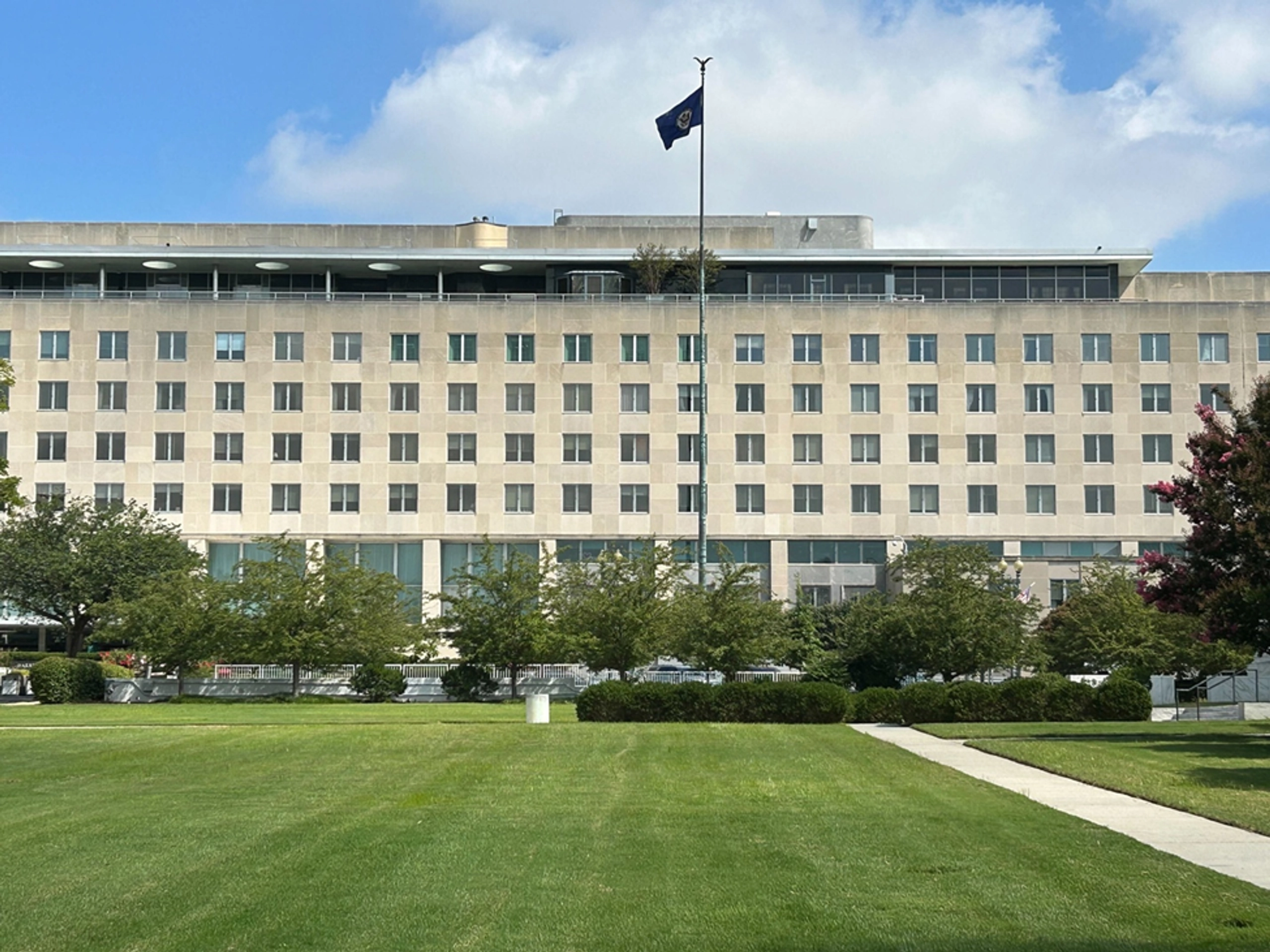
WASHINGTON, D.C. – A senior US State Department official on Monday reaffirmed that Washington’s policy toward North Korea remains focused on denuclearization, while acknowledging the growing Pyongyang-Moscow alignment as a persistent national security challenge, as President Donald Trump commenced a high-stakes trip to East Asia.
Trump, currently in Japan, is scheduled to arrive in South Korea on Wednesday for bilateral summits with its president, Lee Jae Myung, and the Chinese leader Xi Jinping on the sidelines of an Asia-Pacific economic summit in the city of Gyeongju.
JOIN US ON TELEGRAM
Follow our coverage of the war on the @Kyivpost_official.
Trump said earlier he would be willing to extend his trip if North Korea’s Kim Jong Un wants to meet with him. “But I’d love to meet with him if he’d like to meet. I got along great with Kim Jong Un. I liked him, he liked me,” Trump told reporters on Sunday during a gaggle on Air Force One.
A State Department official, speaking to reporters Monday night on condition of anonymity, did not comment on a potential Trump-Kim meeting, instead deferring to Trump’s comments.
The official also dismissed allied concerns that Trump would be too conciliatory toward Beijing, and touted the recent Kuala Lumpur Peace Accords between Thailand and Cambodia as proof of “enduring leadership of the US in the Indo Pacific region.”
North Korea-Russia Connection
The US policy objective toward Pyongyang remains the “denuclearization of North Korea,” a goal Washington has pursued for decades, the official said.

Ukraine's Banks Post Longest Credit Growth in 15 Years as Windfall Tax Threatens to Choke It Off
Emphasizing that the next step in diplomacy is up to the North Korean regime, the official stated: “How the North Koreans choose to respond is [up to them, as] obviously the ball is in their court at this point.”
Shifting focus to the growing relationship between Moscow and Pyongyang, the official acknowledged the close military and political cooperation, particularly in the context of the war in Ukraine.
“They’ve obviously been looking to deepen their cooperation since the breakout of the war in Ukraine, and I think this is part of their diplomacy,” the official told Kyiv Post, in reference to concerns that Pyongyang is supplying arms to Moscow.
Furthermore, the official characterized Pyongyang’s recent actions as a threat to regional stability:
“The North Koreans are obviously continuing to play a spoiler role in the region. They’re deepening their relationship with the Russians. And it’s a national security challenge that needs to be addressed one way or the other.”
Putin’s message to Kim
The US official’s comments came as North Korea’s top diplomat visited the Kremlin on Monday for talks with Vladimir Putin, during which the Russian leader asked his guest to convey his message to Kim, saying that everything was “going according to plan” between the two countries, according to his televised remarks at the start of the talks.
In a separate meeting with her Russian counterpart, North Korean Foreign Minister Choe Son Hui confirmed North Korea’s “unwavering understanding and support” for Putin’s war against Ukraine, North Korean state media said.
In recent months, Pyongyang has sent thousands of troops and large quantities of military equipment, including artillery shells, to Russia to support its war effort. This growing alignment has fueled leader Kim Jong Un’s increasingly assertive foreign policy as he seeks to break out of isolation and position his country as part of a united front against the US-led West.
North Korea has shunned any form of talks with Washington and Seoul since Kim’s high-stakes nuclear discussions with the US fell apart in 2019 during Trump’s first term, when Kim sent personal letters of admiration to the American leader. Since then, Kim has focused on expanding the capabilities of his nuclear-armed military.
Last month, Kim suggested he could return to talks if Washington drops its demand for North Korea’s denuclearization, after Trump repeatedly expressed his hopes for new diplomacy.
China and US Strategy
The State Department official dismissed concerns among allies that Trump would be overly conciliatory to Beijing, noting that such worries have been perennial.
“I personally don’t read much into their concerns,” the official said. “They’ve always had concerns about the US-China relationship, which dates back decades at this point.”
The official said that Trump, who “reframed the entire relationship with China in the first term,” is simply “doubling down on this administration’s existing policy.”
Regarding Taiwan, the official said that US policy “hasn’t changed one bit” and remains anchored in the Taiwan Relations Act, the three communiques, and the six assurances.
The official also briefly touched on Team Trump’s broader diplomatic goals, including the possibility of success with China on the Ukraine issue: “I think the [US] President, along with Secretary [of State Marco] Rubio and other senior officials in [the US] government, have been deeply engaged on how to bring about peace in Ukraine. So I’m going to defer to them in terms of what specific elements that they want to pursue with respect to China on the Ukraine issue,” the official said.
You can also highlight the text and press Ctrl + Enter
Russia Hit by 660-Drone Overnight Barrage Targeting Moscow, Crimea and Key Military Sites