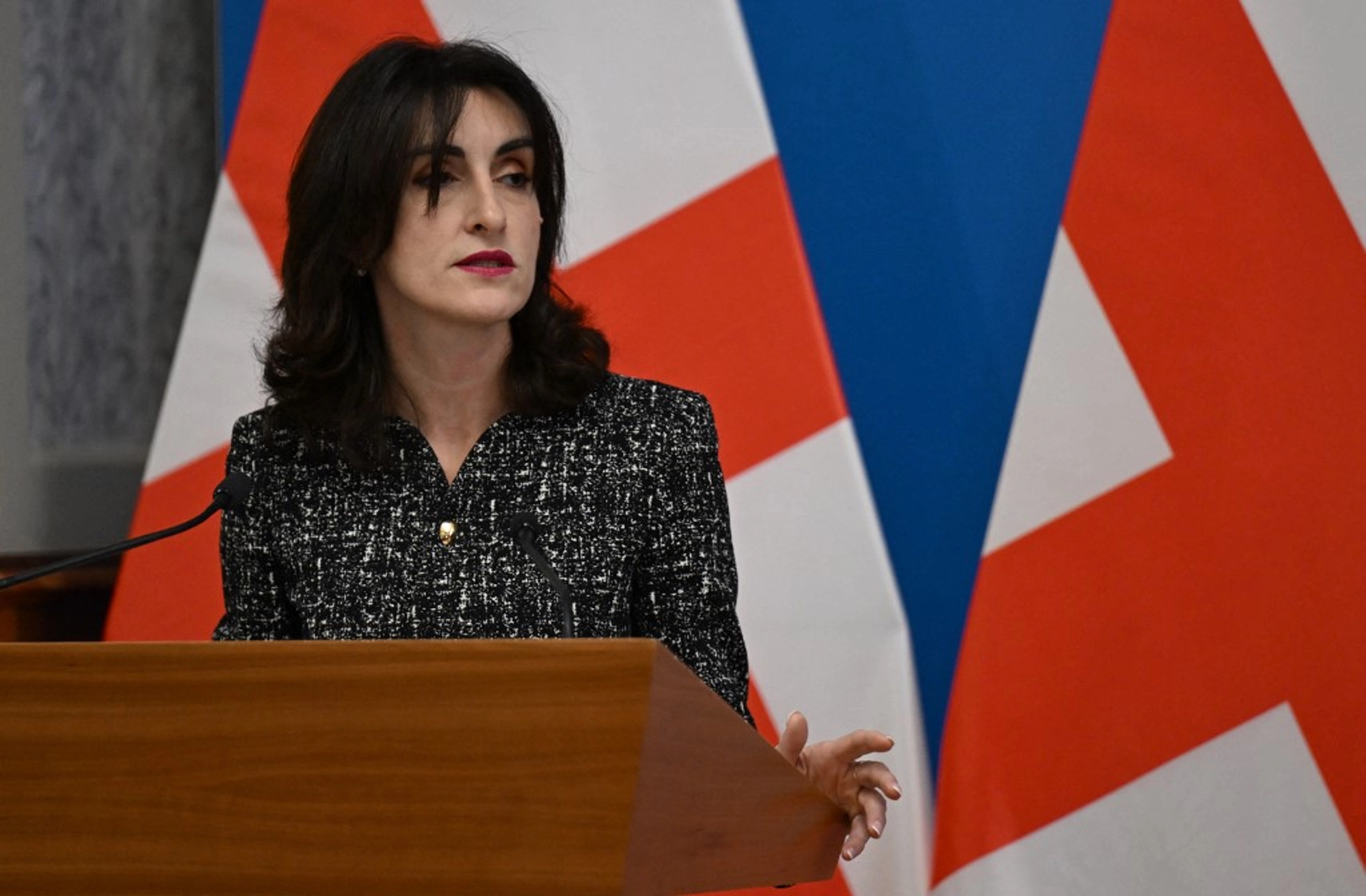
Georgian Foreign Minister Maka Bochorishvili on Thursday accused Ukraine of trying to block Georgia’s path toward joining the European Union, claiming Kyiv led “campaigns” against her country’s EU candidate status.
“Georgia’s integration into the EU was met with a negative attitude from Ukraine – to prevent us from obtaining candidate status,” Bochorishvili said in remarks published by Georgia Online.
JOIN US ON TELEGRAM
Follow our coverage of the war on the @Kyivpost_official.
“We saw campaigns in 2022–2023 in which Ukraine, in various forms, acted against our European integration.”
Bochorishvili – a member of Georgian Dream, the country’s ruling pro-Moscow political party – did not specify which Ukrainian “campaigns” she was referring to or provide evidence to support her claims.
The minister said it was “shameful” that some accused Georgia of failing to support Ukraine amid Russia’s full-scale invasion.
“Since February 2022, from the first days of Russia’s aggression, Georgia has done everything to express political support for Ukraine, and Ukraine has always received it,” she said.
Bochorishvili rejected accusations that Tbilisi had distanced itself from Ukraine in international forums, insisting that “no one can say that Georgia failed to support Ukraine politically.”
She also defended her government’s policy of avoiding direct confrontation with Russia, arguing that this stance is in line with EU and NATO countries that prioritize their own national security.
Zelensky Warns of Massive Russian Overnight Strike on Ukraine
“Our policy is very clear – the same policy that every EU and NATO member follows,” Bochorishvili said.
“No one wants to enter into confrontation with Russia and create additional security challenges. The government’s first duty is to avoid threats to the country. This should be welcomed, not condemned.”
Bochorishvili further claimed that Ukraine, as a non-member of the EU, “cannot have any reservations” about Georgia’s accession process.
“Ukraine today is not an EU member state, and therefore it cannot make any comments or have any say in Georgia’s integration into the EU,” she said.
Her comments came days after the European Commission released its 2025 Enlargement Report on Georgia on Nov. 4, which delivered one of the harshest evaluations among all EU candidate countries.
The annual report assesses progress toward EU standards on democracy, governance, and the rule of law.
The 2025 report described Georgia as a “candidate country in name only” and warned of “significant backsliding” in democracy, judicial independence, and human rights.
“The state of democracy in Georgia was marked by significant backsliding during the reporting period,” the Commission wrote.
“Repressive measures against civil society, media representatives and opposition leaders severely undermine democratic processes.”
According to the report, Georgia “is at an early stage of preparation,” down from “some level of preparation” in 2024 – signaling regression.
The Commission urged the government to restore judicial independence, strengthen anti-corruption institutions, and reverse laws that restrict NGOs and media.
EU Commissioner for Enlargement Marta Kos said Georgia remains a candidate “only formally.”
EU Ambassador to Tbilisi Pawel Herczynski called the findings a “wake-up call” for Georgian authorities.
Bochorishvili dismissed both the Commission’s and Herczynski’s assessments, claiming that the ambassador’s stance mirrors that of European leaders such as Estonian Prime Minister Kaja Kallas and Commissioner Kos.
“Mr. Ambassador cannot make a statement that contradicts the head of the EU’s foreign service,” she said.
“Unfortunately, we saw only one statement from Brussels, which deliberately distorted the facts of what happened in Georgia on Oct. 4 and made false conclusions about our country. So expecting the ambassador to say anything different makes no sense.”
Georgia’s Foreign Ministry later said the EU report was being used to “spread groundless negative assessments” of the country and fuel “political manipulation.”
Protests and political unrest in Georgia
Bochorishvili’s remarks come at a time of deep political unrest in Georgia, where tens of thousands have protested over the past year against the government’s perceived drift away from the European Union.
The protests, some of the largest since Georgia’s independence, were sparked by several overlapping issues – including a decision by the ruling Georgian Dream party to delay EU accession talks until 2028, alleged irregularities in the October 2024 parliamentary elections, and the passage of a controversial “foreign agents” law that critics likened to Russia’s legislation used to suppress independent media and NGOs.
Demonstrators have accused the government of steering the country closer to Moscow and betraying the pro-European aspirations of a population where over 80 percent support EU membership, according to polls.
Human rights observers say police have used tear gas and water cannons to disperse crowds, while government officials have dismissed the protests as politically motivated and “not necessarily peaceful.”
European leaders have repeatedly warned that Georgia risks derailing its EU candidacy if it continues to suppress civil society and undermine judicial independence – key issues flagged in the 2025 EU Enlargement Report.
You can also highlight the text and press Ctrl + Enter

Russia Hit by 660-Drone Overnight Barrage Targeting Moscow, Crimea and Key Military Sites