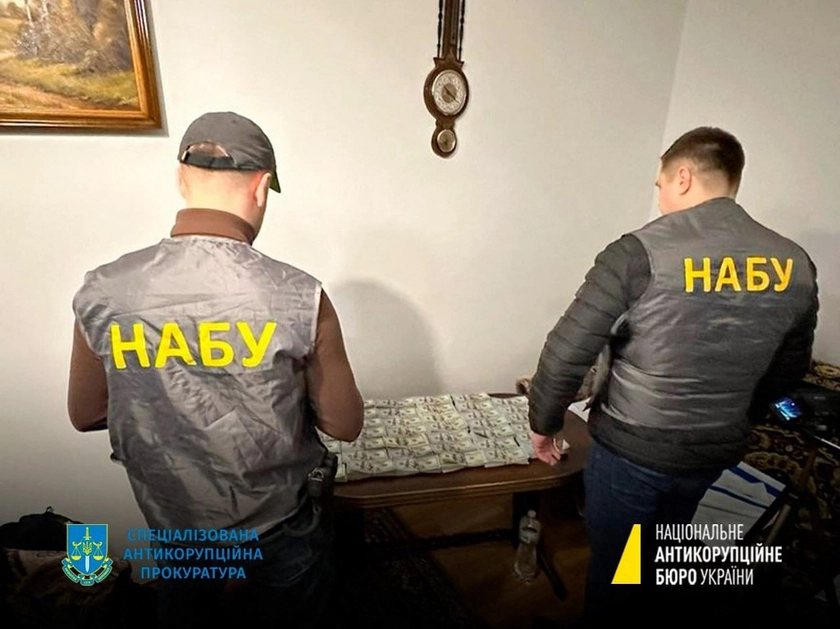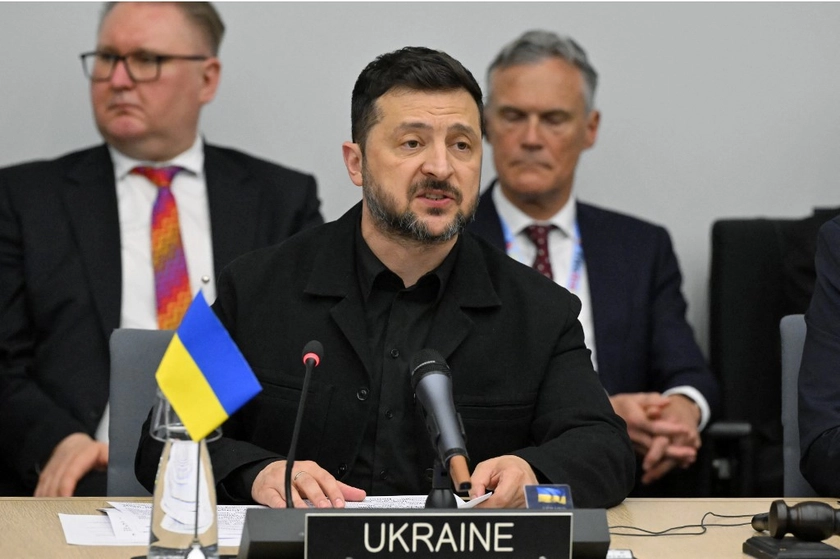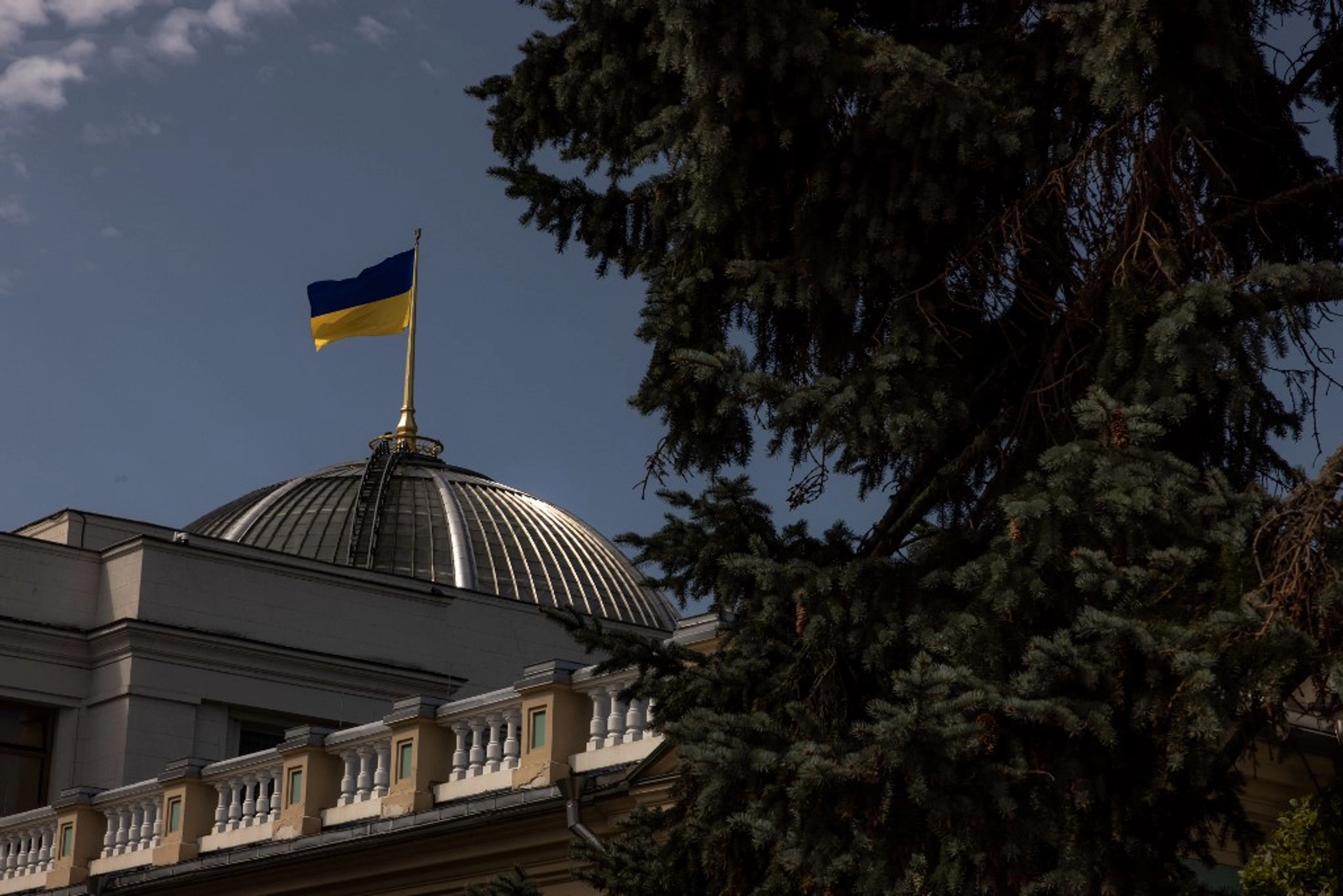
The political consequences of Ukraine’s corruption scandal – involving two ministers, officials from nuclear energy generator Energoatom, and businessman Timur Mindich, co-owner of the production company Kvartal-95 where President Volodymyr Zelensky once had a stake – have not been long coming.
Ukraine’s parliament voted overwhelmingly on Wednesday to dismiss Justice Minister Herman Halushchenko, who served as energy minister from 2021 until this year, and his successor, Energy Minister Svitlana Hrynchuk. Both were implicated in a $100 million kickback scheme involving the state-owned nuclear agency, with the two submitting their resignations on Nov. 12.
JOIN US ON TELEGRAM
Follow our coverage of the war on the @Kyivpost_official.
Lawmaker Mykyta Poturaiev published an address on behalf of the ruling Servant of the People party (although it is unknown how much of the party supported him) strongly backing anti-corruption investigations and declaring the need for a new coalition and a new government in parliament.
“To restore the trust of the citizens of Ukraine and our international partners in the state, we call for immediate negotiations among all pro-Ukrainian factions [political parties] and groups in the Verkhovna Rada [parliament] of Ukraine to form a coalition of national resilience. We call on all pro-Ukrainian parliamentary forces to abandon narrow party and personal priorities that may hinder such unification. A government of national resilience – without party quotas and behind-the-scenes agreements,” Poturaiev wrote.
Zelensky Reportedly Asks Brazil’s Lula to Help Push Peace Talks
Could this be a revolt?
Until now, the ruling party has rarely presented its own voice and never criticized either Zelensky or his appointments. Only four 4 ago, 262 votes were cast for Prime Minister Yulia Svyrydenko’s government, which some party members now evidently want to replace.
Poturaiev has already been supported by high-profile representatives of the Servant of the People party, such as Bohdan Yaremenko. There is still no final count of those who intend to support this resolution, but Kyiv Post’s sources say it could be a “significant group.”
What’s changed?
First, a significant portion of the ruling party feels used.
“This all started with the story about NABU [National Anti-Corruption Bureau of Ukraine] and SAPO [Specialized Anti-Corruption Prosecutor’s Office]. It wasn’t parliament’s idea, but we ended up being the ones blamed,” one Servant of the People lawmaker told Kyiv Post.
The idea to strip anti-corruption institutions of their independence (namely NABU and SAPO) by making them de facto part of the Prosecutor General’s Office (which is controlled by the president) caused mass riots in Kyiv in the summer of 2025. According to media reports, the idea may have stemmed from Andriy Yermak, head of the Office of the President of Ukraine, though no official confirmation has been forthcoming.
The party also dislikes the fact that decisions are made without it being consulted. This is a historic issue that the president’s vertical did not apparently consider a priority, but it has burst into the open.
Why is the government being criticized?
There are two apparent reasons why the government has come under fire, rather than Yermak himself.
First, Yermak was appointed by Zelensky, and parliament cannot directly influence his position. The government, however, is appointed and approved by Ukraine’s parliament, and is accountable to parliament, so the government is something that outraged MPs (members of parliament) can easily attack.
Besides, this does not only concern Servant of the People party MPs. Another party – the opposition European Solidarity of ex-president Petro Poroshenko – has played an active role in promoting the idea of a technocratic “government of national unity,” which has been speaking for over a year about the need for a non-political technocratic cabinet.
According to observers and experts, Poroshenko’s party has its own interests – eyeing a return to power, or at least partly so to gain more influence.
The problem for them is that since the Servant of the People party still make up almost half of parliament, it is impossible to form a government that ignores it. However, it is open to question how many MPs will continue to toe the Office of the President’s line.
The second reason why Svyrydenko’s government came under fire is that many people see her as “Yermak’s protégé” – she rose to a high position as a result of her work in the President’s Office during Yermak’s tenure, as did some ministers in her government, for example Oleksiy Kuleba, whom some opposition MPs also wanted to dismiss.
Some active Servant of the People MPs even mocked the government for its reluctance for a long time to present its program of action.
“If the government had not been afraid to present [its program of action] to the very body that appointed it – parliament – it would have had a year of immunity and would now be untouchable. But they chose substitution of concepts and substitution of the subject, and now may have to pay by replacing the entire cabinet,” says MP Dmytro Natalukha, head of the economic policy committee.
What might happen next?
For members of the Ukrainian public, opinions about the prospect of forming a new majority and a new government have sparked different reactions. For some, especially those who remember anti-corruption investigations against Poroshenko’s inner circle, the idea of a “government of national unity” seems stillborn – essentially, they believe it is an attempt by the opposition to regain power, from which it was ousted in 2019 precisely because of the issue of corruption.
“The government of national unity is an artificial project of Poroshenko. It comes at a time when Russia has intensified its offensive at the front, and we are retreating due to a series of personnel mistakes and planning errors; also at a time when Putin’s lobbyists in the West again demand our capitulation, taking advantage of the turbulence here. Political corpses that will never return to power through elections are doing this,” writes analyst Anna Kaliuzhna.
“In short, everyone who has any ambition and political weight must be given a ministry, because everyone must be included… without everyone what kind of unity government would that be?!” notes activist from Dnipro Serhiy Masliuchenko.
Separate issues relate to the responsibility of the new government, to whom it will be accountable, and for how long it will last without in-fighting. However, the opposition sees it differently.
“I will name just one surname – Churchill… He had a coalition wartime government with the Labour Party, where a key role was played by the slim, mustached, quiet Clement Attlee. While Churchill delivered his famous speeches, Attlee did the routine work… Churchill worked to mobilize the spirit of the nation at war, while Attlee worked to make sure that the nation had something to eat. That’s how they worked in a coalition, although behind the scenes they certainly did not like each other,” writes opposition publicist Maryna Danyliuk-Yermolaieva.
“From the outside, all these quarrels and disputes in the Verkhovna Rada [Ukraine’s parliament] may look like chaos and disorder. But this is exactly how parliamentary agency is born. Today, MPs forced the deputy prime minister not only to present the resolutions dismissing the corruption-accused ministers but also to answer uncomfortable questions. Within the Servant of the People party, there is now an initiative to create a ‘coalition of resilience’ and accordingly a new government. Perhaps the attempt to emerge from the crisis caused by Ukraine’s distorted power structure will offer a chance to return to normal politics capable of producing the decisions the country needs,” notes opposition MP Volodymyr Viatrovych.
While matters play out, Mindich is no longer in Ukraine, having fled before he could be arrested. Zelensky, who is not implicated in the corruption case, has imposed sanctions on Mindich and another businessman.
You can also highlight the text and press Ctrl + Enter

Putin’s Worst Nightmare