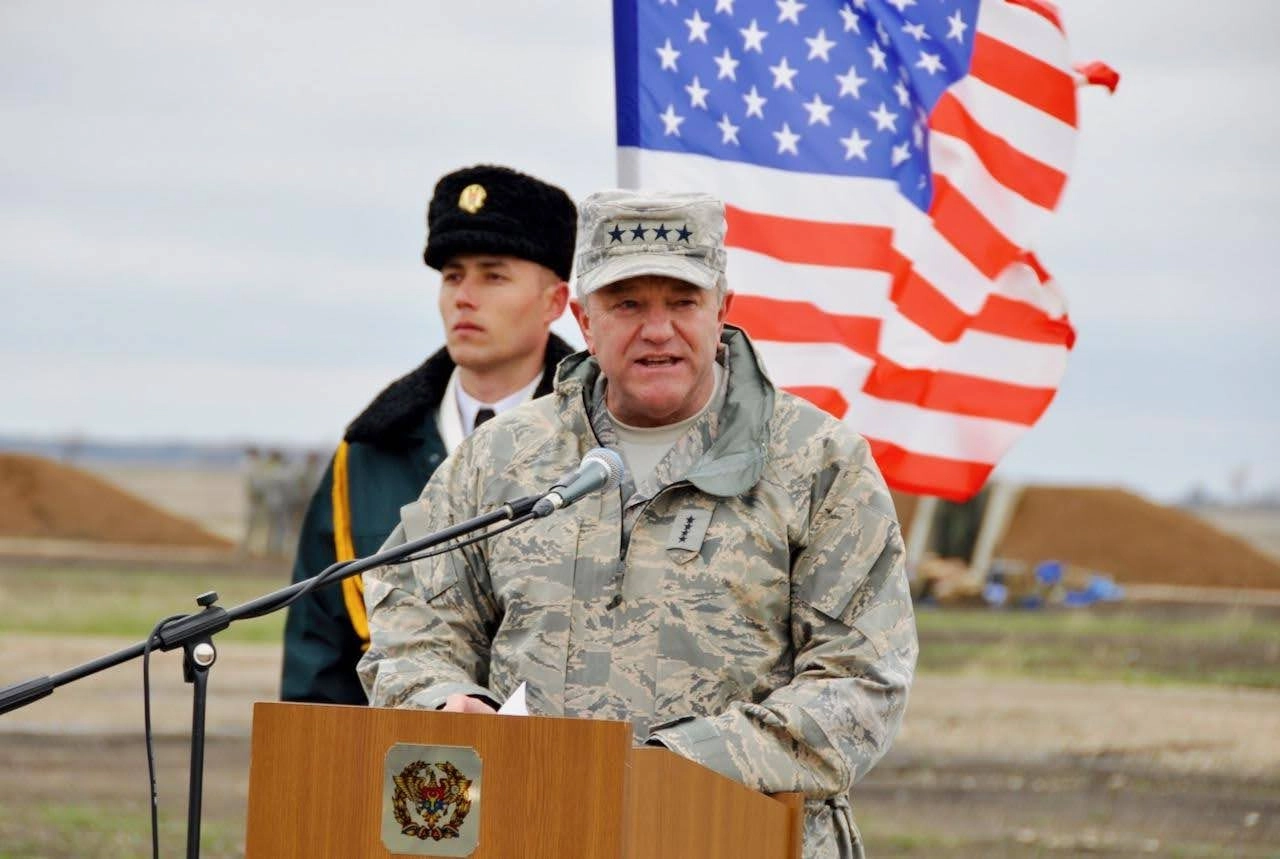
WASHINGTON DC – Retired US Air Force Gen. Philip Breedlove, the former NATO Supreme Allied Commander, warned Wednesday that amid political turbulence in Washington, the United States is neither prepared nor positioned to abandon its allies and confront emerging threats alone, telling Kyiv Post in a wide-ranging interview that Europe’s security depends on sustained American commitment.
While he declined to wade into partisan critiques, he drew a sharp distinction between the posture of the current US administration and the enduring instincts of the American public – a contrast he suggested Europe should take seriously as it evaluates the implications of the new US National Security Strategy.
JOIN US ON TELEGRAM
Follow our coverage of the war on the @Kyivpost_official.
Strategy that echoes Moscow
Breedlove underscored that the latest NSS reflects the Trump administration’s current policy preferences, not a permanent shift in American grand strategy.
Still, he said the document contains elements that raise concern, including what he described as a de-prioritization of Europe and a framework that tracks uncomfortably closely with the “spheres of influence” worldview long espoused by Vladimir Putin.
According to Breedlove, the NSS resembles the multipolar arrangement Russia has been arguing for over the past decade-plus – one that divides the world into regional zones of dominance.
In his view, this alignment with Moscow’s preferred architecture is “deeply concerning,” not because it makes US policy permanently fixed, but because it signals acceptance of an adversary’s strategic framing at a sensitive moment.
G7 to Meet Zelensky as Trump Signals Optimism for Ukraine Peace Push
At the same time, Breedlove stressed that polling consistently shows strong American public support for NATO and for assisting Ukraine.
That enduring sentiment – not the transient priorities of any one administration – should reassure European partners, he suggested.
Putin ‘will come back’ – and Europe must prepare
When asked whether Europe must accelerate readiness targets across critical capabilities, from air defense to ISR to logistics and cyber, Breedlove did not hesitate. Europe, he said, needs all of it – urgently.
He noted that while he does not engage in politics, it was President Trump who succeeded, however controversially, in pushing NATO members to significantly increase defense spending.
After what Breedlove described as a “25 to 30-year procurement holiday” following the Cold War, Europe is now racing to catch up – and needs to continue doing so.
He argued that Putin’s own documents and public statements leave no ambiguity about Moscow’s aims: a restructuring of Europe’s security order reminiscent of the USSR and Warsaw Pact era.
Russian officials’ recent remarks that “we’re not done in Europe,” he said, are not rhetorical flourishes but strategic intent.
Ukraine’s defense of its territory has significantly degraded Russia’s ground forces, Breedlove noted, buying Europe a window of time.
But that window will close. Putin, he said, “will come back,” and Europe must use the present years to prepare for his next move.
Real weapons, real authority, real timelines
Breedlove said the most important immediate step for Europe is not another round of declarations but adopting policies that result in rapid, tangible movement of capabilities to Ukraine – paired with the authority for Kyiv to use them effectively.
He warned that Europe and the US alike are unprepared for the scale of aerial attacks Russia conducts nightly against Ukraine.
Hundreds of drones, he said, represent a threat for which neither NATO nor the EU – nor the US homeland – currently has sufficient defenses.
Asked about some Republican calls to withdraw from NATO, Breedlove described a scenario that illustrates America’s own vulnerabilities: a container ship entering a major port, releasing swarms of hostile drones.
The US, he said, would be “completely defenseless” against an attack modeled on the kind of long-range, deep-strike drone operations already demonstrated in Ukraine and the Middle East.
Adversaries know how to do this. The US, he emphasized, is not prepared – another reason why abandoning allies would not enhance American security but undermine it.
Europe’s best signal to Washington: Show you’re serious
As to European defense leaders hoping to maintain deep military cooperation with the US during political friction, Breedlove’s message was blunt: demonstrate seriousness.
He argued that if Europe shows clear intent to arm itself and take primary responsibility for its defense, it will undercut domestic US arguments for disengagement.
Signaling – and acting on – that commitment, he said, is the surest way to maintain strong military-to-military ties.
In a moment when slogans compete with strategy, Breedlove’s assessment lands with characteristic force: America’s alliances endure because its people understand what its adversaries intend – and because facing that danger alone would be a perilous illusion.
If Washington wavers, he suggests, the ensuing global power vacuum would be a catastrophic victory for America’s enemies, leaving the continent’s security to hang in the balance.
You can also highlight the text and press Ctrl + Enter