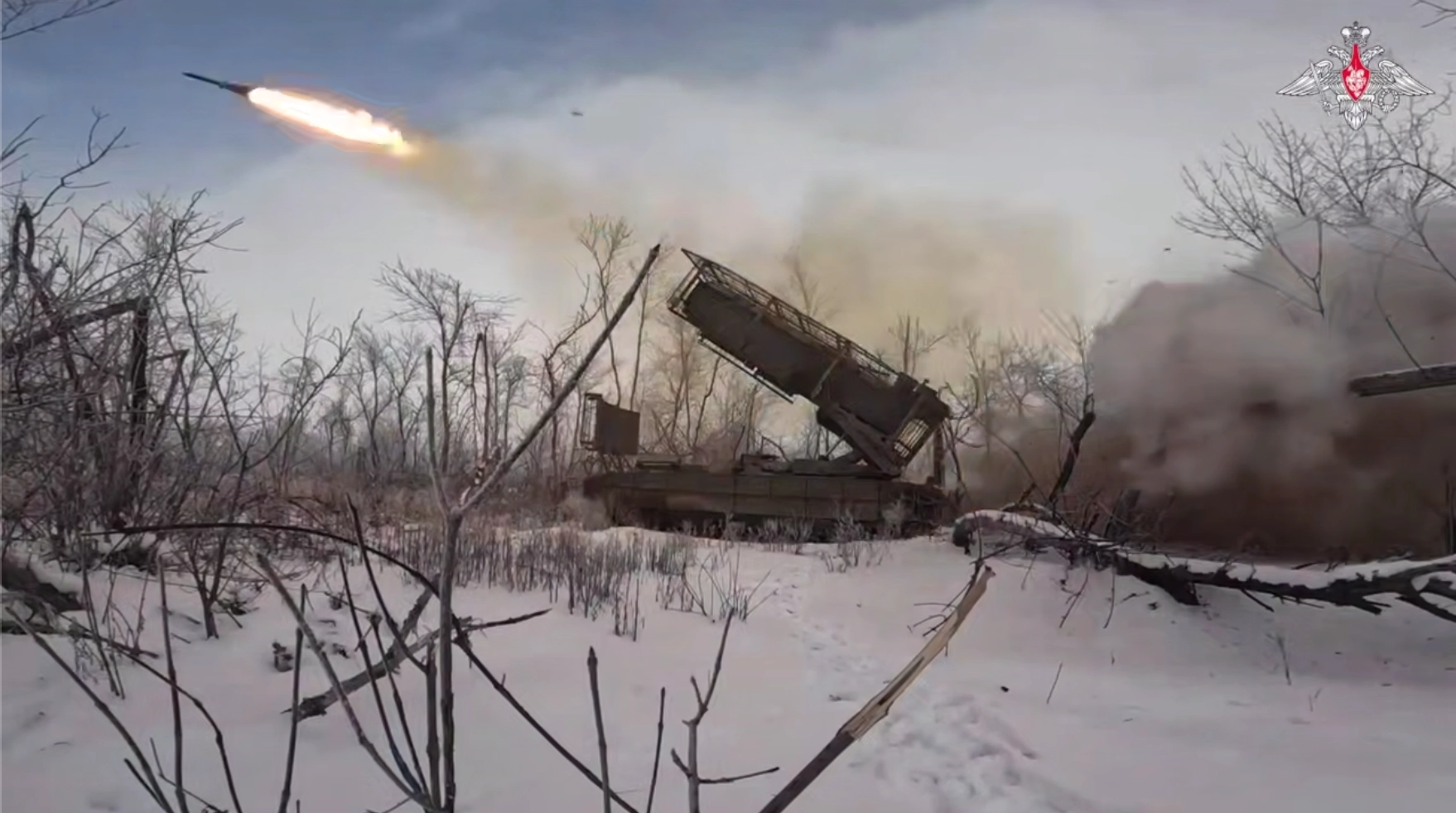
Russian forces have begun deploying the new TOS-3 “Dragon” thermobaric multiple rocket launcher system (MRLS) on the frontlines in Ukraine – an upgraded model of the TOS-1A Solntsepyok dubbed a “legend” by Russian propaganda.
On Thursday, Defense Express reported that footage recently released by the Russian Ministry of Defense which purports to show a TOS-1A Solntsepyok actually shows the TOS-3 “Dragon,” which has a longer range and enhanced protection compared to the Solntsepyok.
JOIN US ON TELEGRAM
Follow our coverage of the war on the @Kyivpost_official.
The system was first introduced in 2024, featuring a welded-on grill and an integrated “Volnorez” electronic warfare suite.
The TOS-3 differs from the older Solntsepyok in several ways: for example, it has 15 launch guides instead of 24, but fires longer-range rockets. While the TOS-1A had a range of up to 6 km (3.7 miles) and required direct line of sight, the TOS-3 can strike targets from 15-24 km (9-15 miles), enabling it to fire from covered positions.
Built on a T-72 chassis, it also includes Kontakt-5 dynamic armor, anti-drone nets, and electronic countermeasures. Additional screens and protective elements shield the rockets when stowed. These upgrades make the TOS-3 more resistant to counter-battery fire and strike drones.
Polish journalist Filip Melczarek recently said that its exact specifications will become known only if Ukraine captures one – but that “currently, the only line of defense is using [first person view] FPV drones to neutralize Dragons before deployment.”
Ukraine Regained Battlefield Initiative but Needs More Aid to Keep It – Fedorov
Often mistranslated as a “heavy flamethrower,” the Solntsepyok is actually a multiple rocket launcher that fires thermobaric munitions. Like the Solntsepyok, the TOS-3 fires thermobaric rockets that produce massive blast waves by dispersing flammable aerosol before detonation, causing severe pressure changes that can devastate personnel and structures. Any incendiary effect is secondary.
Russia uses the Solntsepyok system to strike Ukrainian positions and civilian areas. A single salvo of 24 rockets can blanket roughly 200 by 200 meters, leveling fortifications and damaging entire neighborhoods.
Each rocket weighs over 200 kilograms, and the system is estimated to cost between $6.5 million and $15 million.
Russian officials have long claimed the weapon has no global equivalent, but it comes with serious risks: when damaged, its volatile ammunition can explode, endangering nearby troops. In one 2024 incident, a Solntsepyok munition detonated in Russia’s Belgorod region, killing three Russian soldiers.
Despite its destructive power, the Solntsepyok is large and lightly armored, making it vulnerable to drones and anti-tank weapons. Ukrainian forces have repeatedly destroyed the launchers throughout the war, sometimes striking them even as they fire. In late September 2025, Ukraine’s 429th Separate Achilles Drone Regiment reported destroying two Russian TOS-1A Solntsepyok launchers using FPV drones in Ukraine’s northeastern Kharkiv region.
Ukraine has also captured several of the systems in the past.
You can also highlight the text and press Ctrl + Enter

Russia Hit by 660-Drone Overnight Barrage Targeting Moscow, Crimea and Key Military Sites