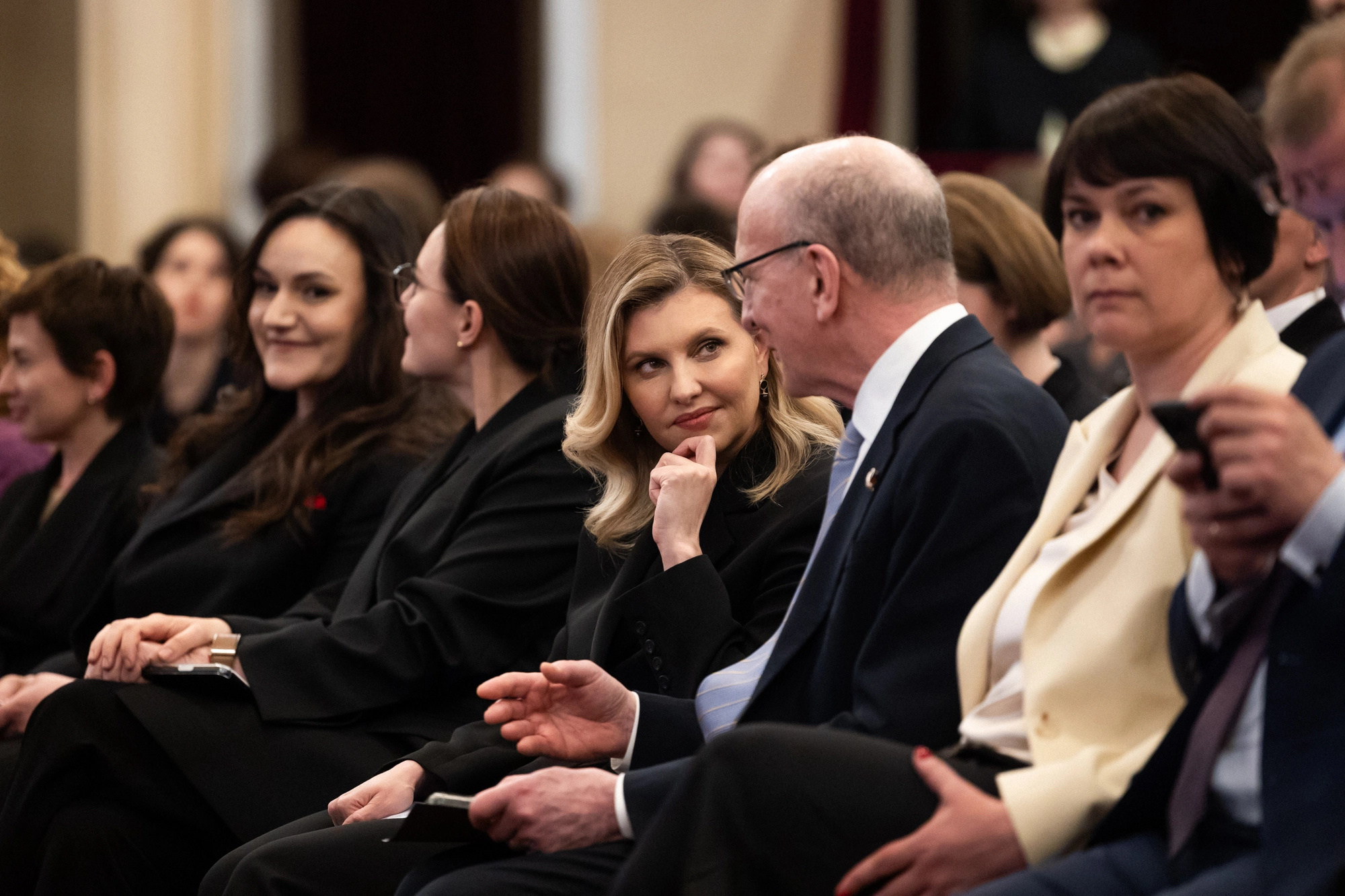
First Lady Olena Zelenska attended the world premiere of the concert version of the opera Mothers of Kherson at the National Opera of Ukraine. The production serves as a prominent cultural and political platform to bring renewed global attention to the systematic abduction and deportation of Ukrainian children by Russian forces.
The premiere was timed to mark a solemn anniversary, taking place on the International Day of Innocent Children Victims of Aggression.
JOIN US ON TELEGRAM
Follow our coverage of the war on the @Kyivpost_official.
Based on true eyewitness testimonies
Mothers of Kherson documents the journey of two mothers from the liberated southern city of Kherson who traveled more than 4,000 kilometers through several foreign countries and temporarily occupied territories to rescue their daughters, who were being held by Russian authorities on the Crimean Peninsula. The libretto is directly derived from the real-world testimonies of Ukrainian women who successfully navigated occupation infrastructure to repatriate their family members.
The concert version performed in Kyiv represents the first public presentation of the work. The high-profile piece was co-commissioned through an international partnership between the Metropolitan Opera in New York and the Polish National Opera in Warsaw.
Conducted by Keri-Lynn Wilson, the performance featured a collaborative ensemble including the orchestra and chorus of the National Opera of Ukraine, the Kyiv Camerata ensemble, and the Children’s Choir of the M. V. Lysenko Kyiv State Music Lyceum.
EU: No More Protection for Ukrainian Men?
Prior to the curtain rise, Zelenska held a diplomatic meeting with Wilson and Peter Gelb, the General Manager of the Metropolitan Opera. President Volodymyr Zelensky also joined the meeting, where Wilson presented the Head of State with a newly released vinyl recording featuring the Kyiv Camerata.
The global fight to return displaced children
During the reception, the First Lady emphasized the critical role that international visibility plays in resolving ongoing forced deportations.
“I am grateful to everyone involved for bringing global attention to this truly painful issue,” Zelenska stated. “Russia has abducted and deported more than 20,000 children, and only 2,223 have so far been returned through the efforts of the International Coalition for the Return of Ukrainian Children. The more people know about this and join the effort to save them, the greater the chances that the children will return home and be reunited with their loved ones.”
The issue of systemic relocations remains one of the most sensitive aspects of the conflict, frequently featuring in conversations surrounding potential peace conditions between Kyiv and Moscow.
While the Kremlin continues to deny wrongdoing, asserting that it relocated minors out of active combat zones exclusively for their own safety, an independent United Nations international commission of inquiry formally accused Russia of committing crimes against humanity by actively obstructing the return of Ukrainian youth.
The scale of the systemic relocation program was further outlined in separate investigation data released by the Yale School of Public Health’s Humanitarian Research Lab. Their findings alleged that Russian state-controlled energy conglomerates, including Gazprom and Rosneft, actively financed the transportation and political indoctrination of at least 2,158 children across six specialized camps between 2022 and 2025.
To counter this infrastructure, Ukraine has relied on international support networks, including a recently introduced $25 million US humanitarian fund dedicated to tracking, identifying, and rehabilitating repatriated youth. By showcasing these real-world rescue operations on the operatic stage, Ukrainian officials aim to amplify the voices of affected families, using international cultural networks to sustain pressure on Moscow until every displaced child is successfully returned.
You can also highlight the text and press Ctrl + Enter

Russia Hit by 660-Drone Overnight Barrage Targeting Moscow, Crimea and Key Military Sites