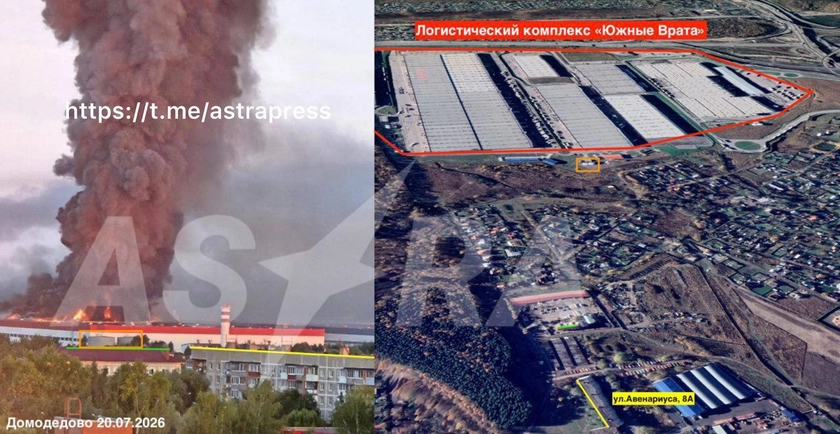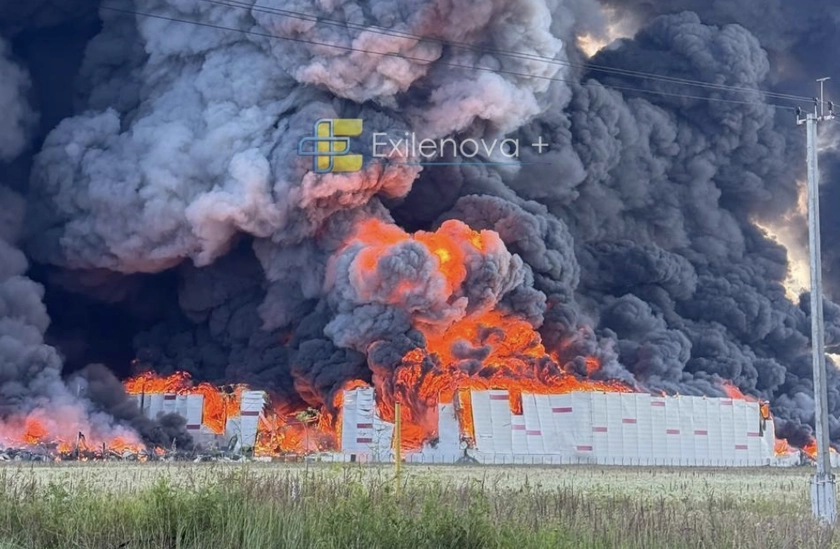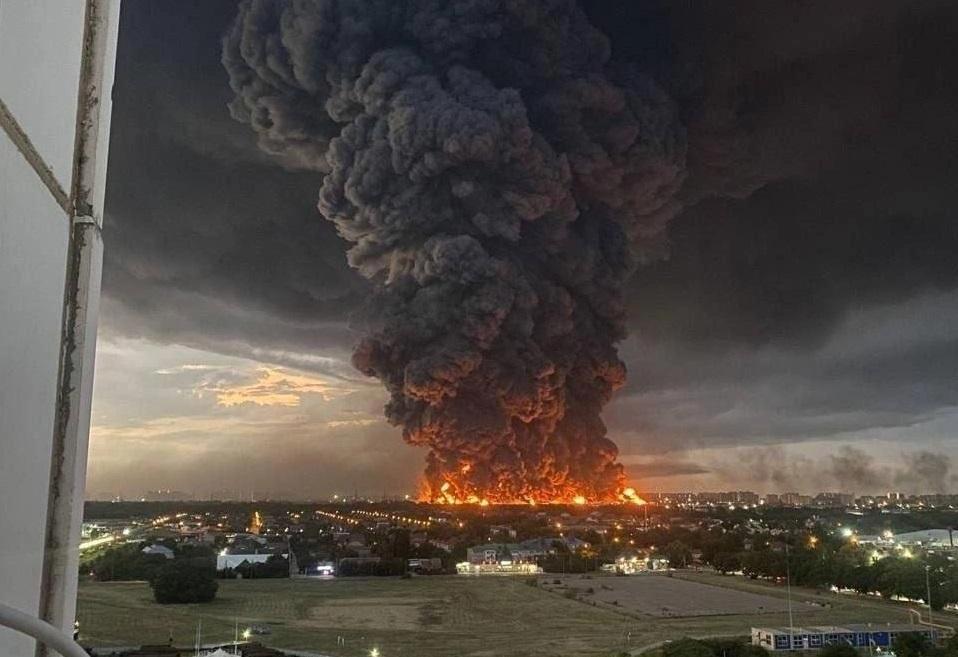
Ukraine has destroyed two more large warehouses belonging to Russia’s biggest marketplace retailer, Wildberries.
This time, warehouses in southern Russia – near Krasnodar and in Stavropol Krai – were set ablaze.
JOIN US ON TELEGRAM
Follow our coverage of the war on the @Kyivpost_official.
Earlier, the company’s largest warehouses, located near Moscow (in Elektrostal) and in Tambov Region, had already been destroyed.
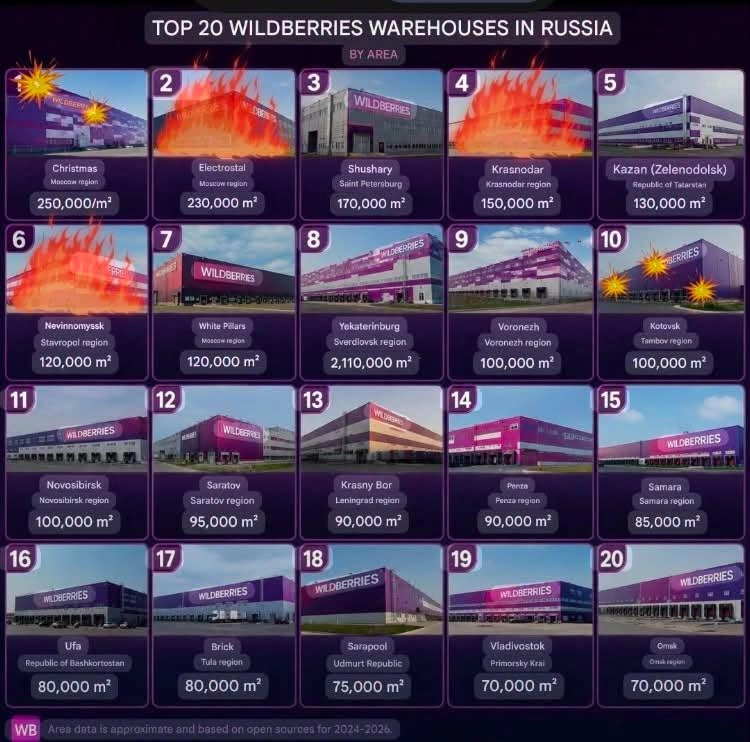
According to various sources, the total damage is estimated at between 150 and 230 billion rubles (about $2 billion), plus another 30 to 35 billion rubles (around $300 million) that will have to be spent on clearing debris and repairing the terminals.
Wildberries, founded in 2004, is now the leader of Russia’s retail sector, controlling more than 40% of the market and, together with its main competitor Ozon, up to 70%. It’s Russia’s equivalent of Amazon, although its role in the Russian economy is even greater than Amazon’s in the United States.
Wildberries’ annual turnover exceeds 4 trillion rubles, or roughly $30-35 billion. That accounts for more than 10% of all domestic trade in Russia.
The Russian internet is filled with desperate appeals from small and medium-sized business owners who lost merchandise worth hundreds of millions of dollars in the destroyed warehouses. Some lost everything.
'Gasoline Situation Is F***ed' – Fuel Crisis Hits Russian Army as Troops Report Severe Shortages
One of them even took his own life. It turned out that the young entrepreneur had borrowed 12 million rubles (around $153,900), purchased inventory, placed it in the marketplace’s warehouse – and it burned to the ground together with one of the Wildberries facilities.
The company has already announced that it will not compensate customers for their losses. As early as July 7, anticipating that after attacks on Russia’s oil industry its own facilities might become targets, the retailer amended its terms of service by removing insurance compensation in cases of “force majeure,” explicitly including wartime circumstances.
In Russia, the strikes on Wildberries are already being described as extremely painful. Why?
At first glance, the targets appear to be civilian. The marketplace mainly sold clothing (up to 40% of turnover), household goods and toys (up to 30%), and electronics (up to 12%).
However, the reality is more complicated. Here is the logic behind Ukraine’s strikes.
But first, one important point must be made.
Ukraine did not start this war
It is important to clarify from the outset: Ukraine did not begin striking logistics centers, oil refineries, or other supposedly civilian infrastructure.
When Russia launched its full-scale invasion in 2022, it destroyed hundreds of civilian infrastructure sites across Ukraine, beginning with the Drama Theater and the maternity hospital in Mariupol, where hundreds of people were sheltering at the time.
Over four years of war, Russia has struck every Ukrainian power plant – there is not a single one that has not been attacked – as well as several railway stations, the country’s largest children’s oncology hospital, not to mention logistics infrastructure.
Hundreds of thousands of square meters of logistics facilities have been destroyed. Hundreds of thousands of tons of humanitarian aid, medicines, books, food supplies, and millions of goods and parcels have been lost.
Russian weapons have destroyed hundreds of branches of Ukraine’s government postal service, Ukrposhta, and more than 400 postal service vehicles.
More than 400 Nova Poshta branches, sorting depots, and major terminals have been damaged or completely destroyed, and 26 employees have been killed.
Eight Epicenter home improvement shopping centers, with a combined area of more than 136,000 square meters (387,500 square feet), have been completely destroyed. A guided aerial bomb strike on the Kharkiv hypermarket in May 2024 killed 19 people.
Three major distribution centers belonging to grocery retailer ATB, which supplied food to millions of people, have been completely destroyed.
A major Fozzy Cash & Carry wholesale distribution hub in Odesa, covering more than 10,000 square meters (107,639 square feet), has been completely destroyed. Near Kyiv, a specialized frozen-food logistics complex belonging to the Silpo supermarket chain, covering 15,000 square meters (161,458 square feet), was burned down.
During Russia’s massive attacks on Kyiv, one of Rozetka’s key distribution hubs was completely destroyed.
In the past 12 months alone, more than 500,000 square meters (around 124 acres) of warehouse facilities and postal terminals have been damaged or destroyed by Russian missile strikes.
In addition, several oil depots and several hundred gas stations have been destroyed during the war.
Entire cities have been completely devastated, with their populations either disappearing altogether or dwindling to just a few hundred people as a result of fighting and Russian forces raining down bombs and firing artillery shells. Among them are Bakhmut (population 100,000), Mariupol (490,000), Marinka (15,000), Volnovakha (12,000), Avdiivka (16,000), Kostiantynivka (74,000), Pokrovsk (60,000), Myrnohrad (35,000), Vuhledar (12,000) as well as several hundred villages. Some experts compare the scale of destruction in southern and eastern Ukraine to that of World War II.
Residents of Kyiv, Kharkiv, Odesa, and Dnipro continue to be killed by Russian aerial weapons every day. Millions of people have become refugees.
Nevertheless, for a long time Ukraine refrained from striking Russia’s supposedly civilian infrastructure, until it had expanded production of its own long-range drones and missiles to several hundred units per week. Has anything changed in Ukraine’s tactics? No. Because the targets are far from civilian.
Not quite a civilian marketplace
Russian business leaders and government officials portray Wildberries as an exclusively civilian retailer.
However, this is not the case. The marketplace offers a large number of dual-use goods, including drones.
For example, a search for the word “drone” returns a large selection of DJI Mavic 3 and Mavic 4 drones, which are widely used on the battlefield.
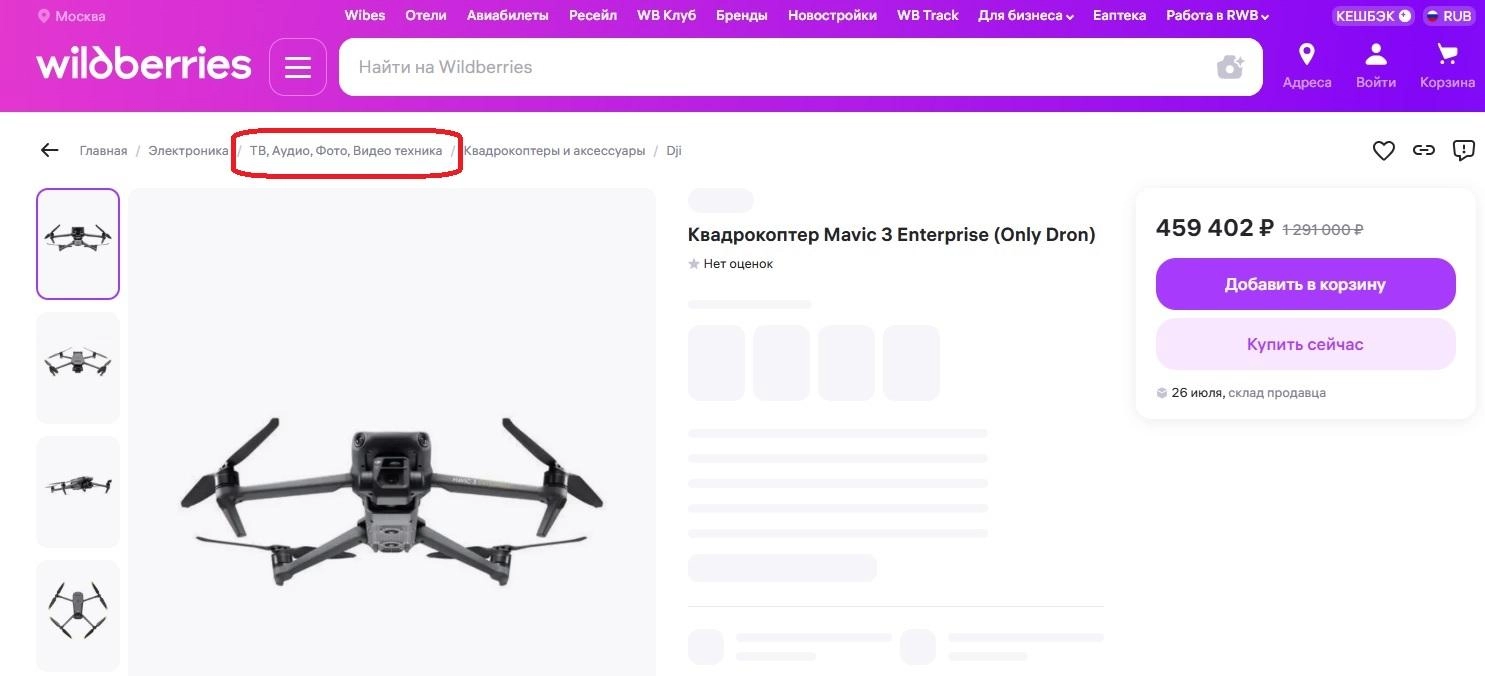
More than that, the platform openly sells quadcopters explicitly labeled as first-person view (FPV). They have become the primary strike weapon for both sides in the war.
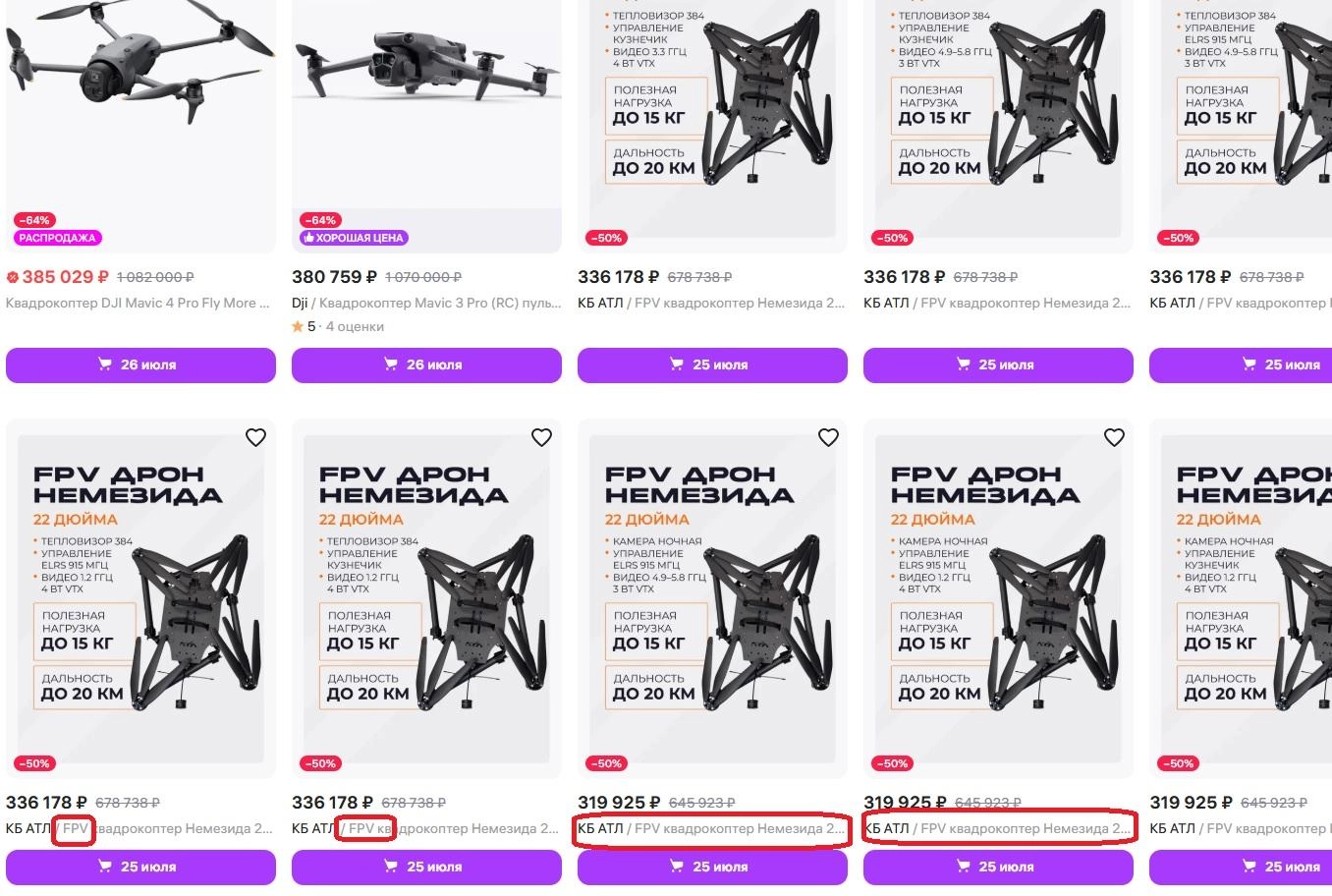
Such listings account for around 1% of all products. That may not sound like much, but on a marketplace with an annual turnover of $30 billion, it represents a significant volume.
Moreover, much of the military-related merchandise is hidden within seemingly civilian categories such as “Auto Parts” or “Electronics.”
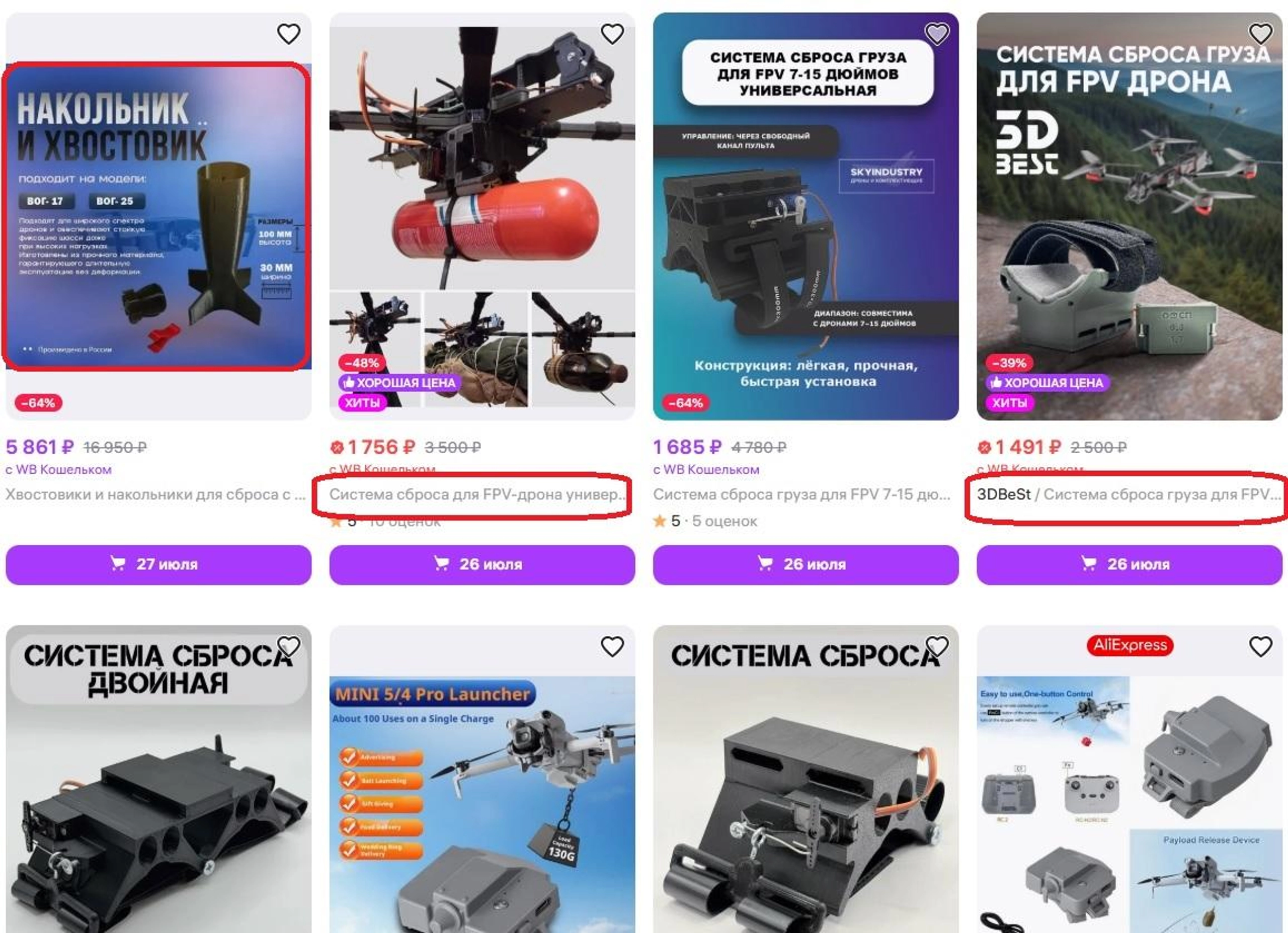
For example, one can openly purchase drone bomb-release mechanisms or payload retention systems – equipment designed to carry and release explosives from drones. Wildberries sells them without restriction, complete with technical specifications.
Furthermore, the “Toys” and “Electronics” sections – which formally are not categorized as drone equipment – contain a large number of training or “children’s” drones.
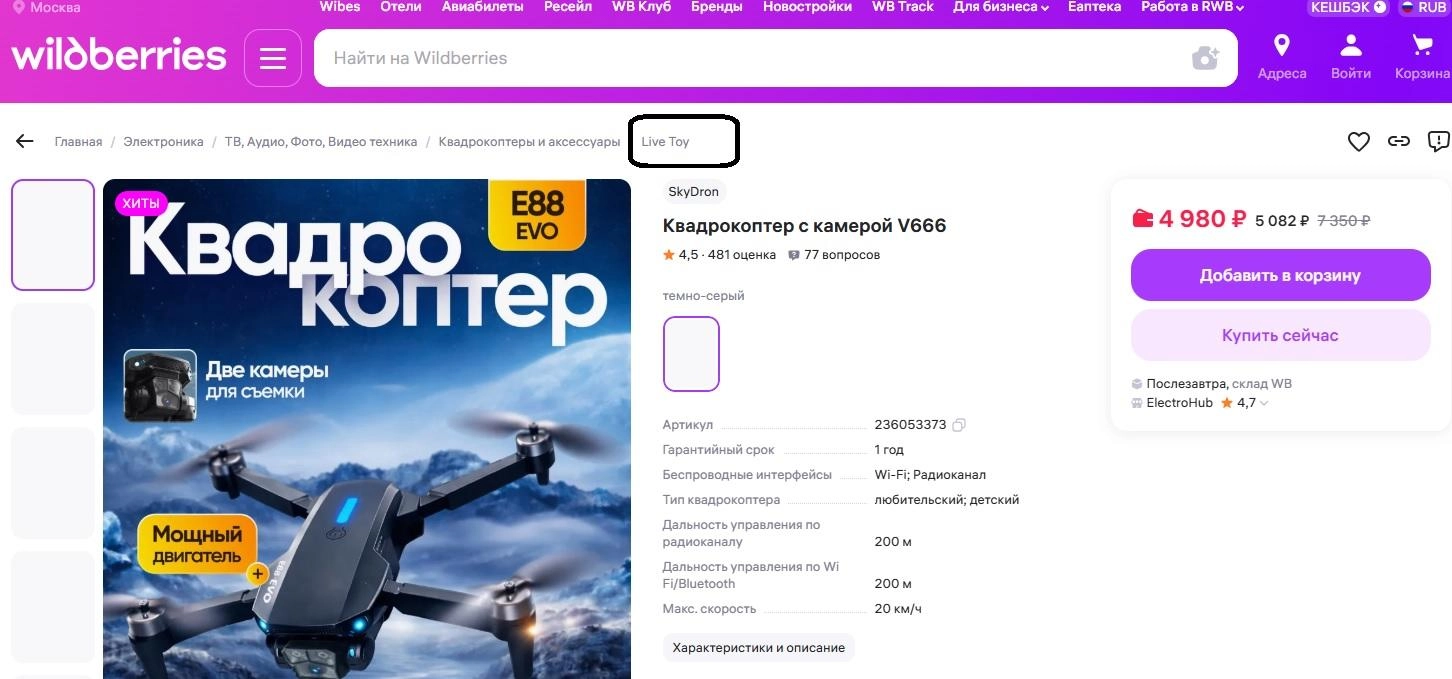
By themselves, these are perfectly civilian products. However, Ukrainian human rights organizations and intelligence agencies have repeatedly published information about Russian plans to train hundreds of thousands of drone operators by 2030, with large-scale educational programs being incorporated into the curricula of Russian schools and universities to achieve that goal.
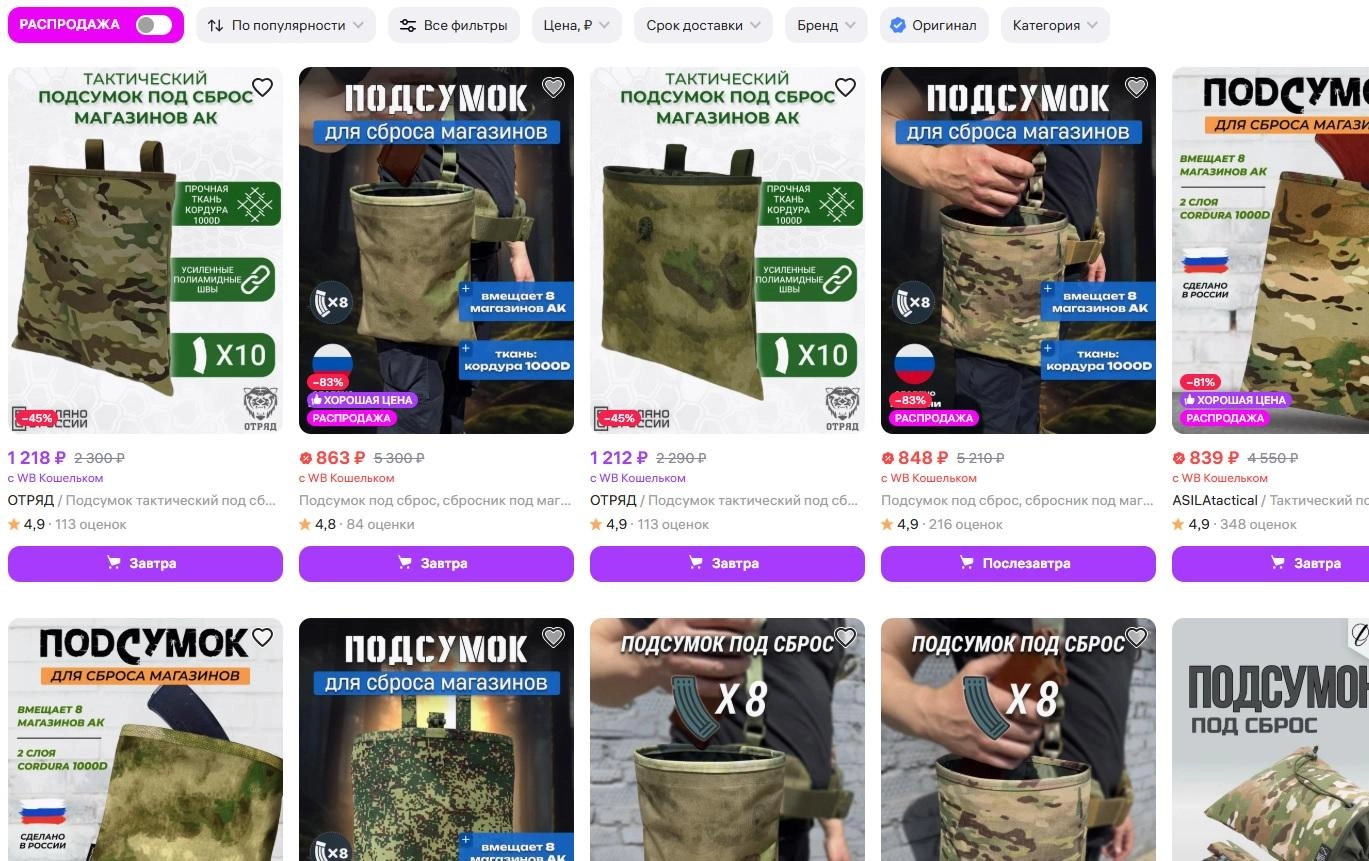
Meanwhile, the “Clothing” section also contains overtly military products, including tactical gear. If a user searches for the word “sbros” (”release”), the platform immediately suggests the most popular related searches.

In addition to drone release mechanisms, it offers magazine dump pouches – commonly known as a “chest rig” or “bra” – equipment worn over body armor to carry and quickly discard rifle magazines.
However, Ukraine’s strikes have another dimension – one that is considerably more painful for Russia.
Less money means less war
Another aspect of Ukraine’s attacks appears to be pressure on yet another vulnerable point in the Russian economy.
Besides the oil refining industry, marketplaces and retail logistics hubs have unexpectedly emerged as one of those weak points.
They have become a narrow bottleneck through which a vast amount of sanctioned products – including smartphones, clothing, electronics, and power tools from Asia and Europe – reaches Russian consumers despite direct sanctions prohibiting such exports. This includes products manufactured by Apple, Samsung, ASUS, and many others.
That is why these goods are supplied through intermediaries in Central Asia, China, and Russia itself. In Russia, this method of circumventing sanctions has become known as “parallel imports.” It is more expensive and takes longer, but it nevertheless sustains small businesses and keeps all sanctioned products – from software and designer clothing to the latest iPhones – available on the Russian market.
Among other things, this creates the impression within Russian society that the war has little impact on everyday life, reducing incentives to oppose it or question the government’s policies.
That picture is now beginning to change.
It is also about enormous sums of money. Wildberries earns up to 100 billion rubles ($1.3 billion) in net profit annually. The marketplace pays up to 13 billion rubles ($167 million) in corporate income tax each year, while its turnover also generates approximately 35 billion rubles ($449 million) in value-added tax (VAT), not including several billion more in payroll-related social taxes.
These amount to hundreds of millions of dollars – according to Kyiv Post’s estimates, as much as $400-500 million annually – that ultimately help finance, among other things, the Russian military, in addition to supporting the flow of goods.
And that, too, must come to an end.
You can also highlight the text and press Ctrl + Enter