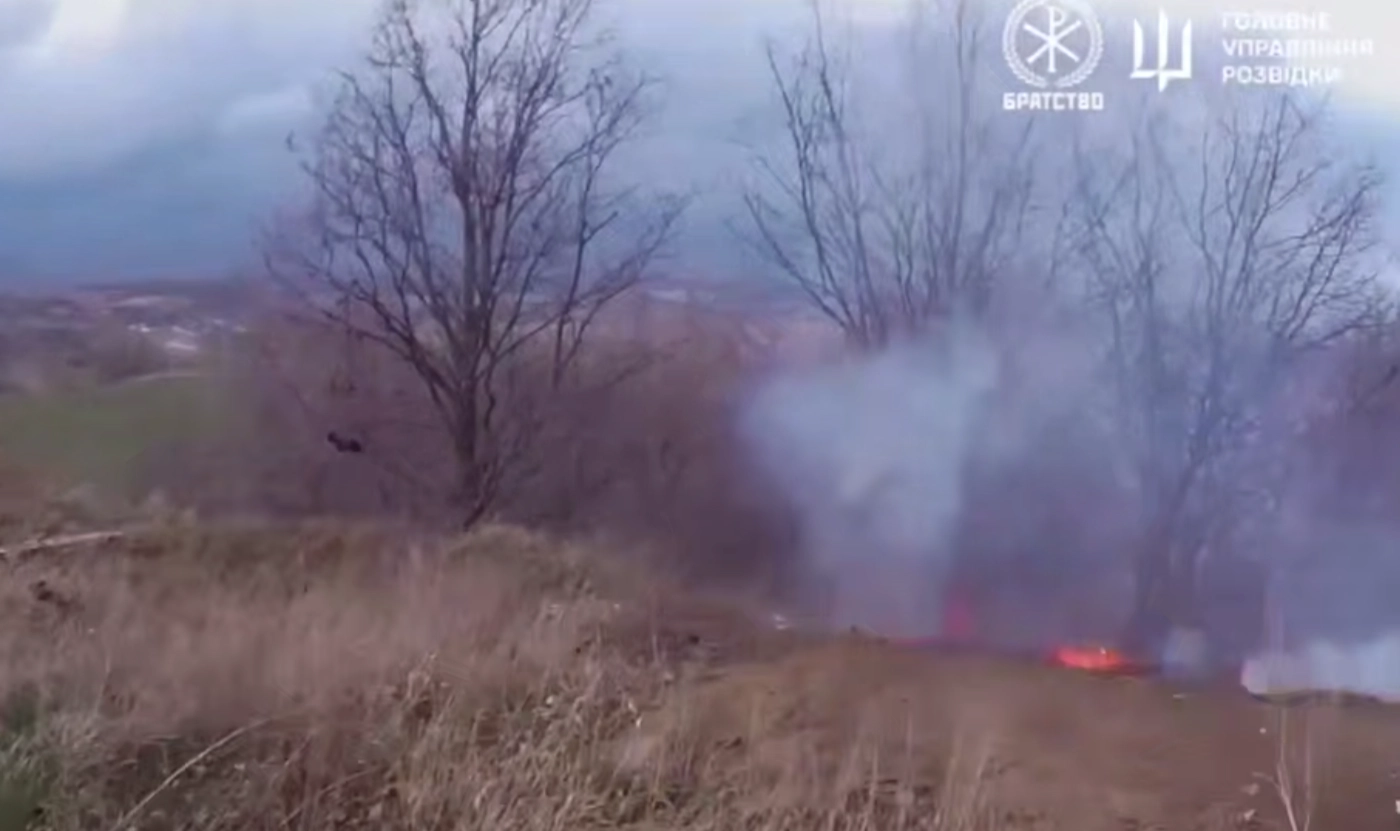
On the Kupiansk axis in Kharkiv region, a soldier from the Ukrainian Defense Intelligence special unit, “Bratstvo,” single-handedly held off an assault by five Russian soldiers.
According to the Defense Intelligence of Ukraine (HUR), Russian forces used banned chemical agents against the Ukrainian soldier and followed up with mortar fire and first-person-view (FPV) drone strikes.
JOIN US ON TELEGRAM
Follow our coverage of the war on the @Kyivpost_official.
“In response to the effective resistance of the Ukrainian soldier, the occupiers resorted to prohibited methods of warfare — deploying poisonous gas. The position was then subjected to heavy mortar fire and FPV drone attacks,” HUR’s press service reported.
As a result of the assault, the soldier sustained multiple shrapnel wounds and was poisoned by an unknown substance, causing periodic loss of consciousness. Due to his critical condition, holding the position further became impossible.
The command made the only possible decision — to evacuate the soldier. Despite the presence of enemy FPV drones, the evacuation team managed to break through, extract the wounded fighter from under fire, and bring him to a stabilization point, intelligence officials added.
“Thanks to the coordinated efforts and high professionalism of the special forces, the position was not only held but the enemy was pushed back from it,” HUR said.
The intelligence service published a corresponding video of the evacuation.

‘Too Early to Say Russia Is Losing Africa’: HUR on Moscow’s Post-Wagner Strategy
Last month, Dutch Defense Minister Ruben Brekelmans said Moscow sees the use of chemical weapons as a “normalized, standardized and widespread” tactic, warranting tougher sanctions and removal from its seat on the executive council of the Organization for the Prohibition of Chemical Weapons (OPCW).
The assessment was made and jointly agreed upon by the Dutch military intelligence agency, MIVD, and Germany’s BND foreign intelligence agency. It cited “thousands” of incidents of use that had caused at least three deaths and more than 2,500 chemically related injuries, Brekelmans said.
You can also highlight the text and press Ctrl + Enter