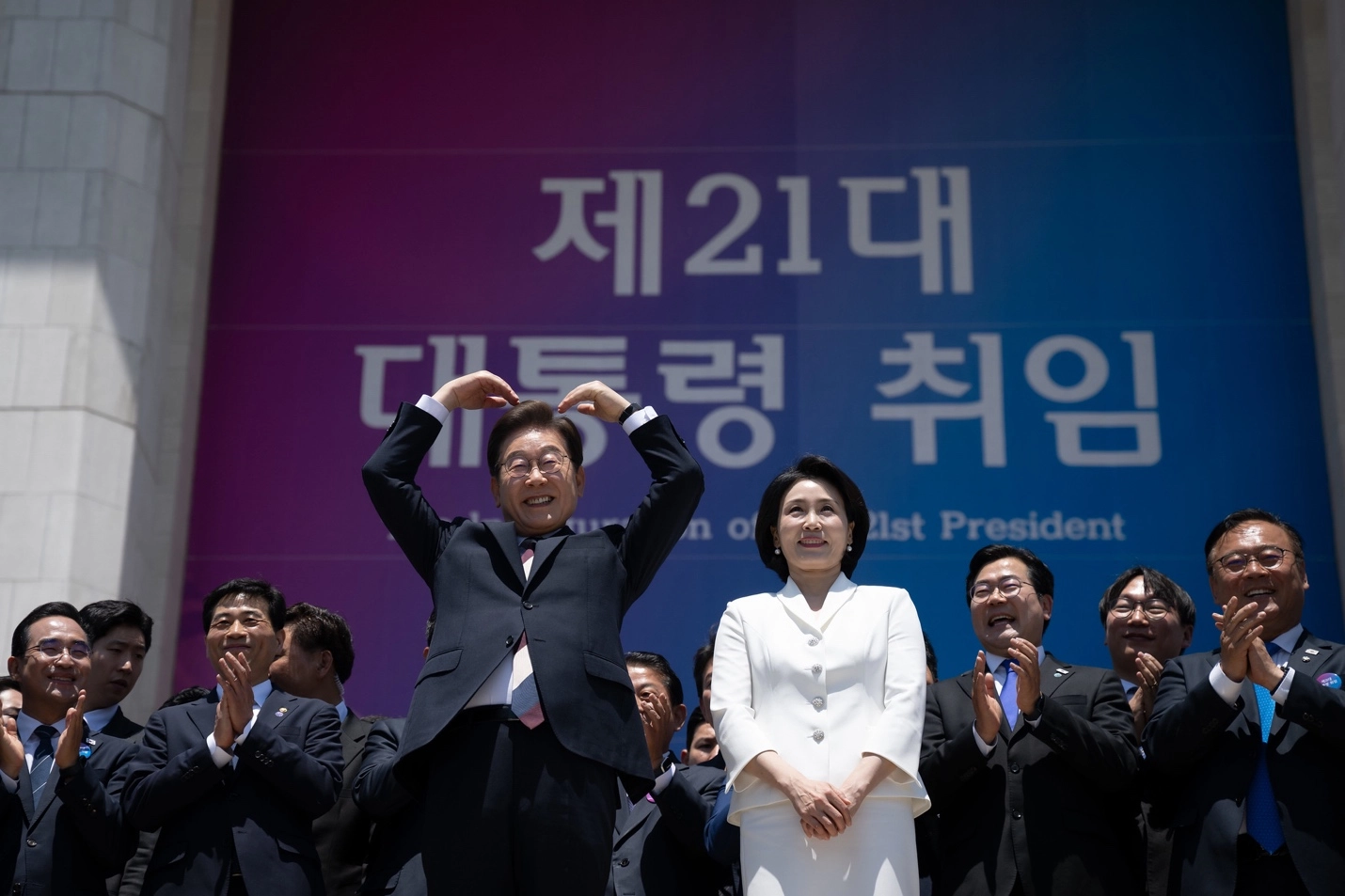
WASHINGTON DC – South Korean President Lee Jae-myung arrived in Washington on Sunday for a high-stakes inaugural summit with US President Donald Trump, which will take place at the White House this afternoon.
This crucial diplomatic encounter is set against a backdrop of complex global security challenges, not least the ongoing war in Ukraine and the escalating, potentially destabilizing alliance between Russia and North Korea.
JOIN US ON TELEGRAM
Follow our coverage of the war on the @Kyivpost_official.
Lee, who took office on June 4, 2025, following a period of domestic political upheaval in South Korea, is embarking on an official working visit designed to forge a strong personal rapport with the unpredictable US president.
A central objective for Lee is to navigate Trump’s “America First” foreign policy while solidifying the vital US-South Korea alliance. He has expressed a clear desire to build a cooperative relationship with Trump. He remains committed to pursuing dialogue with Pyongyang, asserting that “peace is better than war, no matter how expensive.” This pragmatic approach will be tested as the two leaders address a burgeoning array of issues.
Shadow of Ukraine and Moscow-Pyongyang axis loom large over the discussions
Experts at the Center for Strategic and International Studies (CSIS), a Washington think-tank, highlight that Russia’s war in Ukraine and the deepening ties between North Korea and Russia pose significant challenges for Seoul.
During a press briefing ahead of Lee’s visit, CSIS analysts underscored how “North Korea-Russia relations” are actively working against South Korea’s economic recovery.
Poland Calls Zelensky's National Pantheon Plan an ‘Escalation’
According to them, discussions during today’s summit are thus anticipated to delve into how Seoul can bolster international efforts to support Ukraine, potentially through “security guarantees” and strategies aimed at “defending Ukraine’s skies.”
Speaking to Kyiv Post, a senior US administration official further noted that Pyongyang’s “unprecedentedly tight alliance with Russia” since the 2022 invasion of Ukraine has made Kim Jong Un’s regime less amenable to diplomatic engagement with either Washington or Seoul.
This increasingly robust military and economic cooperation between Moscow and Pyongyang, including reported transfers of North Korean munitions to Russia for use in Ukraine, adds a perilous new dimension to regional and global security, the official emphasized.
CSIS analysis also highlighted the interconnected nature of these conflicts, stating: “The Ukraine war and its spillover to the Korean peninsula are taking a hard toll on the Seoul-Moscow relationship, and both sides are firmly locked in their core interests over North Korea and Ukraine and have little wiggle room to narrow down their differences. Russia needs North Korea’s ammunition and missiles to win the war in Ukraine.”
On the economic front, today’s US-Korea summit aims to finalize the details of a July trade agreement. Under this deal, Washington agreed to reduce its reciprocal tariff on South Korean goods to 15%, down from an initially proposed 25%. In return, South Korea committed to a substantial pledge: purchasing $100 billion in US energy and investing $350 billion in the US economy, with further direct investments expected from South Korean conglomerates.
A major point of contention and discussion will undoubtedly revolve around Seoul and Washington’s defense posture. Trump is widely expected to press Lee for increased financial contributions towards the alliance, with South Korea reportedly preparing a multi-year commitment to boost its defense spending.
There are also indications from within the Trump administration of a potential strategic recalibration, with suggestions to shift the operational focus of US Forces Korea from solely deterring North Korea to a broader regional mandate, including responding to a potential Chinese invasion of Taiwan. This could see South Korean forces taking on a more prominent role in deterring North Korea directly.
Ultimately, the persistent threat posed by North Korea remains paramount. Analysts fear that enhanced US-South Korea collaboration, particularly if perceived as provocative, could trigger “not-insignificant North Korean belligerence,” potentially escalating to missile tests or even a nuclear weapons test.
Today’s White House visit thus represents a critical juncture for both presidents to align strategies on deterrence, regional stability, and their complex roles in a rapidly shifting global order.
You can also highlight the text and press Ctrl + Enter