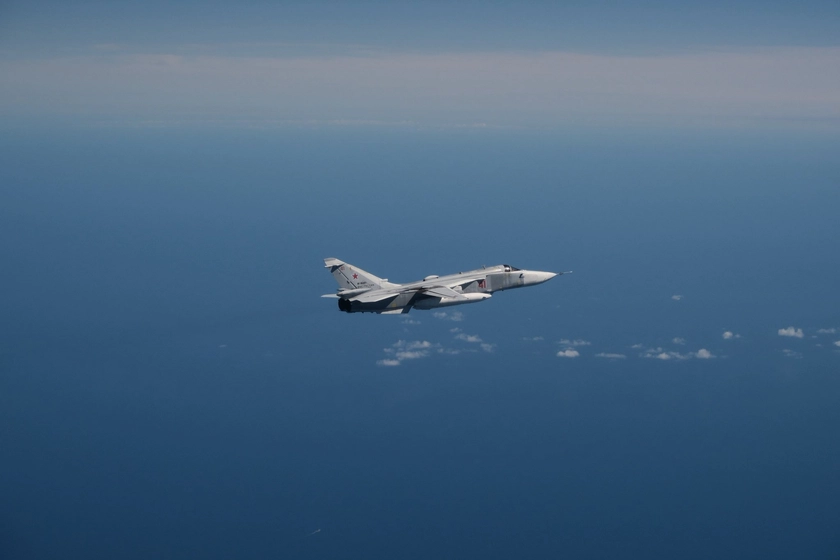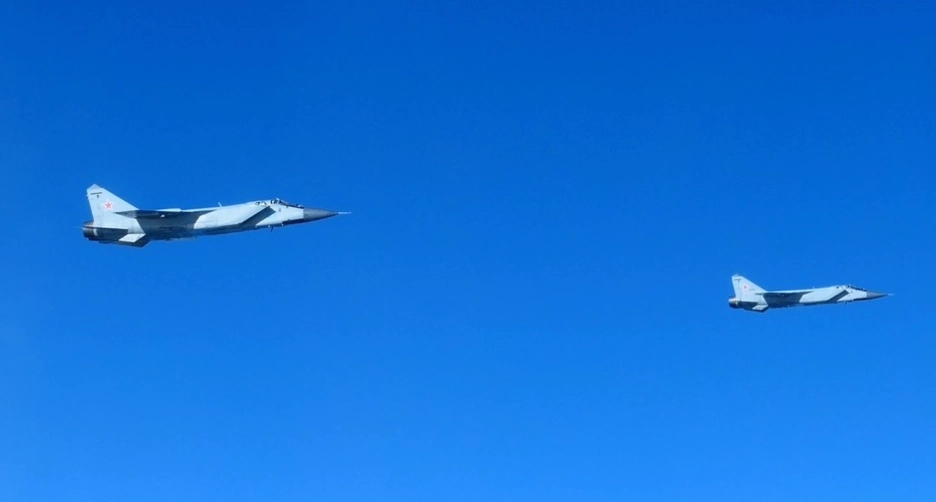
Hungarian Air Force Gripen fighters serving with the NATO Air Policing force were scrambled from Lithuania’s Šiauliai air base to intercept a Russian five-aircraft flight over the Baltic Sea west of the Latvian coast, according to a NATO Allied Air Command statement on Facebook on Thursday.
The Russian formation was said to consist of three MiG-31 (NATO: Foxhound) interceptors supported by a Su-30SM (NATO: Flanker-H) and a Su-35 (NATO: Flanker-E) fighters, which the report said were close to NATO airspace and not complying with international flight safety regulations.
JOIN US ON TELEGRAM
Follow our coverage of the war on the @Kyivpost_official.
The statement said the Hungarian aircraft demonstrated both Budapest’s and NATO’s commitment to protecting the Baltics and NATO’s eastern flank. The jet returned safely to base after the Russian fighters turned away.
The incident occurred just six days after three MiG-31s were reported to have entered Estonian airspace and were confronted by Italian Air Force F-35s – an allegation Moscow denied, but which Western leaders categorized as an intentional provocation.
What is the NATO Air Policing mission?
The NATO Air Policing mission was established in 1961 as part of NATO’s Integrated Air and Missile Defense (IAMD) to secure the alliance’s airspace. It provides a continuous 24/7/365 presence comprising fighter aircraft and crews seconded from national air forces on a four-month rotational basis.
Air Policing missions are commanded from two Combined Air Operations Centers (CAOC): one in Torrejón, Spain, and one in Uedem, Germany, responsible for tasking interceptions in the event of airspace violations, suspicious or unsafe air activity close to the alliance’s borders.
Germany Warns of Russian Orbital Nuclear Threat
NATO has been active over the Baltic since 2004, when Estonia, Latvia and Lithuania joined the alliance with aircraft based at the Šiauliai Air Base in Lithuania and the Ämari Air Base in Estonia.
Since Russia’s illegal annexation of Crimea in 2014 and its 2022 full-scale invasion of Ukraine, additional assets have been deployed to NATO’s eastern borders, with aircraft based in Poland, Bulgaria and Romania.
Air policing missions are also in place in the eastern Adriatic, western Balkans, over the Benelux (Belgium, Luxembourg and the Netherlands) airspace and periodically over Iceland.
You can also highlight the text and press Ctrl + Enter

Putin’s Worst Nightmare