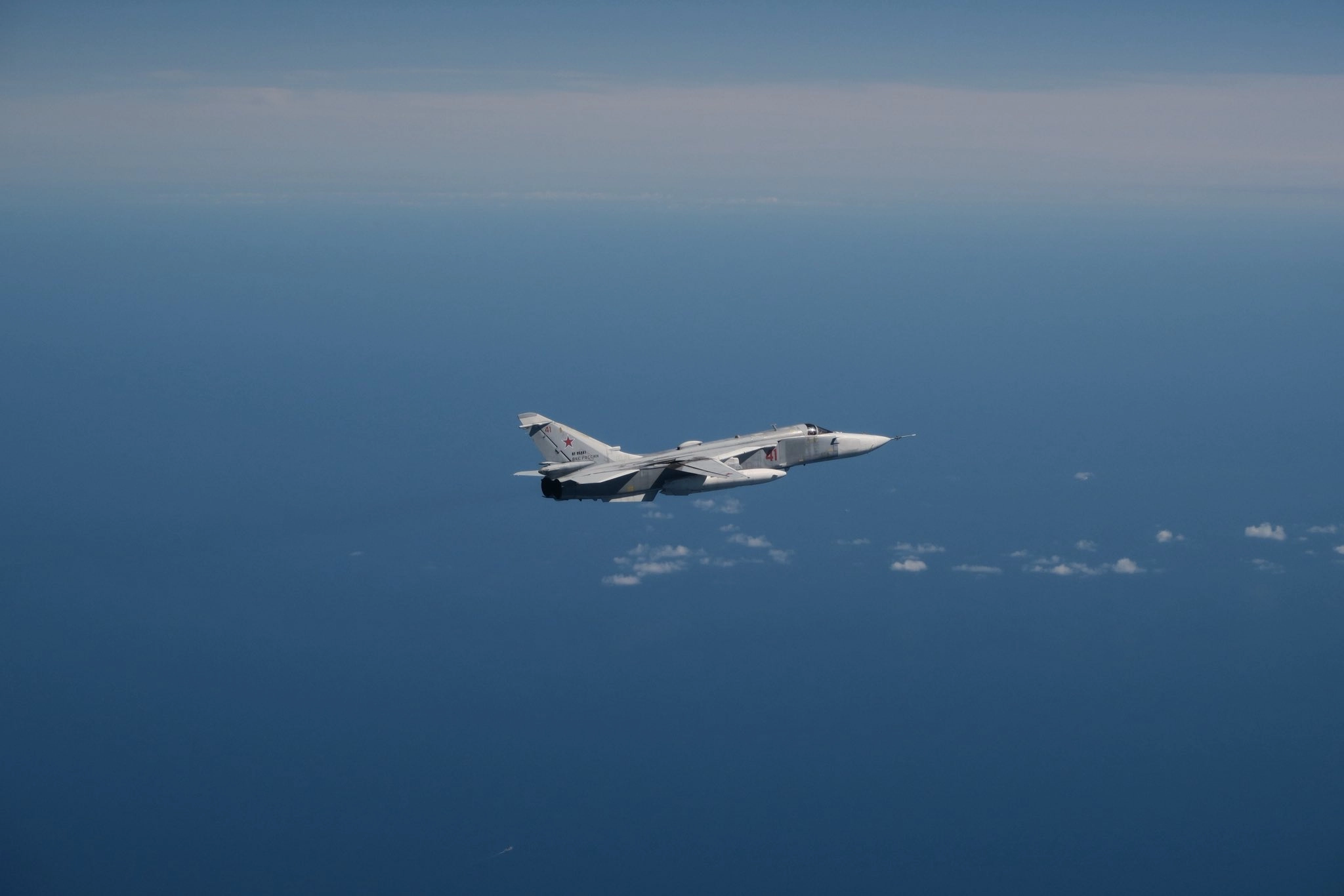
Sweden’s military launched quick-reaction fighter jets twice in a single day to intercept and escort Russian military aircraft operating immediately adjacent to its borders.
Monitoring the Baltic corridor
According to a statement published by the Swedish Armed Forces on X, Swedish air defense radar networks detected unidentified aircraft moving through international airspace close to Sweden’s sovereign boundaries on Friday, June 12.
JOIN US ON TELEGRAM
Follow our coverage of the war on the @Kyivpost_official.
In response, the Swedish Air Force ordered its Quick Reaction Alert (QRA) teams to execute two separate scramble missions. Pilots took off in multirole JAS 39 Gripen fighter aircraft to visually identify and shadow the foreign planes.
The Swedish military confirmed that the intercepts involved two distinct classes of Russian frontline combat aircraft: a Su-24 supersonic bomber and a Su-34 strike fighter. Swedish pilots closed within visual range, documented the assets, and escorted them along the border zone. Military officials emphasized that the Russian planes did not cross into Swedish territory.
“No violation of the country’s airspace occurred,” the Swedish Armed Forces communique stated. “The actions of the fighter jets were directed at protecting our airspace and monitoring activity near Sweden’s borders.”
Svensk incidentberedskap agerade snabbt när man upptäckte de ryska flygningarna och två rotar JAS 39 Gripen lyfte för att hävda det egna territoriet och möta och identifiera de ryska stridsflygen. Svenskt luftrum kränktes ej i samband med incidenterna. pic.twitter.com/EEy2qZcn3e
— Försvarsmakten (@Forsvarsmakten) June 13, 2026
A pattern of aggressive Russian air maneuvers
The Baltic intercepts come amidst a broader, highly volatile pattern of unsafe Russian aerial behavior testing European and NATO defense networks across multiple maritime theaters.
Estonia Urges EU Alumina Ban and Total Russian Energy Maritime Service Blockade
Just weeks prior, the UK Ministry of Defence filed a formal diplomatic complaint with the Russian embassy detailing a “repeated and dangerous” encounter over the Black Sea. In that incident, an unarmed Royal Air Force (RAF) Rivet Joint surveillance aircraft – conducting a routine patrol to secure NATO’s Eastern Flank – was intercepted by Russian Su-35 and Su-27 jets.
Russian Su-27 executed six passes in front of the British plane, at one point closing to within 6 meters (19 feet) of its nose. A Russian Su-35 flew close enough to the RAF aircraft to trigger its emergency defense systems, effectively disabling the plane’s autopilot functionality.
British Defence Minister John Healey condemned the event as unacceptable behavior that creates an immediate risk of catastrophic mid-air accidents and unintended military escalation. The Black Sea encounter marked the most severe air incident between the UK and Russia since 2022, when a Russian jet went as far as releasing a live missile near a British aircraft in the same sector.
Subsurface confrontations
The friction in the skies is mirrored by intense underwater security operations. In April, the Royal Navy deployed around 500 personnel and logged over 450 flight hours to track three Russian submarines executing a month-long, covert deployment in the North Atlantic.
The submarines were operating near vital undersea communication cables and pipelines, prompting explicit warnings from Western officials that tampering with infrastructure would trigger serious international consequences.
With Sweden now firmly integrated into NATO’s defensive layout, the rapid deployment of its Gripen fleet over the Baltic Sea demonstrates Stockholm’s readiness to actively police its borders against Russian provocations that continue to stretch from the Arctic down to the Black Sea.
You can also highlight the text and press Ctrl + Enter

ANALYSIS: Russia’s Air Defense Problems Are Growing