“In light of growing public attention to references to Fire Point in the media, the company is organizing an open dialogue during which it will provide official comments and answers to questions.”
A Kyiv conference hall hosted Ukrainian and foreign reporters invited to the event. First noted by AP in August 2025 and later by President Volodymyr Zelensky, the company quickly drew media attention.
JOIN US ON TELEGRAM
Follow our coverage of the war on the @Kyivpost_official.
Fire Point produces the “Flamingo” missile, capable of traveling 3,000 kilometers (1,864 miles), and FP-1 deep-strike drones with a 1,600-kilometer (994-mile) range. Zelensky promised mass production of Flamingos in January-February 2026.
The company is also under scrutiny for alleged ties to Zelensky’s friend Timur Mindich – a central figure in a recent graft scandal – and a probe by the National Anti-Corruption Bureau of Ukraine (NABU) into overpricing in drone procurement, though Fire Point faces no charges.
What could have been a standard press conference became a three-hour event: a Ukrainian General Staff briefing, a panel discussion featuring military officials and prominent drone advocate Mariya Berlinska, a Q&A with advisor and former US Secretary of State Mike Pompeo, and, finally, the founders’ appearance.
Ukraine’s General Staff showcases Fire Point strike data
General Staff spokesperson Dmytro Lykhoviy said that over 50% of Ukraine’s deep-strike drones come from Fire Point, based on August-September 2025 data.
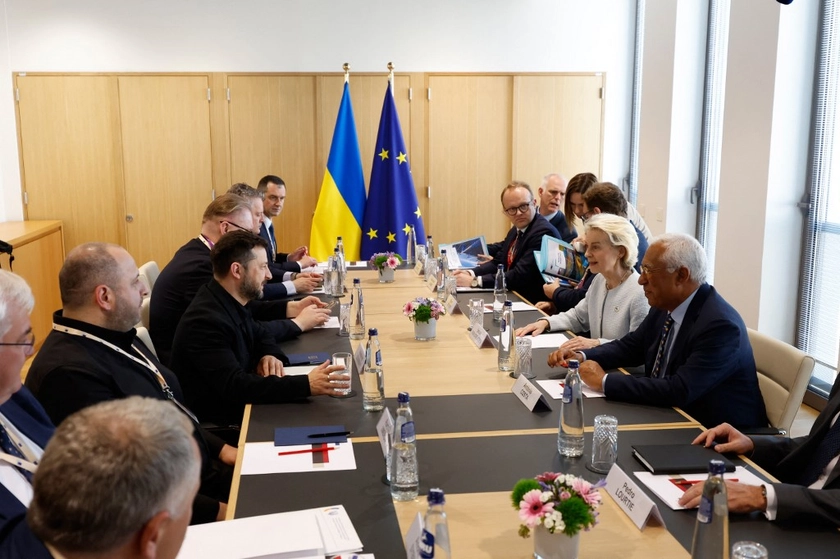
Macron, Merz Clash With EU Over Putin Outreach
While Ukrainian drones targeted Russian positions in 2023 and attacks on oil refineries and infrastructure intensified from March 2024, Lykhoviy did not provide data for the earlier period.

Fire Point’s product line includes the FP-1 deep-strike drone, FP-2 middle-strike drone, FP-5 Flamingo cruise missile, and FP-7 and FP-9 ballistic missiles, according to the company’s booklet the reporters received at the press conference.
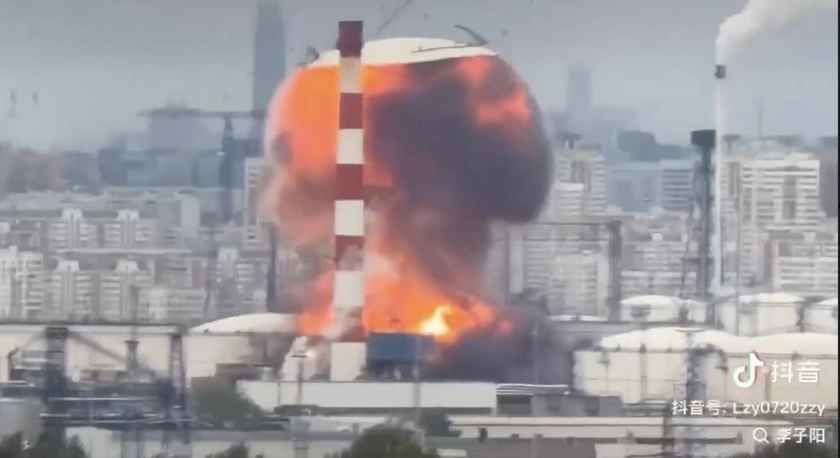
The FP-1 averages 140-180 km/h (87-112 mph) with an operational range of 1,400 kilometers (870 miles), a maximum seven-hour flight time, and a 60-kg (132-lb) payload capacity, it says. Lykhoviy confirmed the FP-1 was used to hit Russian oil refineries.
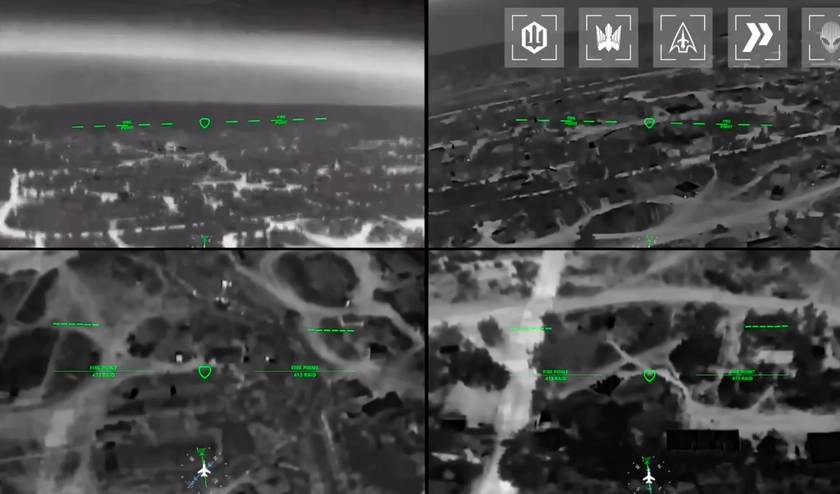
The FP-2, used on occupied Ukrainian territories according to Lykhoviy, has the same speed but a 200-kilometer (124-mile) range, 2.5-hour flight time, and a larger 105-kg (231-lb) payload.
Fire Point reported growing from 18 employees in 2023 to 2,200 by September 2025, with 175,000 square meters (1.9 million square feet) of distributed production facilities. The company said it conducts its own research and development (R&D) and manufactures solid rocket fuel, engines, navigation systems, composites, and other components in-house.
On the Flamingo, Lykhoviy said combat launches began in spring 2025 but declined to provide further details due to “media narratives” surrounding the missile.
Feedback from special ops, intelligence units
Berlinska hosted a panel discussion with four military personnel using call signs: Mike from the Special Operations Forces (SSO), Lynch from the Unmanned Systems Forces, Phil from the Military Intelligence (HUR), and Hrom from the National Guard’s Lazar Group.

They praised the drones’ effectiveness for deep-strike missions at competitive prices and their constant product evolution. When Berlinska said their answers sounded “polished,” Mike from the SSO said the company is deeply involved in system development, though he provided no further details.
Pompeo outlines transparency challenges
Former US Secretary of State Mike Pompeo joined Fire Point’s advisory board in November 2025 and participated in the press conference online.

“My mission set is very clear: to help Fire Point become transparent, to help Fire Point become an important supplier for Western hardware, software, technology,” he said.
Responding to Kyiv Post’s question on Fire Point’s corporate governance, Pompeo said he thinks the company wants “world-class corporate hygiene.”
“I think it’s one of the reasons they’ve asked me to help them so that we can have a governance model, corporate hygiene if you will, that is world-class. Because world-class corporate governance is absent, there is insufficient transparency,” he said.
The Kyiv Independent reported in August 2025 that NABU detectives were investigating Fire Point over possible drone overpricing and potential links to Zelensky associates, including Timur Mindich. The New York Times wrote in October that Fire Point owner Yehor Skalyha runs a film location scouting company that worked on a 2016 romantic comedy starring Zelensky before his presidency.
Origins, capital, alleged Mindich connection
In the last part of the press conference, Berlinska invited Fire Point’s representatives: chief constructor and co-founder Denis Shtilerman, co-founder and CEO Yehor Skalyha, and CTO Iryna Terekh, who became the company’s first public speaker despite previously running businesses specializing in urban furniture and concrete products.

After Russia’s February 2022 invasion, Stilerman and Skalyha said they bought and donated drones with their own funds. “In 2022, we realized they cost a lot, and we can do better and cheaper. We tasked ourselves to make a drone that will carry 50 kg [110 lbs] for 800 km [500 miles],” Shtilerman said.
They founded Fire Point in October-November 2022 by “purchasing the [limited liability company] LLC.”
In January 2023, the local business analytics platform YouControl recorded a change in the LLC’s economic activity code from IT to weapons and ammunition production, as well as aircraft and spacecraft manufacturing, alongside the registration of Skalyha as the legal owner.

Skalyha said he worked in filmmaking and used drones for camera work, though he did not specify the company.
Since 2014, he has been purchasing drones for Ukraine’s intelligence as a volunteer, collaborating with Narodnyy Tyl, one of the country’s largest volunteer organizations. A military paramedic by training, he also assisted in military hospitals and procured medical supplies after Russia’s initial invasion of Ukraine a decade ago.
Fire Point conducted its first flights in January 2023 and received Ministry of Defense certification. Terekh, who joined in June 2023, said production jumped from 20 drones per month to 100 per day, while the engineering team grew to 650.
Shtilerman said Fire Point became the only company to pass Ukraine Defense Forces’ open electronic-warfare (EW) tests, conducted with the US Embassy in March 2024, prompting investment and co-ownership offers – including from Mindich, whose offer they said was declined because he “offered too little.”
Fire Point was built “with our own funds, which we all had – about $1.5 million,” according to Terekh. They declined to disclose previous activities, with Shtilerman emphasizing that the funds were “their own” and that they “never borrowed money from anyone.”
“It somehow happened that I was a wealthy person long before the war – and still am. Yehor and Iryna also worked and were not poor. These were our own funds. We never borrowed money from anyone,” Stilerman said.
Kyiv Post asked about the previous business activities of Fire Point representatives without specifying who should answer. Stilerman said he did not produce furniture, while Terekh remained silent – even though her LinkedIn page shows she founded TEREKH.group, which produces urban furniture and “works both with commercial and governmental structures.”
Since 2014, Terekh has built a diverse portfolio of businesses, according to Ukrainian tech outlet Dev.ua. Apart from TEREKH.group, she also founded an agency for concrete construction called DWELL the SPACE, a charity fund called Frieden Ukraine that cooked meals and distributed aid from the Romanian Red Cross, and a sports goods-producing LLC called “Pochupark.”
Dev.ua also said she founded an LLC called “Stellar Jet,” which describes itself as an “innovative R&D bureau and experimental production” that creates “unique technological solutions.”
Regarding the NABU investigation, none of the Fire Point founders received a notice of suspicion; NABU only requested materials. There were no searches, and the company provided all documents to the agency in spring 2025.
The NABU case targets officials suspected of benefiting from overpriced procurement, with Fire Point among six major suppliers whose pricing is under review. Shtilerman showed NABU’s reply detailing the case, saying it is “easily found online.” Kyiv Post could not locate the reply online, but the company sent the document by email.
Shtilerman also acknowledged visiting Oleksandr Tsukerman, a key suspect in the Mindich case, in 2024. He said Tsukerman’s brother, Mykhailo Davydovych, holds cash belonging to Shtilerman and his mother, because Shtilerman distrusts Ukrainian bank accounts after “living through many banking crises in Ukraine.”

Regarding allegations by AIN.ua that he holds a Russian passport, Shtilerman said he studied in Moscow in the 1990s but claimed his Russian citizenship has since been revoked.
“I deregistered from Kyiv on Aug. 28, 1991, and moved to study at the Moscow Institute of Physics and Technology, which, under the laws in force at the time, made [me] a dual citizen of Ukraine and Russia.”
He said Russia revoked his citizenship in 2016 because of his participation in the Euromaidan protests and his support for Ukraine’s defense during Russia’s first invasion in 2014.
He added that he will provide documents to “trusted journalists” but will not make them public.
Fire Point’s engineering roadmap
Terekh declined to disclose the total output of Flamingo and drone production for security reasons but said there is “no large gap between production and deployment.”
Answering the question of what made the Flamingo missile unique, Skalyha said that, like the FP-1, they were built from scratch by people not from the aerospace industry.
“We built this missile from concept to working system in just nine months with engineers who weren’t aerospace specialists. FP-1 was built the same way: by prioritizing mass production over perfect aerodynamics,” he said.
The company promised quarterly press conferences to maintain transparency and answer reporters’ questions as it scales up production to meet Ukraine’s defense needs.
The first-ever Fire Point press conference did give the impression of greater transparency to the press. However, questions about corporate transparency, the company’s initial capitalization, and potential political connections remained unresolved.
You can also highlight the text and press Ctrl + Enter

Putin’s Worst Nightmare