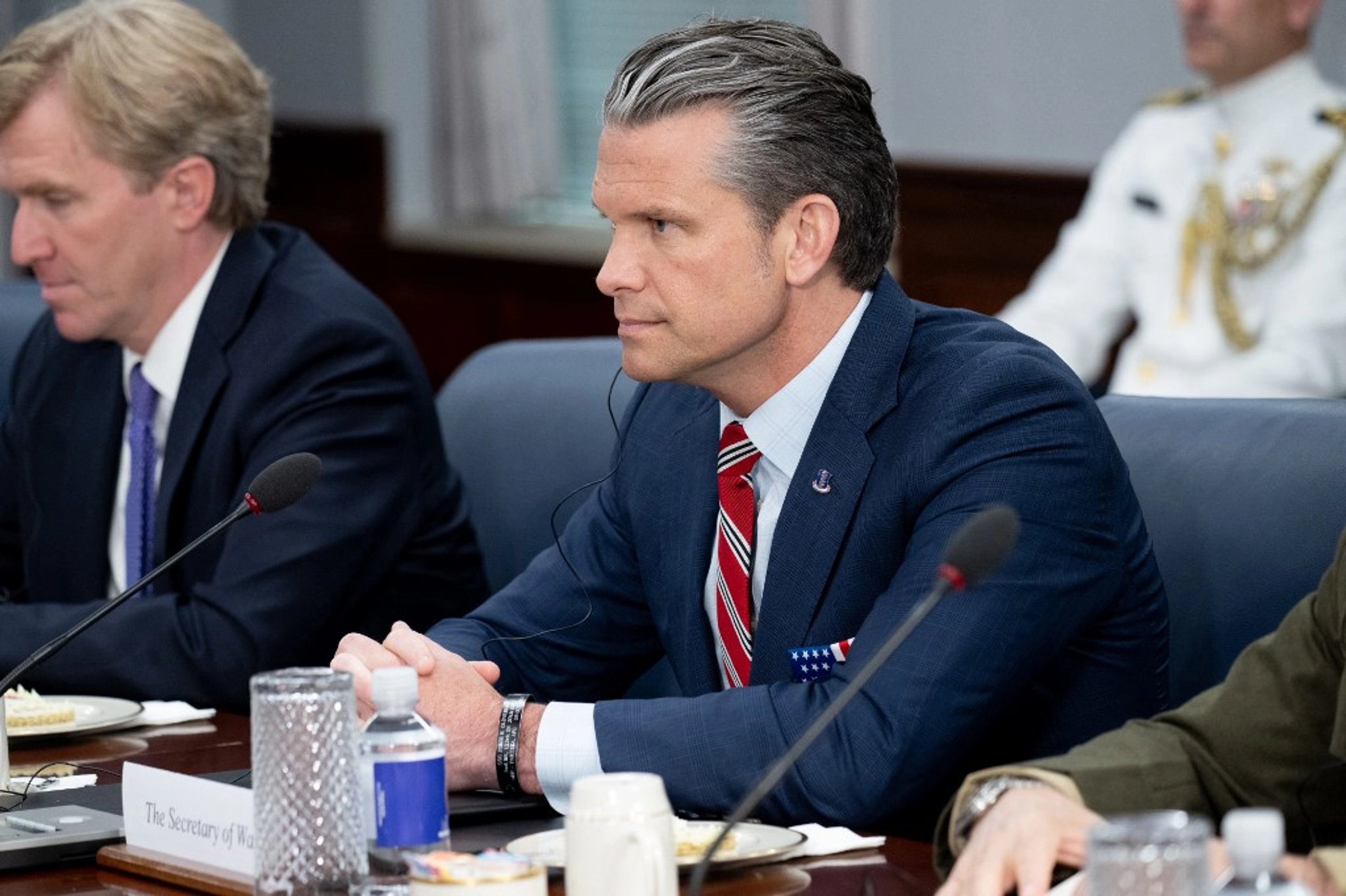
Senior US officials reportedly intervened to halt US Secretary of Defense Pete Hegseth’s plans to impose a more aggressive troop reduction in Europe last month.
According to The Wall Street Journal, Hegseth planned to travel to Brussels to inform NATO military leadership that the US was preparing for further troop reductions, but senior figures such as Secretary of State Marco Rubio were said to have stepped in.
JOIN US ON TELEGRAM
Follow our coverage of the war on the @Kyivpost_official.
Sources indicated that Hegseth’s proposed cuts were designed to be more expansive than the previously announced – and subsequently canceled – deployment of an armored brigade to Poland, as well as the prior withdrawal of an infantry brigade from Romania.
The proposal for more radical reductions was rejected after review by senior officials, including Rubio – who also assumed the role of national security advisor following the ouster of Michael Waltz in May 2025.
After the internal review, the Pentagon said it would instead conduct a comprehensive assessment of the US military presence in Europe, a process expected to take up to six months.
Hegseth, along with his top policy aide, Elbridge Colby, has championed a drastic reduction in deployments to Europe.
Their stated objective is to limit US commitments outside of Asia to allocate resources toward countering China in the Indo-Pacific region, an ambition complicated by the war with Iran.
Congressional and allied response
Hegseth’s pursuit of deeper cuts has generated concern among both Republican and Democratic lawmakers in the US, as well as among NATO allies.
Poland, Ukraine Bust Russian-Backed Protest Network
Legislators recently included provisions in a defense spending bill prohibiting the Defense Department from reducing troop levels in Europe below 76,000 without a formal risk assessment by the head of US European Command and the chairman of the Joint Chiefs of Staff, and confirmation from the secretary of defense.
These concerns intensified last month when Hegseth’s office scheduled a call with lawmakers prior to a meeting with NATO defense ministers, prompting speculation about a major announcement.
During the call, however, Hegseth stated only that he planned to conduct a posture review.
Deep strike capabilities and the Ankara summit
The debate over troop levels will be a central focus at the upcoming NATO summit in Ankara on July 7-8, where US President Donald Trump is scheduled to meet with alliance leaders.
In addition to ground force reassessments, the US plans to halve its deep-strike crisis-allocation capability in Europe, which includes aircraft carriers and combat aircraft. Washington has requested that European allies present plans to bridge this capability gap in time for the Ankara summit.
The push for radical reductions comes amid heightened diplomatic tensions within the alliance. Trump has criticized European allies for insufficient military spending and a lack of support for the US-Israeli war against Iran, previously stating he was considering withdrawing from NATO.
The US has also announced plans to pull approximately 5,000 troops from Germany.
Ongoing base negotiations in Poland
Despite Hegseth’s push for broader reductions, negotiations regarding a permanent US military presence in Poland are advancing. Polish Defense Minister Władysław Kosiniak-Kamysz confirmed that talks with Washington have moved to the next stage following a proposal submitted directly to Hegseth.
Poland currently hosts approximately 10,000 US troops, primarily on a rotational basis. The Pentagon’s recent force posture decisions regarding Poland have fluctuated – the administration halted a planned deployment of 4,000 troops before Trump subsequently announced that an additional 5,000 personnel would be sent to the country.
A force review is currently underway at the Pentagon to establish the basis for further decisions regarding the Polish deployment.
You can also highlight the text and press Ctrl + Enter

CARTOON: Lukashenko Feels the Squeeze and Dithers